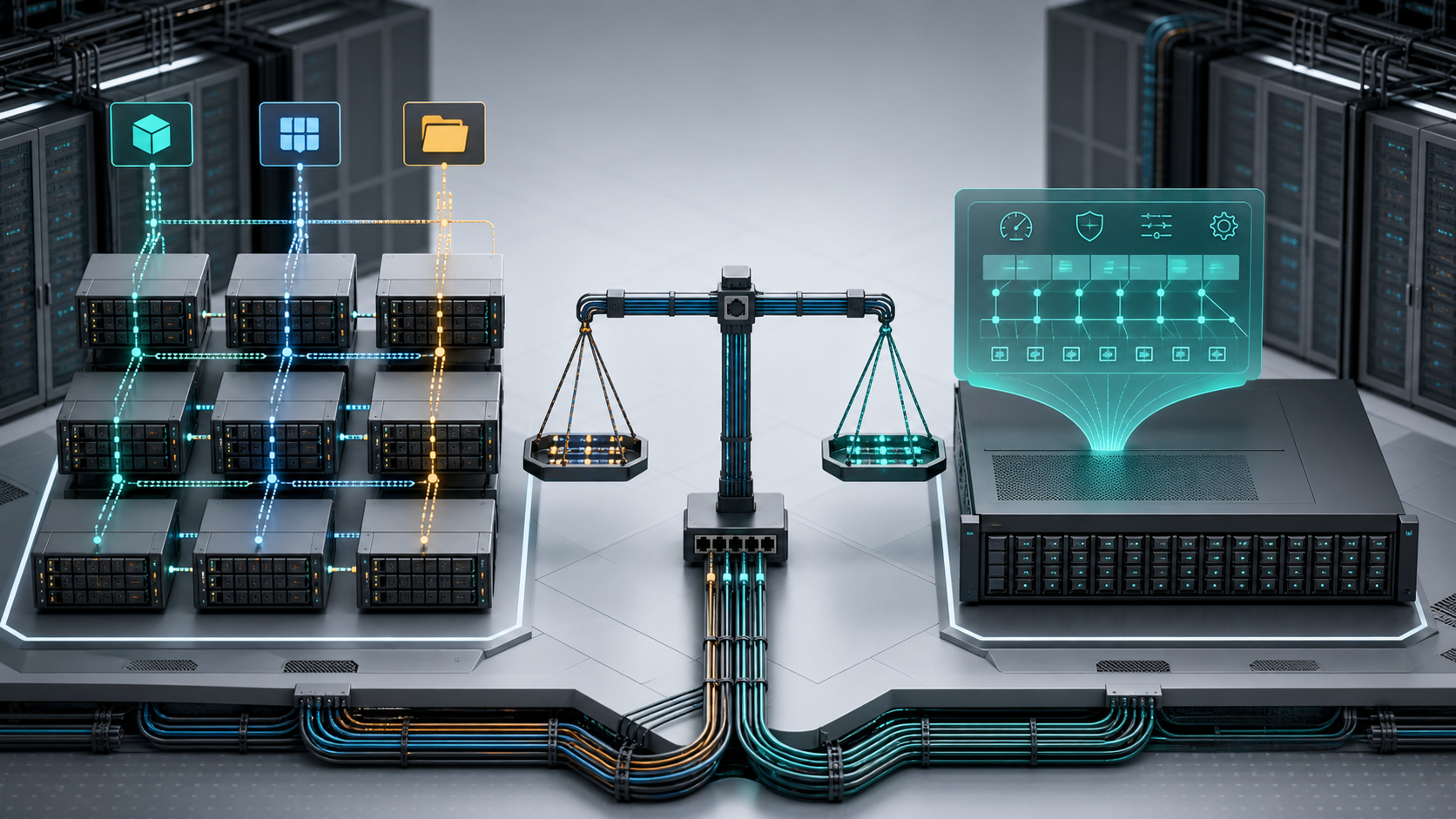
Ceph looks inexpensive on a software bill because the code is open and the hardware choice is yours. That first calculation is also where many storage business cases go wrong. A production Ceph cluster consumes servers, drives, network ports, rack space and engineering time; during a failure it consumes attention as well. The useful question is not whether Ceph is free. It is whether your team can turn Ceph's flexibility into a dependable data service at a lower full cost than a supported commercial platform.
Executive summary
Ceph can beat commercial storage when an organisation needs a large, durable pool with block, object and file access, has competent Linux and distributed-storage engineers, and values control over hardware and upgrade timing. It is particularly credible for S3-compatible repositories, Kubernetes or OpenStack block storage, capacity tiers, research data and mixed private-cloud services.
It is less convincing as a default answer for the hottest part of a large GPU training pipeline. CephFS can serve shared files, but a platform designed around parallel checkpoint writes or direct GPU data paths may reach the required service level with less tuning and less operational uncertainty. Commercial products also package monitoring, tested configurations, support escalation and upgrade procedures that a self-managed Ceph team must build or buy elsewhere.
For many AI estates, the strongest design uses Ceph and a commercial high-performance tier together. Ceph holds durable datasets, model artefacts and object data; a faster file platform stages active training data and absorbs checkpoints. GPUMachines can size the storage nodes and fabric as part of a scale-out storage design, rather than treating storage as a capacity line on a GPU quote.
Quick answer: can Ceph win?
| Buyer condition | Ceph position | Commercial storage position | | --- | --- | --- | | S3, block and shared file services are all required | Strong: RADOS underpins RGW, RBD and CephFS | Depends on the product; some platforms focus mainly on file or file plus object | | The active workload is bursty multi-node AI training | Possible, but proof testing matters | A purpose-built parallel platform may be easier to size and support | | Hardware freedom matters | Strong | Usually tied to a qualified hardware list, appliance or subscription terms | | The team already operates Ceph | Strong | Migration must earn its cost through better service or lower risk | | Storage staffing is thin | Risky | Support, validated designs and managed upgrades carry real value | | Lowest purchase price is the only argument | Weak business case | Licence cost may still be cheaper than repeated operational disruption | | Data must stay portable and standards-based | Strong, especially through S3 and Linux clients | Check export, migration and licence terms before committing |
No row in this table replaces a workload test. It does stop the conversation from collapsing into "open source equals cheap" or "commercial equals fast".
What Ceph actually provides
Ceph is a distributed storage system built around RADOS. Clients and gateway services map data into objects, while Object Storage Daemons, or OSDs, store those objects and handle replication, recovery and rebalancing. CRUSH calculates placement without a central lookup service, which helps the cluster spread data across defined failure domains such as hosts, racks or rooms.
That foundation supports three useful access models:
- RADOS Gateway (RGW) presents S3-compatible and Swift-compatible object interfaces. It suits dataset repositories, application objects, model files and private-cloud services where applications already understand object storage.
- RADOS Block Device (RBD) presents block volumes. Kubernetes, OpenStack and virtualisation estates often use it for persistent volumes and virtual disks.
- CephFS adds a POSIX file system with Metadata Server daemons managing the directory namespace while file data remains in RADOS pools.
One cluster can therefore cover jobs that would otherwise need separate block arrays, object stores and file servers. That consolidation can matter more than a synthetic bandwidth number. It can also create a large blast radius if every service shares the same OSDs, network and maintenance window. Pool rules, media classes and service separation need deliberate design.
Where Ceph can beat a commercial offering
Hardware and media choice
Ceph runs on industry-standard servers, NICs and storage devices. Buyers can select dense HDD nodes for capacity, all-NVMe nodes for latency, or mixed designs that place BlueStore's RocksDB metadata on faster block.db devices. They can choose vendors according to local support, availability and rack requirements instead of accepting one appliance refresh path.
Freedom is useful only when the bill of materials is disciplined. A dense chassis with a weak backplane, insufficient CPU cycles per I/O, consumer SSDs or too few network lanes is still a bad Ceph node. The Ceph project's own hardware guidance warns that NVMe OSDs can consume substantial CPU and that CephFS Metadata Servers favour high clock speed. Commodity does not mean arbitrary.
Protocol breadth
A commercial parallel file system may be excellent at serving a training namespace yet offer little help with virtual-machine disks or a general S3 service. Ceph's common RADOS base makes it attractive to organisations building a private cloud around containers, virtual machines and data services. The same operational team can apply common failure-domain and capacity practices across several access methods.
Control over lifecycle
With Ceph, the operator controls release timing, hardware replacement and many placement decisions. There is no licence feature gate between the source code and an available upstream capability, although supported distributions may package features differently. Long-lived research organisations often value that independence because storage estates outlive individual compute generations.
Capacity economics at sensible scale
Replication and erasure coding let architects trade usable capacity, failure tolerance and recovery behaviour. On large HDD or mixed-media estates, a carefully designed erasure-coded pool can make durable capacity economical. The benefit appears only after allowing for metadata devices, spare capacity, network headroom, failure recovery and the engineers who keep it healthy.
Where commercial storage earns its price
A supported performance envelope
Commercial vendors normally qualify specific servers, drives, NICs, firmware and software combinations. Their sizing tools and reference designs narrow the number of unknowns. That does not guarantee an application result, but it gives the buyer one escalation path when throughput falls short or an upgrade misbehaves.
A community Ceph deployment can reach excellent results. The operator owns the proof. It must test realistic file sizes, queue depths, client counts, read/write ratios, recovery traffic and full-cluster behaviour, then preserve those results through software and hardware changes.
Operational packaging
Monitoring dashboards, support bundles, automated call-home, non-disruptive procedures, security guidance and field replacement processes are part of the product. Ceph has strong management tooling and a large community, but upstream software cannot know who is on call at your site or what response time the business expects.
The difference becomes obvious during the awkward incidents: a cluster is recovering from a failed drive while a training job writes checkpoints; an OSD begins flapping; a block.db device fills; a maintenance change triggers slow requests. Commercial support does not remove these events. It changes who helps diagnose them and how much prior testing exists for the supplied configuration.
Features around the filesystem
Some commercial AI data platforms add integrated snapshots, clones, cross-site replication, policy-based tiering, multiprotocol access or NVIDIA GPUDirect Storage support. Ceph covers parts of this territory through different services and integrations, but assembling an equivalent operating experience can involve several tools and teams.
The AI workload test Ceph must pass
"AI storage" hides several unrelated I/O patterns. Size each one separately.
Dataset ingest often favours object storage and large sequential transfers. RGW may fit well, especially when preprocessing jobs read objects and produce sharded training data.
Training reads can involve many workers reading shards concurrently. Performance depends on shard size, client caching, network paths, OSD layout and whether the framework issues friendly sequential I/O or a storm of small reads.
Checkpoint writes create periodic bursts from many ranks. A slow checkpoint extends job time and can leave costly GPUs idle. Test the actual checkpoint format and synchronisation behaviour; aggregate bandwidth alone misses tail latency and metadata pressure.
RAG and inference may rely more on object access, model loading, vector databases and logs than on a parallel POSIX namespace. Ceph can be a sensible durable base here, while local NVMe or a smaller flash tier handles hot indexes and model replicas.
Research home directories and project shares put pressure on metadata, quotas and small-file operations. CephFS Metadata Server sizing and active/standby design matter more than headline OSD throughput.
Ceph's less visible costs
Open source removes a proprietary software licence; it does not remove engineering work.
Recovery traffic competes with clients
When an OSD or host fails, Ceph restores redundancy by moving or reconstructing data. Recovery protects the service, yet it draws CPU, drive and network resources from client I/O. Operators can tune priorities, but the capacity plan must leave room for recovery at the busiest acceptable time. A cluster that meets its target only while healthy has not met the target.
BlueStore needs balanced devices
BlueStore writes directly to block devices and uses RocksDB for metadata. On HDD OSDs, placing block.db on suitable enterprise SSD or NVMe can improve behaviour, but undersizing that fast tier risks metadata spilling back to the slower primary device. Sharing one small metadata device across too many OSDs also creates a concentrated failure and performance concern.
Networks do more than serve clients
Client traffic, replication, peering, recovery and management all traverse the cluster fabric. A small system may use one redundant Ethernet fabric with careful quality-of-service design; larger systems often separate traffic logically or physically. East-west bandwidth, switch oversubscription, MTU consistency and redundant paths need the same scrutiny as the OSD nodes.
Upgrades are projects
Ceph supports rolling upgrades across supported release paths, but an upgrade still needs compatibility checks, health gates, rollback thinking and time. Large clusters may remain in mixed states for hours or days. Operators should rehearse upgrades on representative hardware and avoid learning the process during a security deadline.
Ceph, WEKA, VAST Data and DDN are not one product class
Commercial alternatives solve different problems.
Ceph versus WEKA is mainly a choice between a broad open distributed-storage platform and a commercial NVMe-led parallel file platform aimed at high-performance workloads. WEKA's object tier can extend a hot namespace, while Ceph can act as the object system itself and also provide block storage.
Ceph versus VAST Data compares Ceph's shared-nothing object placement with VAST's commercial disaggregated shared-everything architecture and multiprotocol data platform. The VAST decision often concerns consolidation, all-flash economics and operational packaging rather than a direct CephFS replacement.
Ceph versus DDN EXAScaler separates a general-purpose distributed store from a Lustre-based platform aimed at sustained parallel file performance. For large training and HPC scratch, DDN may address the hot path more directly. For S3, RBD and private-cloud capacity, Ceph may fit the broader estate.
Comparing product names without naming the access protocol and workload tier produces a false contest.
A two-tier design often beats a forced winner
Suppose a research team holds several petabytes of raw and processed data, but each training campaign uses only a fraction of it. Building every byte on premium flash wastes money; serving every training read from a capacity-focused Ceph pool may waste GPU time.
A staged design can use Ceph RGW or CephFS as the durable repository, with WEKA, VAST, DDN EXAScaler or another high-performance file tier near the GPU cluster. Workflow automation promotes selected datasets before a run and demotes results after validation. Checkpoints can land on the fast tier, then replicate to the durable pool according to the recovery objective.
That architecture adds data movement, which must be measured and owned. It also lets each platform do the work it was bought for. The cost model should include staging time, duplicate capacity and the consequence of running a job against cold data by mistake.
Procurement questions that expose a weak plan
Ask these before approving hardware:
- What percentage of capacity must deliver the peak training service level?
- Which interface does each application use: S3, POSIX, RBD, NFS, SMB or a database API?
- How many files exist, what is their size distribution, and how quickly must directory scans complete?
- What happens to client latency during an OSD, host or switch failure?
- Who owns CRUSH rules, pool settings, upgrades, security patches and capacity forecasts?
- Is support bought from a Ceph vendor, provided internally, or left to community escalation?
- How will data leave the system during migration or platform failure?
If the answers are unknown, postpone the brand decision and instrument the workload.
A practical Ceph configuration approach
Start with failure domains and service targets, then select media. Do not begin with the maximum number of drives a chassis can hold.
For an HDD capacity tier, reserve fast enterprise media for monitor databases, manager services, CephFS metadata pools and BlueStore DB/WAL where the workload benefits. Size CPUs by expected IOPS and coding work, not by a dated cores-per-drive formula. Leave free space and network bandwidth for recovery.
For an all-NVMe tier, watch CPU, PCIe lane distribution, NUMA placement and NIC bandwidth. A node full of fast drives can become CPU-bound or bottlenecked behind one root complex. Map each NIC and NVMe group to the processor that services it, and test through the same client path the GPU nodes will use.
Keep out-of-band management separate. Document the upgrade sequence, failed-drive procedure, host replacement method and data-loss recovery plan before production data arrives.
Who should choose Ceph?
Ceph suits organisations that already run Linux infrastructure at scale, want object or block services as well as file access, can maintain a distributed system and prefer hardware choice over a fixed appliance path. Universities, service providers, private-cloud teams and data-intensive engineering groups often have the right operating shape.
It also suits buyers willing to purchase support for an open platform. "Open source" and "supported" are not opposites.
Who should not choose Ceph?
Do not choose Ceph because the licence line appears cheap. A small team with no distributed-storage owner, no failure testing and a hard training deadline may get a better result from a commercial platform or managed service.
Ceph is also a poor automatic choice when one large GPU cluster needs a proven parallel checkpoint tier and no other Ceph service. It may still pass the test, but the burden of proof sits with the design team. A focused parallel file system can be the cleaner purchase.
How GPUMachines can help
GPUMachines can design the storage hardware, GPU nodes and network as one system. That review covers OSD or storage-server CPU balance, DIMM population, NVMe and HDD layout, PCIe lanes, NIC placement, switch bandwidth, rack power, cooling and service access.
The same discussion can compare an on-premise build with hosted GPU infrastructure, Buy & Host or a mixed deployment. Data gravity often decides that choice: moving hundreds of terabytes across a narrow WAN can erase the flexibility that cloud bursting promised.
FAQ
Is Ceph free for commercial use?
Ceph is open source, but a production deployment still has hardware, integration, support and staffing costs. Check the licence and the terms of any supported distribution or management product you choose.
Is CephFS fast enough for GPU training?
It can be, depending on dataset layout, client count, metadata rate, OSD media, CPU and network design. Test the real framework and checkpoint format under normal and degraded conditions before treating it as the hot training tier.
Does erasure coding make Ceph cheaper than an appliance?
It can improve usable capacity compared with three-way replication, particularly for large durable pools. Erasure coding also costs CPU and network work, changes small-write behaviour and affects recovery. Compare complete service targets, not raw usable terabytes.
Can Ceph use InfiniBand?
Ceph commonly runs over IP networks. IP over InfiniBand is possible, but many sites use Ethernet for Ceph and reserve native InfiniBand for compute traffic. The correct design depends on the existing fabric, client path and operational skills.
Should Ceph run on the GPU servers?
Usually no for a shared production cluster. Dedicated storage nodes isolate CPU, memory, drive and recovery work from GPU jobs. Hyperconverged designs can suit smaller environments, but they need careful failure and maintenance planning.
Can Ceph replace backup?
No. Replication, erasure coding and snapshots improve availability and recovery options; they do not create an independent, immutable backup by themselves. Plan separate protection against operator error, software faults, compromise and site loss.
Is commercial storage always easier?
No. A product can still require network tuning, data migration and skilled administration. Commercial support narrows responsibility and may reduce integration work, but buyers should test operations as seriously as performance.
Verdict
Ceph can beat a commercial offering, but it wins through fit rather than ideology. It is strongest as a controllable, multi-service storage base operated by a team that understands failure domains and accepts ownership. It loses when the buyer expects an appliance experience from community software or asks a general-purpose cluster to behave like a tuned AI scratch system without doing the engineering.
Price the people, recovery headroom and network before declaring victory. Then test the workload.
Plan a Ceph or commercial scale-out storage platform with GPUMachines.
Sources and further reading
- Ceph architecture documentation
- Ceph hardware recommendations
- Ceph BlueStore configuration reference
- Lustre software manual
- DDN EXAScaler product page
- WEKA Data Platform introduction
- VAST AI Operating System white paper
Vendor performance statements should be treated as vendor claims until they are reproduced with the buyer's applications, clients, network and protection settings.