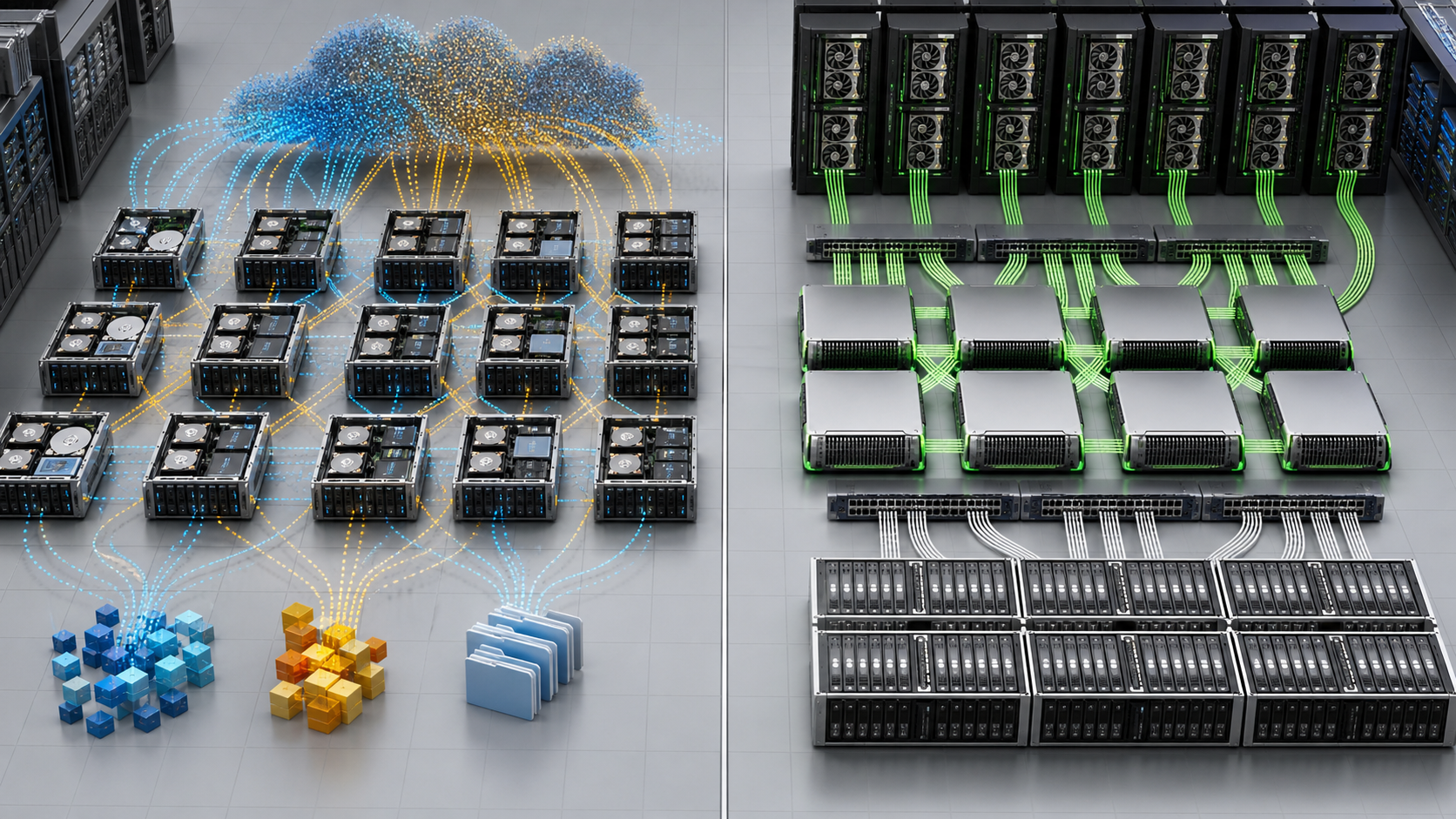
Ceph and WEKA can both occupy a rack labelled "AI storage", yet the label hides the decision. Ceph gives an organisation an open distributed store with object, block and file services. WEKA sells a commercial, NVMe-led data platform built to serve high-performance shared files and tier less-active data to object storage. One is often the durable foundation; the other is often the hot path.
Executive summary
Choose Ceph when the estate needs S3-compatible object storage, Kubernetes or virtual-machine block volumes, shared files and hardware freedom from one open platform. It is a good fit for durable capacity, private cloud, research repositories and teams that already operate Ceph.
Choose WEKA when the main requirement is a supported high-performance file tier for GPU training, checkpointing, HPC or data pipelines, with NVMe performance, integrated snapshots, object lifecycle and qualified NVIDIA GPUDirect Storage support where required. WEKA reduces integration work but adds licence cost, supported-configuration limits and product-specific resource requirements.
The platforms can work together. Ceph RGW may hold the durable S3 corpus while WEKA keeps the active namespace on NVMe and uses an object tier according to policy. Before buying two systems, measure stage time and confirm whether one platform alone meets the service objective. GPUMachines can make that comparison in a scale-out storage review.
Quick comparison
| Area | Ceph | WEKA | | --- | --- | --- | | Model | Open source distributed storage platform | Commercial software data platform | | Core services | RADOS with RGW object, RBD block and CephFS file access | Distributed WekaFS performance tier with file services and optional object-store tier | | Primary media | HDD, SSD, NVMe or mixed designs | NVMe flash for active data; external object storage for capacity and protection roles | | Client paths | S3/Swift, RBD, CephFS and gateways/integrations | POSIX and product-supported NFS, SMB, S3 and GDS paths | | Hardware choice | Broad, qualified by operator or Ceph support vendor | WEKA-supported servers, drives, clouds and client configurations | | Main strength | Breadth, durable capacity and open control | Low-latency shared file performance and packaged operations | | Main risk | Engineering and variable performance under mixed load | Licence dependency, cost and premium-tier overuse |
Different storage foundations
Ceph turns data into RADOS objects and places them across OSDs according to CRUSH rules. OSDs handle reads, writes, replication, recovery and rebalancing. Monitors maintain cluster maps; managers supply operational services. BlueStore writes to raw block devices and stores internal metadata in RocksDB.
CephFS adds Metadata Server daemons for the filesystem namespace. RGW and RBD use the same RADOS base for object and block services. This common foundation is Ceph's defining advantage.
WEKA distributes filesystem services across a cluster using NVMe as the performance tier. Its documentation describes frontend access, backend compute and drive services, management processes and object connectors. Kernel-bypass, RDMA and GDS-related paths are available in supported modes. Object storage can hold tiered data and uploaded snapshots, while writes complete through the SSD tier first.
Ceph spreads durable objects across operator-defined failure domains. WEKA distributes a commercial filesystem across flash resources and connects it to object capacity. They overlap, but they are not interchangeable.
Where Ceph is stronger
S3 and block are part of the platform, not attachments
RGW provides an S3-compatible interface for applications and data repositories. RBD provides block volumes used by virtualisation and container platforms. CephFS supplies files when needed.
WEKA supports several data-access methods and an object connector, but its object tier stores WEKA-managed data in internal structures. WEKA documentation warns administrators not to edit or apply destructive lifecycle policies to those objects. That tier is not automatically equivalent to a general Ceph RGW service that other applications own directly.
Capacity and media flexibility
Ceph can combine HDD capacity OSDs, flash metadata devices and all-NVMe pools within one estate. CRUSH rules and device classes can map data to different failure domains and media policies. This is useful when the durable corpus is much larger than the active training set.
WEKA's performance tier uses NVMe and moves eligible data to object storage. That model can be efficient, but the active flash set and object recall policy need sizing. Ceph lets the operator build more varied pools, at the cost of more design work.
Source, hardware and lifecycle control
Community Ceph has no proprietary platform subscription. Sites choose releases, hardware and support. Supported Ceph distributions are also available for buyers who want commercial help without changing the underlying open model.
WEKA supplies a licensed product and supported matrix. This reduces unknown combinations and creates a single product roadmap. Check renewal, expansion and data-access terms before purchase.
Private-cloud integration
Ceph is widely used with OpenStack, Kubernetes and Linux infrastructure. A team that needs persistent volumes, VM disks and object buckets can avoid adding separate storage products for each service.
WEKA integrates with Kubernetes and cloud environments too, but the product's economic centre is a fast data platform. It may be unnecessary for general VM volumes or bulk S3 capacity.
Where WEKA is stronger
The hot file tier is the product's focus
WEKA was built around NVMe and distributed file services. It targets workloads with high bandwidth, low latency, mixed I/O and many clients. That focus can make it easier to reach a GPU-cluster file target than adapting a general Ceph estate.
CephFS can be fast, particularly on all-NVMe hardware, but OSD CPU, RADOS protection, metadata and recovery must all meet the job objective. A Ceph cluster serving RGW and RBD at the same time adds another source of contention unless services and pools are isolated.
Integrated operations and support
WEKA packages installation, monitoring, GUI, CLI, APIs, upgrades and support. A small platform team may value this more than hardware freedom. Ceph also has orchestration and dashboard tooling, yet the operator still qualifies its specific server, drive, NIC and release combination unless a Ceph vendor does so.
Object lifecycle inside the namespace
WEKA can copy less-active data from SSD to attached object storage and release flash capacity according to policy. Files remain represented in the namespace; a cold read retrieves required data from the object tier. Snapshots can also upload to local or remote object storage.
This is a useful active/archive model when policies match job behaviour. It can hurt when a training run unexpectedly touches cold data. Measure recall bandwidth and cloud retrieval charges, and ensure the scheduler stages data before allocating GPUs.
Supported GPUDirect Storage paths
WEKA documents NVIDIA GDS support in qualified environments. For suitable I/O, GDS can move data between storage and GPU memory while avoiding some host-memory copies. The benefit depends on file size, framework, CUDA, NIC, mount mode and preprocessing.
Ceph and CephFS can participate in GPU-oriented data paths through ecosystem work and specific integrations, but buyers should not assume universal GDS support from the project name. Require written support for the exact stack.
Training reads
Dataset format determines much of the result. Large shards read by many workers can generate high aggregate throughput with relatively modest metadata work. Tiny files shift the bottleneck towards namespace operations and IOPS.
On CephFS, clients use MDS daemons for metadata and RADOS pools for file data. CRUSH spreads objects across OSDs. Scale depends on MDS ranks, OSD media, CPU and network. The cluster's background recovery also competes with training reads.
On WEKA, data resident on NVMe can use the distributed performance tier. Data present only in object storage must return across the object connector. A benchmark built entirely on warm flash will not predict the first epoch against cold capacity.
Test repeated epochs and a deliberately cold run. Record client CPU and time to first batch as well as steady-state throughput.
Checkpoint writes
Checkpoints are bursty and often synchronous. The job may stop until every rank completes its write.
CephFS checkpoints inherit the RADOS pool's protection policy and OSD commit path. Replication can provide predictable small-write behaviour but uses more capacity. Erasure coding can improve usable capacity while adding coding and read-modify-write considerations. Test the actual file sizes and framework.
WEKA writes through the NVMe tier and markets the platform for checkpoint performance. Treat vendor results as proof that the product deserves testing, not proof that the quoted system meets your interval. Distinguish application completion from snapshot upload or independent protection.
Restore matters as much as write. A fast checkpoint that takes an hour to recall from object storage may fail the recovery objective.
Metadata and small files
CephFS MDS daemons are CPU-intensive and favour high clock speed. Metadata pools should use suitable flash, and multiple MDS ranks can scale active subtrees. Poor directory layout can still concentrate work.
WEKA distributes metadata work across its architecture and may avoid a visibly separate MDS tier, but file creation and lookup remain finite operations. Ask for small-file tests at the planned client count and during snapshots or node recovery.
Both systems benefit when applications use indexed shards instead of millions of loose files. Fixing data layout can lower the required storage tier.
Network and host resources
Ceph traffic includes client I/O, replication, recovery, peering and management. An all-NVMe Ceph node can exhaust CPU or NIC bandwidth before it exhausts drives. Map PCIe and NUMA carefully.
WEKA can use several network and client modes. High-performance modes may reserve CPU cores or use RDMA and DPDK-related paths. Those resources compete with tokenisation, augmentation and simulation on GPU hosts. Measure the whole node.
Both platforms need redundant switch paths and enough east-west bandwidth. If storage shares the fabric with GPU collectives, model the combined burst. Ethernet cluster design must include congestion policy; InfiniBand design must include partitions, routing and service levels.
Failure and rebuild behaviour
Ceph automatically restores placement after supported failures, subject to configuration and available capacity. Recovery protects redundancy but consumes drive, network and CPU resources. Operators can tune priorities, though they cannot remove the work.
WEKA protects data across cluster resources and provides product self-healing. Ask what performance remains after losing a node or drive at the minimum and proposed cluster size, how quickly protection returns and which failures need vendor intervention.
Run failure tests while clients train. "Available" and "within job service level" are different outcomes.
Snapshots and backup
Ceph supports snapshots in RBD and CephFS workflows, plus replication and backup tools around its services. WEKA provides filesystem snapshots, writable snapshots and Snap-To-Object features. Neither platform's local snapshot is an independent backup by itself.
WEKA's remote object snapshots and Ceph's separate clusters can form part of site protection. Check immutability, credentials, restore order and the fate of encryption keys. A recovery plan should survive compromise of the primary administration domain.
Economics
Ceph can lower software dependency and use economical media, but its full cost includes management nodes, MDS, OSD CPU, DB/WAL devices, redundant networking, spare capacity, upgrades and storage engineers. A badly balanced cluster turns inexpensive disks into expensive latency.
WEKA adds software and support cost, supported hardware or cloud resources, NVMe and possible object-storage charges. It may reduce staff effort and improve GPU productivity enough to offset that premium. The answer changes with utilisation.
Model the active tier separately from the durable tier. Comparing a petabyte of Ceph HDD with a petabyte of WEKA NVMe ignores the workload each byte must serve.
A two-platform design
Ceph RGW can act as the durable S3 source and destination. WEKA can hold the active training namespace. Data pipelines copy or expose selected datasets to WEKA before jobs begin and return model artefacts to Ceph after validation.
WEKA can also use S3-compatible object storage as its managed tier, subject to compatibility and support. If Ceph RGW is proposed for that role, confirm the exact WEKA support matrix and configuration with both vendors. Do not infer support from protocol labels alone.
The design needs bandwidth for staging and enough duplicate capacity to survive overlapping campaigns. Automate readiness checks in the scheduler.
Who should choose Ceph?
Ceph fits organisations that need open object, block and file services, have distributed-storage expertise and want to control hardware. It is a natural durable layer for private cloud and research data.
It may also be the only platform required for modest AI clusters, especially when active datasets fit on local NVMe or the Ceph design passes the workload test.
Who should choose WEKA?
WEKA fits teams buying a supported high-performance shared tier for GPU, HPC and data pipelines. It is strongest when integrated snapshots, object lifecycle, multiple client paths or GDS support reduce engineering work.
Do not place every cold byte on the premium tier. The object policy and active-set estimate are part of the purchase.
Who should choose neither?
A small workgroup may need only a conventional NAS and backup. A dedicated HPC site may prefer Lustre. An enterprise seeking a commercial multiprotocol all-flash platform may compare Ceph with VAST Data.
Storage should match the workload scale, not the size of the GPU marketing deck.
Proof-of-concept checklist
Use identical clients and framework versions. Test:
- Warm and cold dataset reads.
- Checkpoint write, protection and restore.
- Metadata-heavy environment and project operations.
- Mixed object, block and file load on Ceph if production will mix them.
- WEKA object-tier recall and object-store interruption if tiering is planned.
- A failed node, drive or network path.
- Capacity near the expected steady state.
- Client CPU consumption and NUMA placement.
Record application time, tail latency, recovery duration and operator effort. Peak gigabytes per second are only one line.
GPUMachines technical view
Ceph is the better foundation; WEKA is often the better accelerator. That is a position, not a universal rule.
If an organisation needs a broad private data service, start with Ceph and prove whether CephFS meets the hot workload. If training and checkpoint targets dominate and the team wants a supported product, start the WEKA proof phase early. Buying both makes sense only when staging is automatic and each tier has a clear service.
GPUMachines can size OSD or WEKA nodes, CPU and memory, NVMe endurance, NIC placement, switches, GPU clients, rack power and cooling. We can also compare on-premise with Buy & Host where facility operations are the limiting factor.
FAQ
Is WEKA built on Ceph?
No. WEKA uses its own distributed filesystem architecture. It can connect to object storage for tiering and snapshots, but that does not make the performance tier Ceph-based.
Can WEKA use Ceph RGW as its object tier?
Both use S3-compatible concepts, but compatibility and support must be confirmed for the exact WEKA and Ceph releases. Do not attach production data based only on protocol similarity.
Is CephFS fast enough for AI training?
It can be. The result depends on MDS design, OSD hardware, protection, network, file layout and recovery load. Run the real data loader and checkpoint process.
Does WEKA replace an S3 data lake?
Not automatically. WEKA's object tier stores WEKA-managed filesystem data, while the product also supports S3 access features by release. A general object repository has different ownership and lifecycle needs.
Which is cheaper?
Ceph can reduce licence cost and use broad hardware choices. WEKA can reduce integration and improve hot-tier performance. Price engineers, support, GPU idle time and object capacity before deciding.
Which supports GPUDirect Storage?
WEKA documents GDS in qualified configurations. Ceph support depends on the selected integration and stack. Require written compatibility and test it with the production image.
Can Ceph and WEKA share one network?
They can, but replication, recovery, object tiering and GPU traffic may compete. Calculate bandwidth and define congestion and failure behaviour before consolidation.
Do we still need backup?
Yes. Cluster protection and local snapshots do not replace an independent, tested recovery copy.
Verdict
Ceph wins on open control, service breadth and durable capacity. WEKA wins when a commercial NVMe-led file tier and its operational packaging keep expensive compute more productive than a self-managed design.
For many buyers, the useful architecture places Ceph underneath the data estate and WEKA beside the GPUs. For others, one platform is enough. Measure the active set and failure behaviour before funding the second.
Compare Ceph and WEKA storage configurations with GPUMachines.
Sources and further reading
- Ceph architecture documentation
- Ceph hardware recommendations
- Ceph BlueStore configuration reference
- WEKA Data Platform introduction
- WEKA networking, RDMA and GPUDirect Storage documentation
- WEKA data lifecycle overview
- WEKA object-store management documentation
- WEKA snapshot documentation
WEKA product and performance statements are vendor claims unless the source identifies an independent result. Validate the quoted release and system with representative data.