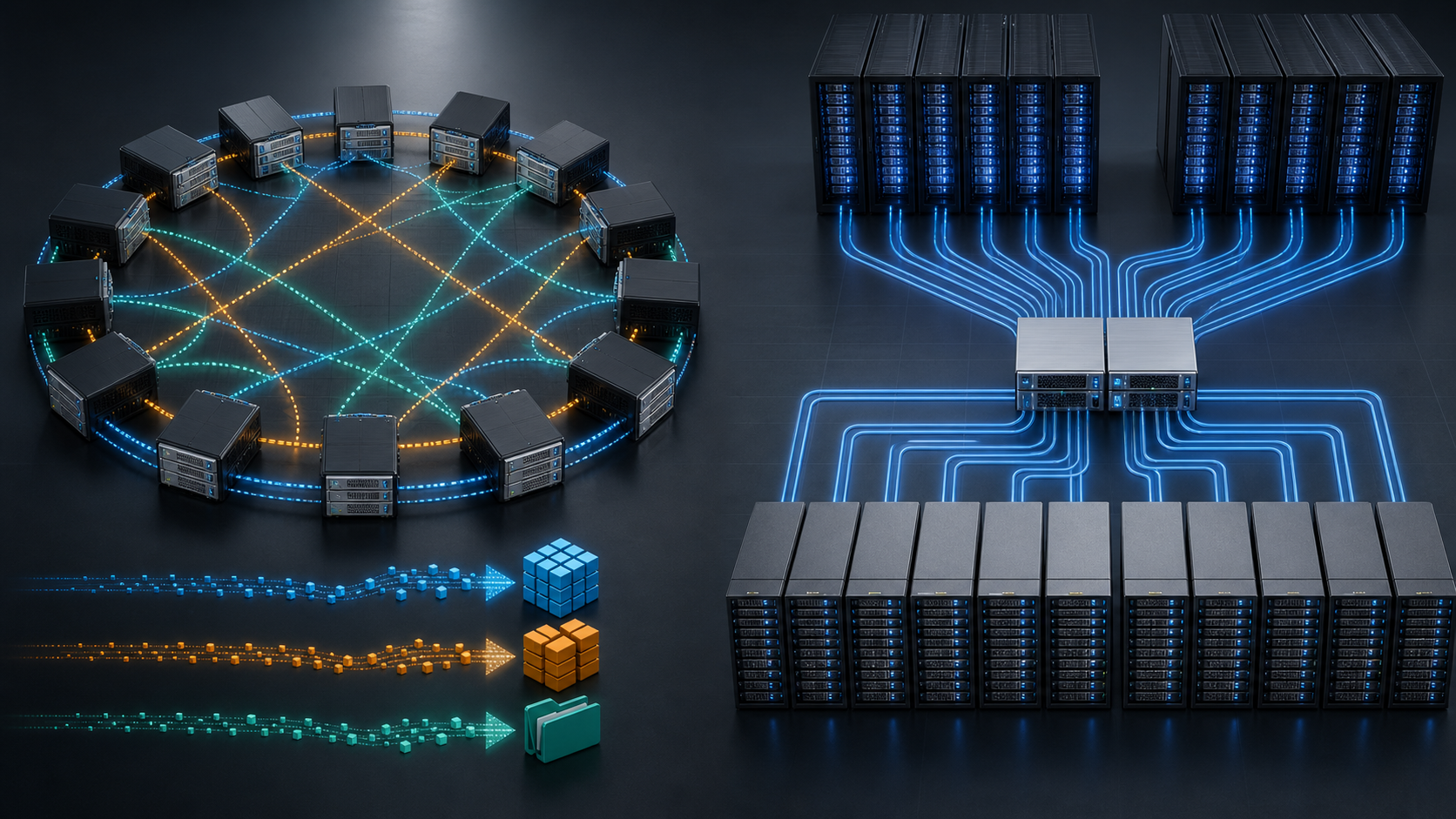
Ceph versus DDN EXAScaler is not a close filesystem race. Ceph is a distributed storage foundation that can present object, block and file services. EXAScaler is DDN's commercial Lustre-based platform, aimed at parallel file workloads in AI and HPC. One can underpin a private cloud; the other is designed to keep large compute jobs supplied with files. The first task is deciding which problem the storage must solve.
Executive summary
Choose Ceph when the organisation needs S3-compatible object storage, RBD block volumes, CephFS shared files or a combination of all three; it wants hardware and software control; and it can operate a distributed system. Ceph is a strong durable data layer for private cloud, Kubernetes, research repositories and mixed services.
Choose DDN EXAScaler when the primary requirement is high-throughput parallel POSIX access for a large GPU or HPC cluster, with qualified hardware, commercial support and DDN's Lustre engineering. It is the more direct candidate for training datasets, scratch and checkpoints when the cost of delayed GPU jobs is high.
Many estates should not force a winner. Ceph can keep the durable object and block services while EXAScaler holds the active training namespace. GPUMachines can size that two-tier path, including the data movers and storage network that determine whether it works in practice.
Quick comparison
| Area | Ceph | DDN EXAScaler | | --- | --- | --- | | Platform type | Open source distributed object store with block, object and file services | Commercial Lustre-based parallel file platform | | Main interfaces | RGW S3/Swift, RBD and CephFS | Lustre client and POSIX namespace, plus DDN platform features by release | | Hardware | Industry-standard servers selected by operator or support vendor | DDN-qualified systems and configurations | | Data placement | CRUSH places RADOS objects across OSD failure domains | Lustre files use Metadata and Object Storage Targets on DDN systems | | Main strength | Service breadth, durable capacity and cloud integration | Parallel file bandwidth, checkpointing and supported AI/HPC deployment | | Main risk | Operational complexity and variable hot-file performance | Commercial dependency, product cost and narrower protocol role | | Natural buyer | Private-cloud or data-platform team | AI/HPC compute-platform team |
Ceph's architecture serves several masters
Ceph stores data as RADOS objects across OSDs. CRUSH calculates placement according to rules and failure domains, while monitors maintain cluster maps and managers expose operational services. BlueStore writes directly to block devices and keeps internal metadata in RocksDB.
RADOS Gateway turns that base into an object service. RBD presents block devices for virtual machines and containers. CephFS uses Metadata Server daemons to provide a POSIX filesystem while file data remains in RADOS pools.
This breadth lets one storage estate support applications that would otherwise need several products. It also means OSD and network resources may serve recovery, object requests, block volumes and files at once. Careful pool and media design is required to stop one service from surprising another.
EXAScaler's architecture targets parallel files
EXAScaler is based on Lustre. Metadata Servers and Metadata Targets manage the namespace and file layouts. Object Storage Servers and Targets hold file data. Clients communicate with these services over LNet and access multiple targets in parallel.
DDN adds its Lustre distribution, storage systems, management, tuning, data services and support. The result is a product rather than a community integration project. DDN also supplies EXAScaler technology behind Google Cloud Managed Lustre.
The focus is narrower than Ceph's: feed many compute clients through a high-bandwidth shared namespace. That narrowness can be an advantage for an expensive GPU cluster.
Where Ceph is stronger
Object and block services are first-class
If applications expect S3 or the private cloud needs persistent block volumes, Ceph addresses those requirements directly. EXAScaler can exchange data with object systems through surrounding DDN tools and workflows, but it is not a general RBD equivalent or an open S3 foundation.
Ceph therefore suits estates where AI is one consumer among virtualisation, Kubernetes and data services. The storage investment can serve more than the training cluster.
Hardware and release control
Ceph runs on operator-selected servers and media. Organisations can source dense HDD capacity nodes, all-NVMe pools or hybrids, choose support separately and adopt releases according to internal policy.
DDN qualifies and supports a narrower platform. That reduces unknown combinations while creating a commercial dependency. Neither model is automatically cheaper; one spends more engineering internally, the other purchases more of it from the supplier.
Durable capacity economics
Ceph supports replication and erasure coding across defined failure domains. Large capacity pools can use HDD for object data with flash for BlueStore DB/WAL and metadata-heavy services. This often makes Ceph attractive for repositories that hold far more data than the GPU cluster actively reads.
EXAScaler offers flash and hybrid DDN configurations according to the current portfolio, but its economic argument centres on serving compute workloads. Compare usable capacity, protection and recovery rather than raw drive totals.
Cloud-native ecosystem integration
Ceph is common under OpenStack and Kubernetes through RBD, RGW and CSI integrations. Teams building an internal cloud may prefer one distributed storage base that fits their automation and identity model.
EXAScaler integrates with AI and HPC environments and is available in managed cloud form through Google Cloud. That is a different operating route, not a drop-in private-cloud storage layer.
Where EXAScaler is stronger
Parallel file performance is the product's reason to exist
Large training jobs need many clients to read datasets and write checkpoints concurrently. Lustre's direct client-to-target model and file striping address that pattern. DDN packages hardware and tuning around it.
CephFS can deliver high throughput, but the design must prove that RADOS placement, OSD work, Metadata Servers and recovery traffic meet the job target. EXAScaler has a narrower path from requirement to product sizing.
One support boundary covers more of the stack
DDN can support the EXAScaler distribution, management and its qualified storage hardware. A Ceph build may involve a server vendor, drive vendor, Linux distribution, Ceph support partner and internal integrator. Supported Ceph distributions can narrow that boundary, but a self-built cluster leaves more coordination to the operator.
Ask DDN where client kernels, fabric switches and application tuning sit. The boundary is wider, not infinite.
Checkpoint and HPC experience
DDN publishes case studies and performance claims around checkpointing, AI training and large supercomputers. That estate gives its engineers experience with workload shapes that matter to GPU buyers. Treat the figures as DDN claims until a proof phase reproduces them with the proposed protection and client count.
Product lifecycle
Installation, monitoring, upgrades and support bundles arrive as part of EXAScaler. Ceph has capable orchestrators and dashboards, yet the site must establish its own validated procedures and escalation. The difference matters when the storage team is small.
CephFS versus Lustre inside EXAScaler
CephFS and Lustre both present POSIX files, but the route to data differs.
CephFS Metadata Servers manage namespace metadata and clients store file objects through RADOS. CRUSH spreads those objects across OSDs. The same OSD cluster may serve other Ceph interfaces, and RADOS handles recovery and rebalancing.
Lustre clients receive file-layout information from metadata services and access OSTs through OSSs. File striping controls how extents spread across targets. In EXAScaler, DDN supplies the integrated backend and tuning.
For a mixed storage cloud, CephFS's common RADOS base can be attractive. For dedicated AI scratch, Lustre's explicit target layout can be easier to reason about and tune. Neither architecture removes application effects.
Training datasets
Start by measuring active capacity, files per dataset, shard size, concurrent workers and repeated-read behaviour. Large shards may stream well from either platform. Millions of tiny files increase metadata and open/close work.
Ceph may place dataset objects across many OSDs, giving wide parallelism. OSD CPU, network and BlueStore metadata devices must keep pace. If data also sits in RGW, the team may need an explicit path to expose or stage it for POSIX training.
EXAScaler serves the Lustre namespace directly to clients. Stripe policies can spread large files across targets. DDN should demonstrate the proposed client and server configuration at the intended concurrency, not only quote a larger reference system.
Checkpoint bursts
Checkpoint I/O often decides the shortlist. Several ranks may write large files together and wait for completion before training resumes.
On CephFS, the write traverses the file client into RADOS and the selected pool's protection policy. Replication or erasure coding, OSD commit behaviour, metadata and network all affect the pause. Recovery traffic can make a healthy benchmark optimistic.
On EXAScaler, the Lustre client writes across selected OSTs. DDN markets fast checkpointing, but the test must include the chosen stripe layout, client count, protection and restore process. Record the time to a usable checkpoint and to an independent protected copy if those differ.
Small files and metadata
CephFS Metadata Servers are CPU-intensive and benefit from high clock speed. Multiple active MDS ranks can divide directory subtrees, but file and directory layout still matter. Metadata pools should use suitable flash.
Lustre uses MDTs and MDSs, with directory striping and multiple MDTs available for larger namespaces. EXAScaler product sizing should state metadata capacity and service assumptions.
For either system, convert loose samples into larger dataset containers when the framework permits. Storage cannot compensate economically for unlimited path walks.
Network competition and recovery
Ceph's network carries client I/O, replication or coding work, peering and recovery. A failed OSD or host causes data movement that protects redundancy but competes with applications. Reserve enough bandwidth and free capacity to recover without breaking the service objective.
EXAScaler carries Lustre client and backend traffic according to its system design. Failed components, target failover and rebuild also affect the fabric. DDN can specify supported topologies and expected behaviour, while the buyer still integrates the GPU network.
If storage shares a fabric with GPU collectives, simulate a checkpoint and a failure during training. Port labels alone cannot predict congestion.
Data protection
Ceph's replicated or erasure-coded pools protect against defined component losses. Snapshots exist for RBD and CephFS workflows. None of this creates an independent backup unless copies leave the failure and security boundary.
EXAScaler provides platform availability and DDN data-management options by product version. Ask how snapshots, replication, archive and backup are licensed and operated. Lustre scratch may accept limited protection; accepted model artefacts should not.
Write recovery objectives in time and data loss, then compare the steps each platform needs to meet them.
Cost model
Ceph's bill includes storage servers, OSD media, fast DB/WAL devices where used, monitor and manager services, Metadata Servers for CephFS, switches, spares, support and engineers. Erasure coding can improve capacity efficiency but consumes resources and changes recovery behaviour.
EXAScaler includes DDN hardware or qualified systems, software, support, network integration, expansion and renewal. It may reduce internal engineering and shorten fault resolution. That saved time has value when each stalled GPU node is expensive.
Do not compare Ceph raw capacity with an EXAScaler performance tier. Decide which bytes need which service first.
A sensible two-tier architecture
Ceph RGW can hold the durable data lake, model registry and archive. EXAScaler can hold the active POSIX working set and checkpoints. Workflow software stages selected datasets into the Lustre namespace before scheduling GPU resources and returns approved outputs after a run.
This pattern lets Ceph optimise durable capacity and EXAScaler optimise the compute path. It adds duplicate data, transfer bandwidth and operational handoffs. The scheduler should check stage completion so GPUs never wait for a copy.
Some organisations can use Ceph alone and avoid the second platform. Others may choose EXAScaler plus a cloud or third-party object store. The two-tier design is an option, not a rule.
Who should choose Ceph?
Ceph fits private-cloud and data-platform teams that need object or block services as well as shared files, want open software and can run a distributed system. It is strongest when the capacity pool serves many applications and AI is part of a wider estate.
It is less persuasive when the sole requirement is a supported high-performance POSIX tier for a large training cluster and the team has no Ceph experience.
Who should choose DDN EXAScaler?
EXAScaler fits AI and HPC operators who need Lustre semantics, high parallel file service and a commercial support relationship around qualified hardware. It is attractive when storage interruption has a direct cost in lost training time.
It is less suitable when the organisation mainly needs economical S3, Kubernetes block volumes or a general private-cloud foundation.
Who should choose neither?
A small inference service may need only object storage plus local NVMe. WEKA versus Ceph is more relevant when a commercial NVMe file tier and object lifecycle are under consideration. VAST Data versus Ceph is more relevant when multiprotocol consolidation is the requirement.
Keep the platform proportional to the data and the team.
Proof-of-concept plan
Build one test from application traces rather than storage folklore. Run dataset reads, checkpoint writes, restore and metadata operations at the expected client count. Add one failed drive or server and repeat.
For Ceph, monitor OSD latency, CPU, recovery, MDS behaviour and network load. For EXAScaler, monitor clients, LNet, metadata, targets and DDN system telemetry. Record operator actions and support-response assumptions.
Test data export as well. A platform is easier to buy than to leave.
GPUMachines technical view
Ceph and DDN EXAScaler answer different primary questions, which makes a universal winner unhelpful. Ceph is the broader open storage foundation. EXAScaler is the sharper commercial tool for parallel AI and HPC files.
GPUMachines can size Ceph nodes, DDN integration, GPU clients and the fabric as one bill of materials. We check CPU and PCIe balance, DIMMs, drive endurance, NIC rails, switch ports, rack current, cooling and service access. The design can sit on-premise, in Buy & Host or across a planned hybrid path.
FAQ
Is DDN EXAScaler based on Ceph?
No. EXAScaler is based on Lustre. Ceph and Lustre are separate open source storage projects with different architectures and service roles.
Can CephFS replace EXAScaler?
It can meet some of the same POSIX workload requirements, but the buyer must prove performance, recovery and operations on the proposed Ceph design. EXAScaler packages a Lustre-based AI/HPC platform and DDN support.
Can EXAScaler provide S3 object storage?
DDN offers broader data-platform and movement capabilities, but EXAScaler's primary role is a Lustre filesystem. Check the exact proposal for object interfaces. Ceph RGW is a direct S3-compatible service.
Which is cheaper per terabyte?
The answer depends on media, protection, performance and support. Ceph capacity pools can be economical, while EXAScaler may justify a premium by reducing GPU wait and internal engineering. Compare service tiers, not raw terabytes.
Which is better for Kubernetes?
Ceph has established block, file and object integrations for Kubernetes. EXAScaler can serve file workloads to supported clients, but it is not a general replacement for RBD-based persistent volumes. Define the application interface first.
Do both work with InfiniBand?
Lustre commonly uses LNet over InfiniBand in HPC. Ceph usually uses IP networking and can run IP over InfiniBand, though Ethernet is common. Validate the supported topology and operational preference.
Should checkpoints go to Ceph or EXAScaler?
EXAScaler is the more purpose-focused candidate for a large shared checkpoint tier. Ceph may still meet the requirement and offers a strong durable destination. Measure write pause, restore and failure behaviour on both.
Can GPUMachines deploy both?
GPUMachines can design the hardware, networking, rack placement and data-flow plan for a Ceph plus EXAScaler estate, subject to product sourcing and support terms.
Verdict
Ceph wins when storage must be a broad open service for objects, blocks and files. DDN EXAScaler wins when a large compute cluster needs a supported parallel filesystem and the organisation values DDN's integrated engineering more than hardware and software freedom.
The mature design may use both. Put durable, widely shared data on the platform built for breadth; put the hottest parallel file work on the platform that proves it can keep the GPUs working.
Plan a Ceph, DDN EXAScaler or tiered AI storage system with GPUMachines.
Sources and further reading
- Ceph architecture documentation
- Ceph hardware recommendations
- Ceph BlueStore configuration reference
- Lustre Software Release 2.x Operations Manual
- DDN EXAScaler product page
- DDN explanation of EXAScaler and Google Cloud Managed Lustre
DDN performance and scale figures are vendor claims. Require a workload test on the quoted configuration before using them in a purchase case.