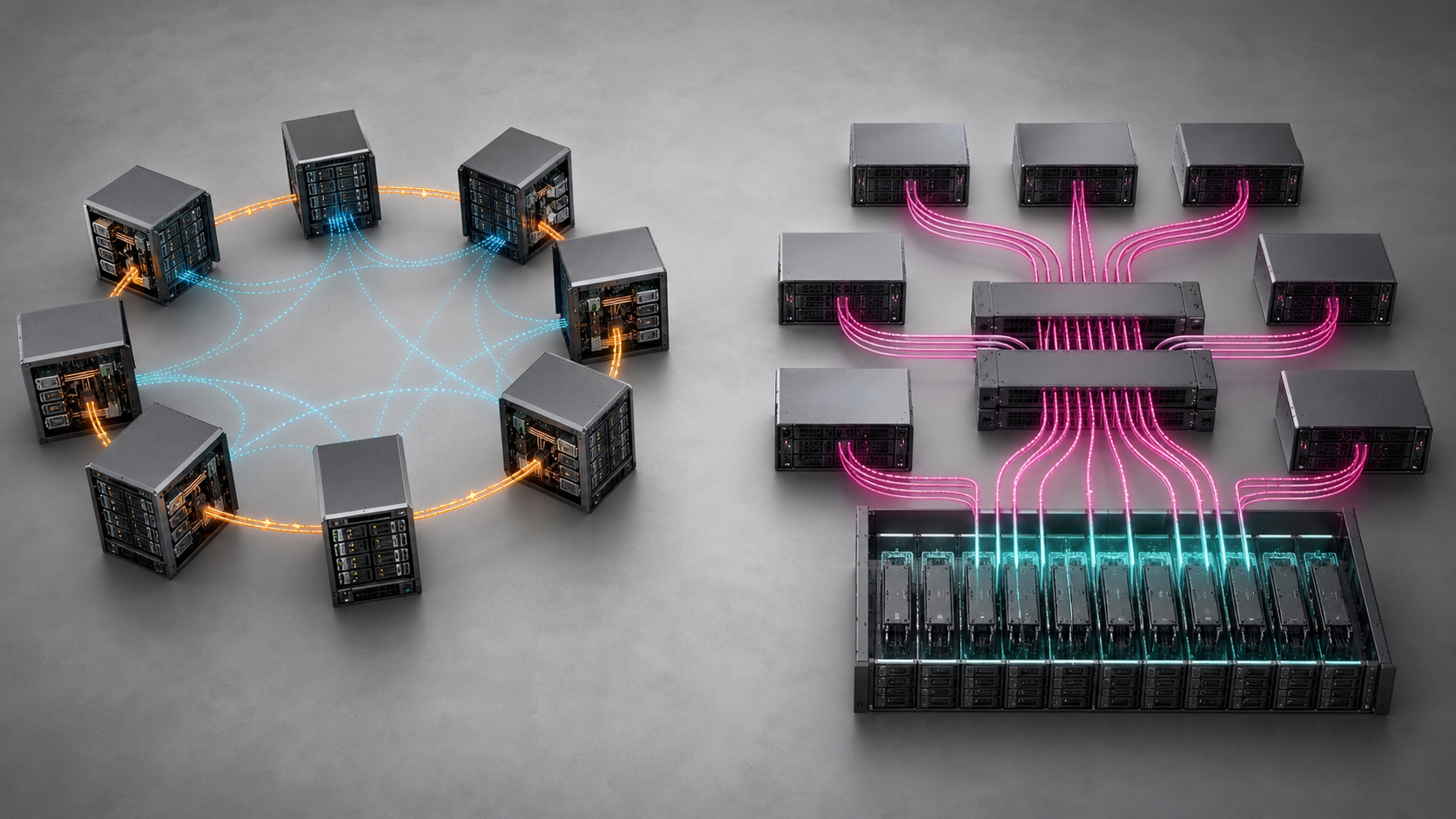
Ceph and VAST Data represent two competing ideas about scale-out storage. Ceph distributes ownership across OSDs and lets clients calculate placement through CRUSH. VAST's DASE architecture gives stateless service nodes shared access to persistent media and system state. Both can serve files and objects; only one is an open project, and only one arrives as a commercial data platform with a single product roadmap.
Executive summary
Choose Ceph when open software, hardware flexibility, S3-compatible object storage, RBD block services and integration with private-cloud tools carry more weight than a packaged appliance experience. It suits teams willing to own placement rules, OSD balance, recovery and upgrades.
Choose VAST Data when the organisation wants a supported multiprotocol data platform, all-flash capacity, disaggregated scaling and commercial operations around file, object and broader data services. VAST may reduce storage silos and administrative assembly, but its data-reduction, scale and performance statements must be tested with representative data.
Ceph often wins as a controllable infrastructure substrate. VAST often wins as a consolidated enterprise product. A GPUMachines scale-out storage review should decide whether the buyer needs a platform to build on or a platform to consume.
Quick comparison
| Area | Ceph | VAST Data | | --- | --- | --- | | Delivery | Open source project; commercial distributions and support are available | Commercial software data platform and supported configurations | | Architecture | Shared-nothing OSD services with CRUSH placement | Disaggregated Shared Everything with stateless CNodes and shared NVMe media | | Interfaces | RGW object, RBD block and CephFS file | NFS, SMB, S3 and platform data services according to release | | Media | HDD, SSD, NVMe and mixed pools | All-flash design with VAST data reduction and supported hardware models | | Scaling | Add OSD and service nodes; roles and pools can scale independently | Add service and capacity resources through DASE-supported expansion paths | | Operations | Operator or Ceph vendor integrates lifecycle and hardware | VAST product management, support and lifecycle | | Best fit | Private cloud, object and block services, open data infrastructure | Enterprise AI data consolidation and high-performance multiprotocol access |
Ceph: distributed ownership and calculated placement
Ceph's RADOS layer stores objects on OSDs. CRUSH maps each object to placement groups and OSDs according to rules that describe media classes and failure domains. Clients do not query one central metadata controller to find every object.
OSDs serve I/O and handle replication, peering, recovery and rebalancing. Monitors maintain authoritative cluster maps, while managers provide operational modules. BlueStore manages raw block devices and RocksDB metadata.
RGW, RBD and CephFS build object, block and POSIX file services on this common base. The operator can run them together or separate media and pools according to service needs.
VAST: shared persistent state behind stateless services
VAST describes DASE as a disaggregated shared-everything architecture. Stateless service nodes access persistent data and metadata on shared NVMe media over NVMe-oF. Because service nodes can reach the same state, VAST can scale processing and capacity along separate paths and move client service when a node fails.
VAST's Element Store presents related data through protocols such as NFS, SMB and S3. The wider platform also includes database, data-engine and namespace services by product release. This scope extends beyond a direct CephFS or RGW comparison.
The shared model and all-flash design are proprietary VAST engineering. The buyer gains one supported system and accepts the vendor's release, hardware and licence boundaries.
Where Ceph is stronger
Open source and ecosystem independence
Ceph can be downloaded, inspected and operated without a proprietary platform licence. Several vendors sell support and distributions, so organisations can change support relationships while retaining the underlying architecture and data services.
VAST offers a software-defined platform, but production use follows its commercial terms and supported configurations. That can be a fair exchange for product accountability, though it is not the same kind of portability.
Block storage
RBD is a mature part of the Ceph proposition for OpenStack, Kubernetes and virtualisation. VAST supports block-related capabilities in its broader platform according to release, but many Ceph buyers choose it specifically because object, block and file live on one open RADOS base.
If persistent container volumes and VM disks dominate, require VAST to demonstrate the exact access path and ecosystem integrations rather than comparing a generic "block supported" statement.
Media and hardware freedom
Ceph can place economical HDD under capacity pools, NVMe under latency-sensitive pools and fast DB/WAL devices beside HDD OSDs. Hardware can follow local supply, density and service preferences.
That flexibility increases qualification work. VAST narrows the platform to designs it supports, which can speed deployment and reduce component ambiguity.
Transparent placement policy
CRUSH rules let operators express failure domains and placement without a central object-location table. Skilled teams can model host, chassis, rack and site boundaries and use different rules for different pools.
VAST manages placement and protection inside its product. Buyers get less source-level control and more packaged behaviour. The right choice depends on whether storage policy is something the team wants to engineer.
Where VAST Data is stronger
One commercial support boundary
VAST supplies the platform software, management and supported hardware relationship. When a fault crosses namespace, protocol and media services, the customer has one product escalation path. A Ceph build can achieve a similar boundary through a supported distribution, but a community integration usually involves more parties.
Multiprotocol consolidation
VAST's Element Store can expose data through file and object protocols and aims to reduce duplicate silos. This matters when data scientists use NFS, applications use S3 and enterprise users require SMB against related content.
Ceph offers several interfaces too, but RGW objects, RBD blocks and CephFS files have different semantics. "One RADOS cluster" does not mean every byte appears interchangeably through every protocol. VAST's shared Element model is a distinct product claim that deserves a permissions and application test.
All-flash economics and data reduction
VAST uses a persistent write buffer, wide protection and global data-reduction techniques to make high-capacity flash economical. If representative datasets compress and deduplicate well, the platform may reduce racks, power and latency compared with an HDD-heavy Ceph estate.
Compressed media, encrypted data, model checkpoints and unique scientific measurements may reduce poorly. Ask VAST to measure samples and keep a no-reduction capacity case in the proposal.
Enterprise lifecycle and data services
VAST packages snapshots, replication, management, security and broader data services into its platform roadmap. Ceph has rich capabilities, but teams often integrate several services, tools and operating procedures to reach the same user experience.
The commercial package is valuable only if the organisation uses it. A simple S3 archive may not need an AI operating system.
File access: CephFS versus VAST NFS
CephFS uses MDS daemons for namespace metadata and stores file data in RADOS pools. Native CephFS clients understand the service, and kernel or FUSE variants have different performance and compatibility considerations.
VAST presents scale-out NFS and other protocols from its service nodes. Its documentation discusses multipathing, RDMA and GPUDirect-related access for GPU environments. Standard NFS client familiarity can simplify host images and enterprise integration.
Do not reduce this to "native client faster than NFS" or the reverse. Test mount recovery, locking, permissions, metadata, client CPU and failover with the exact kernel and network. Scale-out product NFS behaves differently from a single conventional filer.
Object access: RGW versus VAST S3
RGW is a dedicated S3-compatible object service with its own front-end scaling, bucket indexes and operational design. Ceph is widely used as an object foundation in private clouds and service providers.
VAST S3 presents objects through the Element Store, potentially allowing related data to appear through file and object paths. That can reduce copies for AI pipelines that switch between access methods. It also creates permission and semantic questions: directory hierarchy, object naming, consistency expectations and identity mapping need application tests.
Check API compatibility rather than the S3 logo. Applications may depend on particular headers, multipart behaviour, versioning, events or lifecycle functions.
GPU training and checkpointing
VAST positions the platform for GPU data delivery, high-throughput NFS, RDMA and GPUDirect. Ceph can also feed AI pipelines through RGW or CephFS, but a general cluster may need a dedicated high-performance pool and client network.
For training reads, test warm and cold data, file-size distribution, worker count and repeated epochs. For checkpoints, measure the application pause, durability point and restore. Add a failed device or service node.
VAST's all-flash design may provide lower latency than HDD-based Ceph. An all-NVMe Ceph cluster creates a fairer performance comparison but changes the cost. A tiered design may use Ceph as the durable pool and local or commercial flash for active jobs.
Metadata pressure
CephFS MDS daemons need high clock speed and sufficient memory. Metadata pools should use flash, and multiple active ranks can scale namespace service. RGW also has bucket-index and gateway considerations for large object populations.
VAST distributes metadata within its shared architecture and service layer. Ask for measurements on the real namespace: file creates, directory enumeration, snapshot load and mixed S3/NFS access. Architecture diagrams do not set the service rate.
Application changes such as sharding samples or reducing recursive scans benefit both.
Recovery and degraded-state performance
Ceph recovery moves or reconstructs objects after failures. The work consumes OSD CPU, media and network. CRUSH and pool settings determine placement, while operator policy controls recovery priorities and backfill limits.
VAST's shared service model lets surviving CNodes access persistent state, and its media protection restores redundancy according to the product design. Ask VAST how node, drive, DBox and fabric failures change throughput and latency at the proposed scale.
Both can remain technically available while missing the application's service target. Test the degraded state, not only failover completion.
Network design
Ceph typically uses Ethernet IP networks for clients and cluster traffic, though other IP transports are possible. Replication and recovery can create heavy east-west load. Separating or prioritising traffic and providing redundant paths matter at scale.
VAST uses high-speed Ethernet or InfiniBand-related configurations and NVMe-oF inside the supported architecture. Client NFS, RDMA and backend media traffic need a complete switch design. Product qualification does not create spare switch ports.
For either platform, map NICs, PCIe root complexes, CPUs and switches. A cluster with fast media and one oversubscribed uplink is a network benchmark, not a storage benchmark.
Security and governance
Ceph supplies authentication and permissions for its services, while enterprise identity, key management, audit export and tenant operations depend on deployment and integrations. Open control appeals to security teams willing to engineer the stack.
VAST packages enterprise identity, encryption, audit and governance capabilities according to release. Multiprotocol access makes consistent policy especially important. Test one user accessing related data through NFS and S3, including denial cases.
Ask who owns encryption keys and what happens to data access if a support subscription lapses.
Cost model
Ceph costs hide in OSD server CPU, fast metadata devices, redundant networks, spare capacity, support and labour. HDD and erasure coding can lower durable capacity cost, but recovery and small-write behaviour need allowance.
VAST costs include supported systems, software, support, networking, expansion and renewal. Flash density and data reduction may lower facility cost, while poor reduction raises effective cost per usable byte.
Price five years and a migration. Include GPU idle time, operator time and the business cost of missed recovery objectives. Acquisition price alone favours whichever quote omits more work.
Migration and data exit
Ceph's open interfaces and tooling give several export routes, but moving petabytes still takes bandwidth and time. RBD images, RGW objects and CephFS files need different migration plans.
VAST's standard protocols can support data movement, yet the platform's internal representation remains proprietary. Ask for sustained export performance while production remains online and test metadata preservation. Licence and support terms should not surprise the organisation during exit.
Write the exit plan before the platform contains the only copy.
Who should choose Ceph?
Ceph suits organisations building private cloud or durable data infrastructure around open object, block and file services. It rewards teams that understand distributed systems and want to control failure domains, media and release timing.
It may be a poor choice for a small team that expects a finished enterprise appliance and has no storage owner.
Who should choose VAST Data?
VAST suits enterprises and AI service providers that want to consolidate high-performance file and object access on a supported all-flash platform. It is strongest when multiprotocol data access, commercial lifecycle and data services replace several existing systems.
It may be excessive for bulk S3 capacity, disposable scratch or buyers that require open source.
Who should choose both?
Ceph can hold economical durable objects and block services while VAST serves the enterprise active-data tier. This split is justified when datasets, access methods or support boundaries make one platform unsuitable for every role.
It also creates another copy and integration path. Measure staging, synchronisation and recovery. Some buyers will discover that VAST can consolidate enough to remove Ceph; others will discover that Ceph meets the requirement without VAST.
Alternatives
Ceph versus WEKA is the sharper comparison for a commercial NVMe filesystem and object tier. Ceph versus DDN EXAScaler applies when Lustre-based AI and HPC file performance is the priority. Ceph versus commercial AI storage covers the wider make-or-buy decision.
A small GPU cluster may use local NVMe and a simple NAS instead of any of them.
Proof-of-concept checklist
Test each required protocol with real clients. Include:
- S3 API operations and multipart uploads used by applications.
- POSIX or NFS training reads at production concurrency.
- Checkpoint write, protection and restore.
- RBD or block workload if it is part of the consolidation case.
- Mixed file and object access to related data where proposed.
- Node, drive, enclosure and network failures.
- Capacity assumptions with representative reduction results.
- Export to an independent target.
Track support calls and operator steps during the proof. A platform that performs well but takes days to diagnose may still lose.
Use the storage server catalogue to shortlist the media and node layout only after the software architecture is chosen. For a rack-scale deployment, the Vera Rubin scale-out AI Factory design provides the surrounding compute, 800 Gb/s fabric and shared-storage context needed for a credible Ceph or VAST proof of concept.
GPUMachines technical view
Ceph offers more freedom and demands more ownership. VAST offers more packaging and demands a stronger commercial justification.
For a private-cloud substrate, Ceph is usually the first design to test. For an enterprise AI data platform meant to consolidate NFS, S3 and active analytics, VAST is the more direct candidate. Neither should be judged by one bandwidth chart.
GPUMachines can map storage nodes and VAST integration to GPU clients, InfiniBand or Ethernet fabrics, rack power, cooling and hosting. We can also calculate whether keeping a capacity tier outside the premium platform improves the business case.
FAQ
Is VAST Data based on Ceph?
No. VAST uses its proprietary DASE architecture and Element Store. Ceph uses RADOS, OSDs and CRUSH placement.
Can VAST replace Ceph RGW?
It may replace some S3 use cases, but application compatibility, lifecycle, multi-tenancy and operations need testing. RGW is a dedicated open S3-compatible service; VAST's S3 sits inside a wider multiprotocol product.
Can VAST replace Ceph RBD?
VAST offers block-related platform capabilities by release, but buyers should verify ecosystem integration and service semantics for their hypervisor or Kubernetes stack. RBD remains one of Ceph's core services.
Which is faster for AI training?
VAST's all-flash platform is designed for high-performance AI data access. Ceph performance varies widely by hardware and service design. Compare complete systems and include degraded operation; there is no honest software-name answer.
Which stores more data per rack?
It depends on Ceph media and protection versus VAST flash density and measured data reduction. Use no-reduction and conservative cases in the comparison.
Is Ceph cheaper?
It can reduce licence cost and use economical hardware. Staff, support, recovery headroom and integration remain. VAST may cost more to buy and less to operate for some teams.
Do both support NFS and S3?
Ceph provides S3 through RGW and can expose files through CephFS or NFS gateways. VAST presents NFS and S3 through its platform. Exact semantics and performance differ, so test the application's required operations.
Can GPUMachines source and integrate either platform?
GPUMachines can design and source Ceph hardware and can review VAST integration subject to current product and partner availability. The review includes servers, NICs, switches, racks, power and hosting.
Verdict
Ceph is the better choice when the organisation wants an open storage foundation and is prepared to engineer it. VAST Data is the better choice when multiprotocol consolidation, all-flash service and one commercial support path justify the product commitment.
The deciding question is simple: does the team want to own the storage system's moving parts, or pay a vendor to turn more of them into a supported service? Test the answer with real data and a failed component.
Compare Ceph and VAST Data architectures with GPUMachines.
Sources and further reading
- Ceph architecture documentation
- Ceph hardware recommendations
- Ceph BlueStore configuration reference
- VAST AI Operating System white paper
- VAST multiprotocol storage access overview
- VAST explanation of DASE for HPC storage
- VAST NFS access discussion
VAST performance, scale and data-reduction statements are vendor claims. Validate them on the quoted platform with representative data and protection settings.