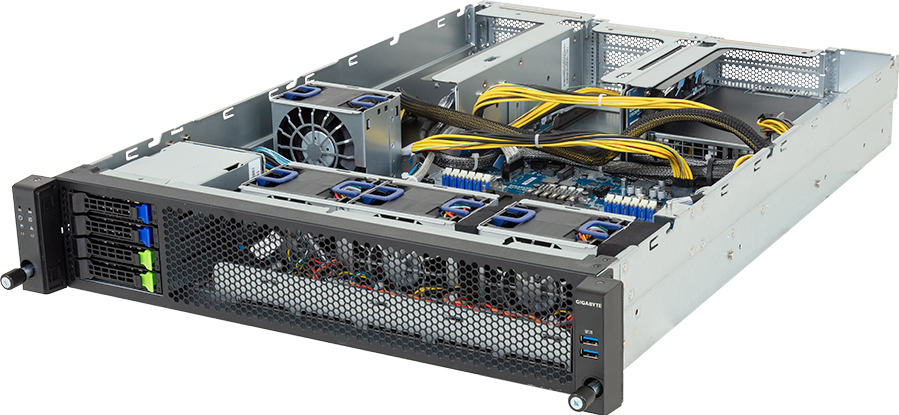
E264-AG0-AAS1 has to survive a site survey before its component list matters. Treat the base system as a design boundary, not a finished build; CPU, memory, storage, networking and facility choices still decide the outcome.
The buying decision is fairly narrow: choose E264-AG0-AAS1 when placement close to the data is a hard requirement and the final components can be qualified inside the site's electrical and airflow limits. A conventional rack server or hosted node is the better buy when physical placement is not the constraint.
Review the E264-AG0-AAS1 configuration options on GPUMachines before treating the base chassis as a finished design.
Executive Summary
GIGABYTE E264-AG0-AAS1 is a short-depth 2U edge server built around one Intel Xeon 6 processor in the LGA 7529 family. GIGABYTE specifies 12 DDR5 DIMM slots with RDIMM and MRDIMM support, four full-height full-length PCIe 5.0 x16 GPU slots, one OCP NIC 3.0 PCIe 5.0 x16 position, four front 2.5-inch drive bays and two internal M.2 positions. Chassis depth is 625 mm.
The server is for teams that need several qualified PCIe accelerators near a data source but cannot install a conventional full-depth 4U or 8U machine. Likely uses include video analytics, industrial inspection, inference serving, rendering and local private-AI services. A single CPU avoids cross-socket NUMA traffic and keeps the design compact, although CPU capacity and I/O ownership must still match four busy GPUs.
Its strongest argument is physical fit combined with four independent GPU positions. It becomes a poor choice for tightly coupled large-model training, very large local datasets or deployments without a suitable high-current rack supply and front-to-back cooling path. Buyers should confirm the current GIGABYTE GPU qualification list before treating any card as supported.
Configure the GIGABYTE E264-AG0-AAS1 through GPUMachines.
Key Specifications
| Area | Verified platform detail | | --- | --- | | Form factor | 2U edge server, 438 mm wide, 87.5 mm high and 625 mm deep | | CPU platform | Single Intel Xeon 6900E-series or compatible Xeon 6900-series platform listed by GIGABYTE | | CPU sockets | 1, LGA 7529 | | GPU support | Four full-height, full-length PCIe 5.0 x16 positions for qualified GPUs | | Memory | 12 DDR5 DIMM slots; RDIMM and MRDIMM support is platform and processor dependent | | Storage | Two 2.5-inch PCIe 5.0 NVMe/SATA/SAS-4 bays, two 2.5-inch SATA/SAS-4 bays and two internal M.2 positions | | PCIe expansion | Four full-height, full-length PCIe 5.0 x16 GPU slots plus one OCP NIC 3.0 PCIe 5.0 x16 position | | Networking | One OCP NIC 3.0 PCIe 5.0 x16 slot with NCSI support, plus dedicated management LAN | | Power | 1+1 redundant 3200 W 80 PLUS Titanium power supplies | | Cooling | Four high-pressure 80 x 80 x 56 mm system fans | | Best-fit workloads | Edge inference, video analytics, industrial AI, rendering, regional private AI and multi-GPU hosting where workloads remain mostly independent |
GPU power limits, cable sets and supported card dimensions must be checked against the current system qualification. Four physical x16 positions are not a promise that any four retail GPUs will operate safely together.
Platform Highlights
- A 625 mm chassis depth opens edge deployment options. Many accelerator servers exceed the depth available in telecom, industrial or regional racks. The shorter E264 still requires rail-clearance and rear-cable checks, but it can fit rooms designed around shallower equipment.
- Four Gen5 x16 GPU positions support parallel independent work. Video streams, rendering jobs or inference replicas can be assigned to separate cards without relying on a scale-up fabric. Workloads that exchange large tensors between GPUs need a different architecture.
- One CPU owns the system's memory and I/O. The absence of a second socket removes cross-socket placement problems. It also means CPU-side preprocessing, networking and GPU submission all share one processor's resources.
- The OCP 3.0 position preserves a dedicated network path. A suitable high-speed NIC can serve inference requests or upstream data without occupying a GPU slot. Port speed, optic type and switch reach still have to suit the site.
- Storage is deliberately limited. Four front bays and two M.2 devices cover boot, local cache and a working dataset, not a large training corpus. Shared storage or an upstream object service will usually carry the durable data.
Our Technical View
E264-AG0-AAS1 belongs in the edge-server category for a real physical reason, not merely because the word appears in its name. At 625 mm deep, it can enter racks that reject many dense GPU systems. Four dual-slot-length accelerator positions then provide enough local compute for serious inference or media work without the height of a 4U platform.
The design is strongest when each GPU can run a separate queue, service replica or pipeline stage with limited peer-to-peer traffic. Suppose a video site assigns camera groups to individual GPUs, or a rendering service schedules independent frames across cards. PCIe is appropriate and capacity scales cleanly. Large-model training that continually exchanges gradients is different; an HGX platform with NVLink and NVSwitch exists for that traffic pattern.
One Xeon socket can be an advantage. There is one memory domain, one CPU root complex to plan around and no inter-socket link. Yet the processor must feed all four accelerators, manage network interrupts, run data decoding and handle the application. An oversized GPU bill paired with a weak CPU or thin memory population can leave expensive cards waiting.
The front drive layout reinforces the intended role. Two bays can accept PCIe 5.0 NVMe or SATA/SAS media, while two more serve SATA/SAS-4. That is enough for boot mirrors, cache, model artefacts and local buffering. It is not enough to make the box an isolated repository for a growing collection of models, training datasets and retained video.
We would treat GPU qualification as a release-gate item. Card length is only one check. Slot width, connector orientation, cable count, per-card power, combined load and firmware support all matter. A bare retail-card specification does not settle those questions.
Best-Fit Workloads
Multi-stream video analytics
Video ingest can be divided across four GPUs, while the Xeon processor handles decode paths, metadata, rules and network services according to the software design. Local NVMe can buffer footage during a network interruption. Retention storage should normally live elsewhere because four front bays disappear quickly under continuous recording.
Industrial inspection
A factory may need inference close to cameras and sensors to avoid wide-area latency or data-transfer limits. The E264 can host several models or production lines in one rack unit pair. Site conditions still matter: dust control, inlet temperature, power quality and maintenance access may require a proper equipment room rather than placement on the factory floor.
Regional inference service
Four GPUs can run model replicas for a branch, campus or national point of presence. The OCP slot allows a fast service network without displacing an accelerator. Capacity planning should include model load time, concurrent context memory, prompt and output rates, and the CPU work performed outside the GPU.
Rendering and media processing
Independent frames, shots or transcode queues map well to PCIe GPUs. Applications that require certified professional drivers or display-related features should use accelerators present on the supported list and retain the required software licences.
Private AI for a bounded user group
Research groups, engineering teams and regulated organisations may run retrieval, document processing or moderate-size inference locally. Four large-memory PCIe GPUs can serve several models or users. Model fit depends on weight format, context cache, batching and parallelism, not model parameter count alone.
Who Should Consider It
The E264-AG0-AAS1 suits organisations with a measured need for two to four PCIe GPUs in a rack shallower than the usual data-centre accelerator chassis. It also works for service providers that allocate independent GPUs to separate tenants or queues, provided security and I/O isolation are designed at the software layer.
Good candidates already know the intended accelerator family, power-feed capacity and data source. They can explain whether the jobs communicate across GPUs and how persistent data reaches the server.
Who Should Not Buy It
Do not choose this server for large distributed training merely because it accepts four GPUs. PCIe peer traffic and host-mediated transfers cannot replace an HGX scale-up fabric for communication-heavy jobs. A four-GPU PCIe server may run fine-tuning or smaller research work, but model, framework and parallelism behaviour decide the result.
One or two modest inference cards do not justify a fully populated 3200 W-class platform. A smaller edge server or workstation can lower power, noise and acquisition cost. The E264 is also unsuitable as a primary storage node; its drive layout favours boot and staging.
Office deployment is rarely sensible. High-pressure fans and several accelerators produce noise and concentrated heat. The server belongs in a controlled rack with adequate voltage, cooling and service access.
Architecture Notes
PCIe GPUs versus scale-up accelerators
Each GPU position provides a full PCIe 5.0 x16 path according to GIGABYTE's specification. That link carries host-to-device data and, where supported, peer traffic. Four independent inference workers may barely communicate, which makes PCIe a sensible fit. Tensor-parallel training can move data between GPUs repeatedly; fabric bandwidth and topology then affect whether scaling remains useful.
No article can infer NVLink support from the chassis alone. The exact accelerator model and qualified bridge arrangement would need confirmation. Buyers who require NVSwitch should move directly to an HGX-class system.
CPU and memory balance
The single LGA 7529 socket supports the Intel Xeon 6900 platform listed for the server. Processor selection should account for decode, data preparation, network processing and the number of application workers. The highest core count is unnecessary when most work stays on the GPUs, while a thin CPU can restrict a media or retrieval pipeline.
Twelve DIMM slots permit one module per channel on the supported memory architecture. Balanced population preserves bandwidth. MRDIMM and RDIMM choices depend on processor support, firmware and the desired speed-capacity trade; do not mix memory technologies.
Storage layout
Two front bays support Gen5 NVMe as well as SATA/SAS-4 paths, while two further bays are SATA/SAS-4. The two internal M.2 positions can hold operating-system or local service media, although one shares a resource with SATA. The order needs a documented boot and failover plan rather than six drives selected at random.
Use local NVMe for hot model files, indexes, temporary output and ingest buffering. Durable datasets, checkpoints and retained media should sit on protected storage reachable over the network. A cache-fill procedure is part of deployment because a replaced node starts empty.
Networking and data movement
The OCP 3.0 Gen5 x16 slot can hold a fast Ethernet or InfiniBand adapter supported by the server and operating environment. One port may be enough for an isolated appliance; production services often need redundant paths to separate switches. Management LAN should remain reachable when the data link is saturated or misconfigured.
Network speed follows the workload. Video ingress may consist of many moderate streams, while remote model loading can create bursts. Inference outputs can be small even when inputs and model files are large. Measure each direction instead of selecting a port speed from the GPU count.
Power and cooling
GIGABYTE supplies 1+1 3200 W Titanium-rated PSUs. At lower input voltage the available output may be reduced, so site voltage and current must be checked against the final GPU build. Redundancy also requires the surviving supply and feed to carry the configured peak without overload.
Four 80 mm high-pressure fans move air through a dense 2U path. Accelerator heatsink orientation must suit server airflow; some workstation-style cards recirculate heat inside the chassis and may not appear on the qualification list. Inlet temperature and nearby rack exhaust affect fan speed and GPU throttling.
Short-depth rack planning
The 625 mm chassis solves only part of the fit problem. Add rail dimensions, rear power plugs, network transceivers, fibre bend radius and service clearance. GIGABYTE lists a two-section rail kit and an optional three-section kit with cable-management support; the rack type and maintenance method should decide which one is ordered.
Configuration Guidance
Start with the GPU workload. Record model or application, required GPU memory, card power, form factor, driver branch and whether jobs need peer communication. GPUMachines can then check the current GIGABYTE qualification and cable set.
Leave CPU headroom for the pipeline. Video decode, retrieval, tokenisation, compression and request handling do not vanish because GPUs are present. Profile representative input rather than estimating CPU demand from accelerator utilisation alone.
Populate memory channels evenly. Capacity must cover the operating system, page cache, model-loading process, CPU-side data and concurrent workers. Use one supported DIMM technology and leave a documented expansion route if the first build is partial.
Use the front bays intentionally. Mirrored boot media, a local NVMe cache and ingest buffers are credible roles. Avoid storing the only copy of models or customer data on one edge server.
Choose networking with the site. Confirm switch model, port mode, optic or cable, distance, redundancy and management separation. A 400 Gb/s card has little value when the edge switch or upstream path cannot carry it.
Model power at the configured card limit. Include PSU failover, processor load, memory, drives and NICs. The rack PDU and building circuit must support the result. In some facilities, power rather than rack space limits how many E264 nodes can be installed.
Test failure and restart behaviour. Pull one data path, restart a GPU worker, replace cached model data and verify recovery after a server reboot. Edge locations often have fewer hands on site, so remote management and predictable boot sequencing matter.
Recommended Configuration Paths
Edge video-inference node
Use qualified GPUs sized for the stream count and model, a Xeon processor with enough decode and orchestration capacity, balanced RAM and local NVMe buffering. Fit redundant network paths where the camera and service networks permit them, then send retained media to separate storage.
Regional model-serving host
Select large-memory PCIe GPUs according to concurrent model demand, keep CPU capacity for request handling and fit enough RAM to stage model weights. Use the OCP slot for a fast service network and maintain model artefacts in a protected upstream repository.
Rendering or media worker
Choose professional accelerators supported by the application and server, with local NVMe scratch for active jobs. Queue state and source assets should remain outside the node so a maintenance event does not lose work.
Cost-controlled two-GPU deployment
Order only the qualified GPUs the service needs and retain the remaining positions for future growth if the manufacturer permits that population. A lower card count reduces draw, but the server may still be more machine than a small workload warrants; compare a compact workstation before committing.
Alternatives and Related Systems
A conventional 4U PCIe GPU server provides more physical room, often more drive capacity and easier cable routing when rack depth is not restricted. An HGX platform is the right comparison for large models that exchange data continuously across GPUs. A workstation may serve one researcher or a small inference service more economically.
Browse the GPUMachines edge AI server category for other depth and accelerator counts. The edge AI infrastructure design guide covers site power, data movement and remote operations. For agent platforms, hardware requirements for agentic AI systems explains why retrieval, tool execution and concurrency can shift load away from the GPU alone.
Buying Through GPUMachines
GPUMachines can check accelerator qualification, GPU power cables, processor, DIMM population, boot media, OCP adapter and rail choice against the current E264-AG0-AAS1 platform. The review should also cover the site: usable rack depth, inlet conditions, voltage, PDU feeds, switch ports and remote access.
Where the workload may grow beyond one node, GPUMachines can map storage and network paths before the first server arrives. Hosted or financed deployment depends on the finished bill of materials and current service terms.
FAQ
How many GPUs does the E264-AG0-AAS1 support?
GIGABYTE specifies four full-height, full-length PCIe 5.0 x16 GPU positions. The exact accelerator models, slot widths, power cables and supported population must come from the current qualification information.
Is 625 mm genuinely short for a GPU server?
It is shorter than many four- and eight-GPU data-centre systems. Rail length, rear connectors and cable clearance still need measurement against the intended rack.
Can it train a large language model across four GPUs?
It can run workloads that fit the selected PCIe GPUs, but communication-heavy training may scale poorly compared with an HGX system using NVLink and NVSwitch. Framework, model partitioning and inter-GPU traffic decide whether the four-card layout is suitable.
Which Intel processors can be fitted?
The platform is built for the Intel Xeon 6900 family on LGA 7529, with the exact supported processor list controlled by GIGABYTE's current BIOS and qualification. GPUMachines should verify the chosen SKU before order.
Is there enough local storage for AI models?
The server provides four front bays and two M.2 positions, which can hold boot media, caches and a working model set. Large shared datasets and durable artefacts normally need networked storage.
What network adapter should be selected?
Choose from measured ingest, model-loading and service traffic, then confirm switch support and redundancy. The OCP 3.0 x16 position can host a high-speed NIC without consuming one of the four GPU slots.
Can it operate in an office?
It is a rack server with high-pressure fans and potentially several high-power GPUs. Noise and heat make a controlled equipment room the more suitable location.
Can GPUMachines verify a specific GPU build?
Yes. GPUMachines can review the card model, quantity, power, cables, thermal style, firmware and driver plan against current manufacturer information before a quotation is finalised.
Verdict
GIGABYTE E264-AG0-AAS1 is a focused answer to a physical deployment problem: fitting four serious PCIe GPUs into a 2U chassis that is only 625 mm deep. It works best for edge inference, media and rendering jobs that divide cleanly across accelerators and rely on external protected storage.
It should not be mistaken for an HGX training node or a storage-rich general-purpose server. Check accelerator qualification and site power first. When those two tests pass, the E264 offers an unusually dense amount of GPU capacity for constrained racks.