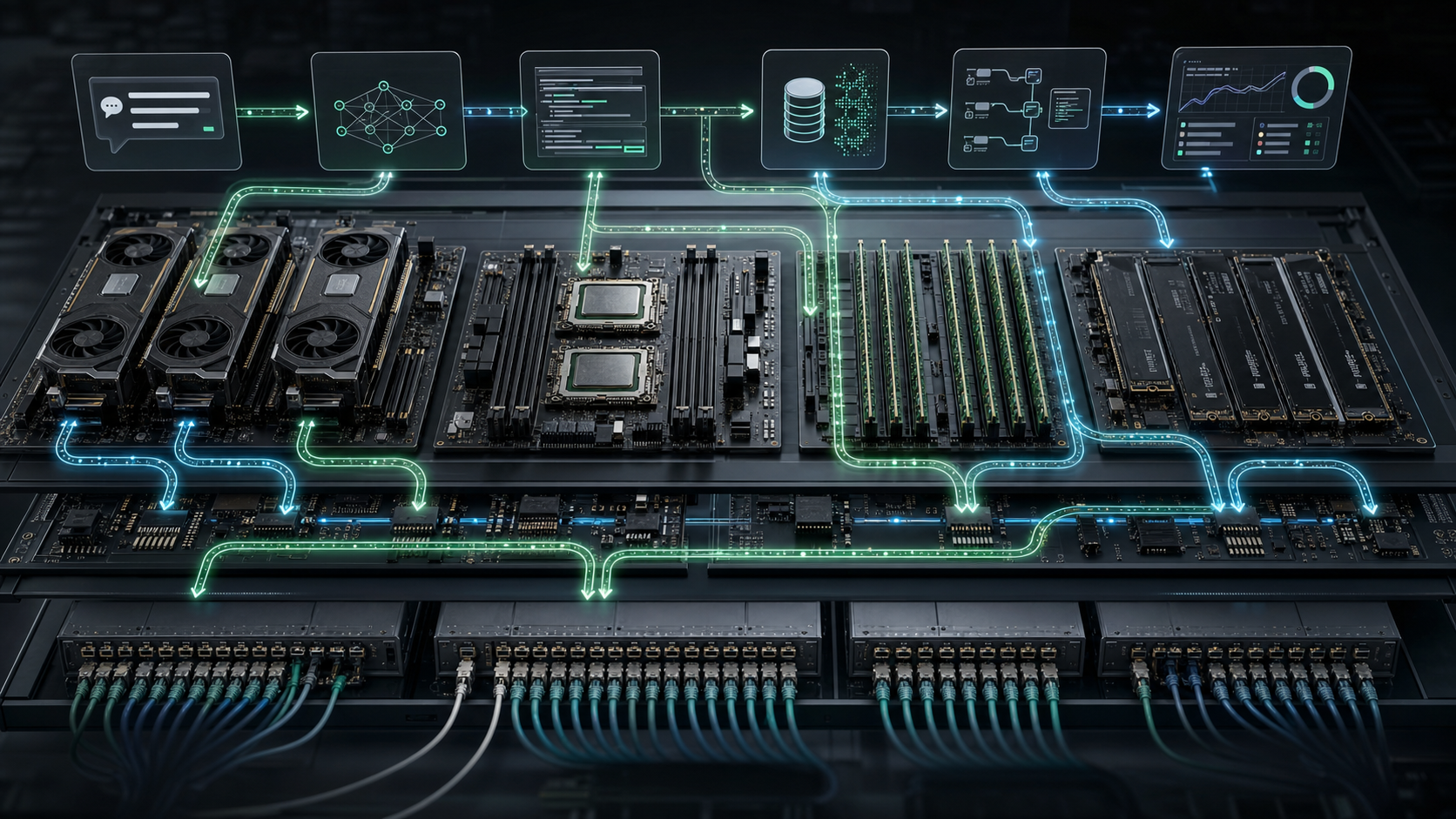
An agent can turn one user message into dozens of model calls. Planning, retrieval, tool selection, retries, validation and summarisation all consume tokens, while browser or code tools hold sessions open long after the first response. Hardware sized from a single chat benchmark will usually miss that behaviour.
Start with the trace. Count model calls per task, tokens per call, concurrent tasks, tool duration, cache hits and failure retries. Those figures tell you whether the system needs more GPU memory, more replicas, faster storage or simply tighter agent limits.
Executive Summary
- Who it is for: AI teams planning tool-using agents, coding agents, research assistants and private automation.
- Headline platform: balanced GPU, CPU, storage and network infrastructure.
- Why it matters: an under-specified system wastes engineering time, while an over-specified one ties up capital in GPUs that may sit idle.
- When it is overkill: smaller pilots, low-concurrency internal tools and proof-of-concept deployments may be better served by a workstation, hosted GPU instance or smaller PCIe server.
Start by comparing HGX server platforms, PCIe GPU servers, tower GPU workstations and the GPU cluster configurator before committing to a fixed design.
Key Planning Table
| Area | What to define before buying | | --- | --- | | Model variant | Exact Agentic AI Systems release, parameter size and serving framework | | Precision | Full precision, mixed precision or quantised operation | | GPU memory | Model weights, KV cache, context length and batch size | | CPU platform | Enough cores and PCIe lanes for GPUs, NICs and local storage | | System memory | Dataset staging, retrieval, host-side processing and service overhead | | Storage | Model repository, cache, logs, datasets, checkpoints and outputs | | Networking | User traffic, storage fabric, cluster fabric and management separation | | Deployment | On-premise, hosted private infrastructure or hybrid operation |
Platform Highlights
- Agentic AI Systems sizing should start with the actual software path, because inference engines, quantisation and batching policies can change the memory profile.
- GPU memory is usually the first constraint for large LLMs, but CPU memory, storage and network design decide whether the platform feels reliable in production.
- For multi-GPU deployments, NVLink vs PCIe guide explains why PCIe-only scaling is different from HGX systems with NVLink and NVSwitch.
- Retrieval, logging, safety checks and orchestration can create hidden load outside the GPU.
- A private system should include management networking and monitoring from day one, not after the first service incident.
Our Technical View
In the GPUMachines portfolio, Agentic AI Systems sits in the space where buyers need to be honest about intended use. For development and evaluation, a capable tower GPU workstations configuration may be enough. For production inference with many users, a PCIe GPU servers or HGX server platforms design becomes more appropriate. For distributed training or very large model variants, cluster planning quickly matters.
The strongest reason to invest in dedicated hardware for Agentic AI Systems is control: predictable capacity, data locality, security boundaries and the ability to tune the platform for a known workload. The risk is buying for a headline model name without modelling concurrency, context length, retrieval, storage and operational support. the bottleneck may be memory, retrieval, network latency or scheduler design rather than one GPU alone.
Best-Fit Workloads
Agentic AI Systems can make sense for private LLM inference, RAG-backed assistants, domain adaptation, evaluation pipelines and research workloads. It can also be part of agentic AI systems where multiple calls, tool use and retrieval steps run in sequence.
For training or heavy fine-tuning, GPU interconnect and storage design become more important. For inference, the practical questions are response latency, queue depth, uptime, cost per served request and how quickly models can be updated without disrupting users.
Who Should Consider It
Consider dedicated Agentic AI Systems infrastructure if your organisation has sensitive data, predictable demand, recurring cloud spend, compliance concerns or a need to keep AI workloads close to internal systems. Universities, research groups, AI startups and enterprises can all justify private hardware when utilisation is known and the operating model is ready.
Who Should Not Overbuild
Do not buy a large HGX cluster for Agentic AI Systems if the workload is a small pilot, a few internal users or an uncertain experiment. A hosted GPU option, workstation, smaller PCIe server or managed private deployment may be more sensible until usage patterns are measurable. Do not assume a single GPU choice solves storage, retrieval, security or operations.
Architecture Notes
For PCIe systems, pay attention to PCIe lane allocation, GPU spacing, power delivery, airflow and NIC placement. A server that supports multiple GPUs on paper may still be a poor fit if cooling or expansion compromises the intended configuration.
For HGX systems, NVLink and NVSwitch matter because the GPUs can communicate through a purpose-built high-bandwidth fabric. That is valuable for large models, training and tightly coupled multi-GPU inference, but it should be justified by the workload. Storage should be designed with model loading, dataset access, checkpoints and logs in mind; see best storage for AI training for a deeper storage planning view.
Configuration Guidance
Choose CPUs for platform balance rather than peak core count alone. Leave enough memory channels populated for bandwidth, and size RAM for the serving stack, retrieval layer and host-side processing. Use fast local NVMe for model cache and operational working sets, then connect to shared storage where datasets, checkpoints or documents must be shared across systems.
Networking should separate management, user traffic, storage traffic and cluster traffic where the deployment is large enough. For multi-node designs, compare InfiniBand cluster solutions and Ethernet cluster solutions; the best answer depends on scale, latency sensitivity and operational familiarity.
Recommended Configuration Paths
- Best for evaluation: high-memory workstation or single PCIe GPU server with enough NVMe for model cache and test data.
- Best for private inference: PCIe GPU server or hosted private GPU node with clear monitoring, queueing and rollback plans.
- Best for fine-tuning: multi-GPU PCIe or HGX platform with balanced CPU memory, fast storage and a high-speed fabric.
- Best for scale-out service: HGX nodes or a cluster planned through the GPU cluster configurator, with storage and networking sized alongside GPUs.
Alternatives and Related Systems
If Agentic AI Systems is only one model in a broader roadmap, review training vs inference infrastructure, best GPU for DeepSeek R1, best GPU for Llama 70B, GPU Cloud and Buy & Host. Smaller teams may start with a workstation, while regulated teams may prefer private hosted infrastructure to avoid building data centre operations too early.
Buying Through GPUMachines
GPUMachines can help review the GPU choice, CPU platform, RAM population, NVMe layout, networking, rack power, cooling and deployment route for Agentic AI Systems. The aim is not to force every buyer into the biggest server; it is to make the selected system match the model, users and operational constraints.
The Unit of Work Is a Task, Not a Prompt
Chat serving often measures requests per second and time to first token. Agentic systems still need those metrics, but they also need task completion time and model calls per completed task. A request that produces a quick planning response can remain active for ten minutes while tools run, results return and the model checks its own work.
Build a test set from real tasks. Include short successful paths, long retrieval jobs, tool failures, large outputs and concurrent users. Record p50 and p95 completion time, GPU memory, KV-cache pressure, CPU use, storage traffic and external API waits. Without that trace, adding GPUs is guesswork.
GPU Memory: Weights Are Only the First Claim
NVIDIA's current NIM guidance breaks LLM memory into model weights plus KV cache, activations, communication buffers and CUDA graphs. Quantisation can reduce weight memory, but long contexts and concurrency still consume cache. Tool output makes this worse because agents often feed large documents, logs or browser results back into later calls.
Leave operating headroom. A model that starts with almost every byte committed may fail when context length rises or another service touches the GPU. On unified-memory systems such as DGX Spark and GH200, CPU and GPU share physical memory, so host processes and model serving must be planned together.
CPU and RAM Aren't Support Characters
Retrieval, tokenisation, document parsing, sandboxed code, databases and browser automation can be CPU-heavy. Several agents may wait on tools while keeping Python processes, containers and session state alive. Four fast GPUs behind a weak host can deliver poor task throughput because the non-model stages queue.
Size RAM for the model runtime, retrieval index, containers, filesystem cache and concurrent tool sessions. Populate memory channels properly on rack servers. For SFF systems, understand that advertised unified memory isn't a pool reserved solely for model weights.
Storage Layout
Separate boot and application data from model cache, active indexes and logs where the system allows it. Model downloads create bursts; vector indexes perform smaller reads; agent traces and browser artefacts can create many files; fine-tuning checkpoints are another workload entirely. One consumer SSD may run all of them in a test machine, but production storage needs endurance, backup and a cleanup policy.
Shared teams also need an answer for model provenance. Record source, licence, checksum, quantisation and approval status. A directory called models-final-v2 is not a registry.
Network Requirements
Most single-node agent services don't need InfiniBand. They do need predictable application traffic, fast access to retrieval storage and a management path that doesn't disappear when the serving network is busy. Place external tool calls behind egress controls and log which agent can reach which service.
Very large models may span several GPUs or nodes. NVIDIA NIM uses tensor and pipeline parallelism for that class of deployment and warns that cross-node tensor parallelism needs high-bandwidth, low-latency RDMA networking. Buy that fabric because the model topology requires it, not because “AI cluster†appears in the project name.
Four Hardware Profiles
Personal or SFF agent bench: one capable local GPU or unified-memory SFF system, fast NVMe and enough host memory for tools. Good for one developer, private experimentation and light automation. It isn't a shared production service by default.
Team inference server: one to four PCIe GPUs, redundant storage for the service layer, high-speed Ethernet and a scheduler or container platform. This fits independent replicas, mixed models and departmental agents.
Large-model node: an HGX-class system where NVLink/NVSwitch supports tensor-parallel inference or fine-tuning within the node. Storage and network design must keep model loading and retrieval from wasting the accelerator investment.
Private agent platform: several serving nodes plus CPU workers for tools, shared storage, observability and strong tenant controls. The platform may use different GPU types for planning, embedding, reranking and heavy generation.
Security Changes Capacity Planning
Sandboxing isn't free. Browser workers, code containers, malware scanning, trace retention and network proxies consume CPU, RAM and storage. That cost belongs in the bill of materials. So does redundancy if the agent touches a production workflow.
NIST's AI RMF gives governance, mapping, measurement and management ongoing roles through the AI lifecycle. For infrastructure teams, that means retaining enough evidence to reconstruct what ran, which model answered, which tools executed and who approved access. Logs need storage, but indiscriminate prompt retention can create a different risk; set a policy before production.
What Not to Buy
Don't start with eight tightly connected GPUs when the workload is a few independent 8B or 14B model agents. A workstation, SFF system or modest PCIe server will expose the software bottlenecks faster and at lower cost.
Avoid a single giant model when routing smaller tasks to smaller models meets quality requirements. And don't buy cluster networking until measurements show model parallelism or storage traffic needs it.
Configuration Checklist
- Named models, precisions and maximum context lengths.
- Measured calls and tokens per completed task.
- Peak concurrent tasks, not only concurrent users.
- Tool runtimes, timeout policy and retry limits.
- Retrieval index size, model-cache size and trace retention.
- Required isolation between users, tools and external services.
- Availability target and recovery procedure.
- Six-month growth case with a clear scale-out route.
FAQ
How much VRAM does an agentic AI system need?
Add model weights, KV cache, runtime overhead and concurrency. Use the model card and serving engine measurements; the same model can need very different memory at 4K and 128K context.
Is one large GPU better than several smaller GPUs?
One large memory space is simpler when the model fits and latency matters. Several GPUs suit independent replicas or models, but splitting one model adds communication and software constraints.
Do tool-using agents need more CPU?
Usually. Parsing, retrieval, browser work, containers and databases run outside the main model kernel. Measure those stages before choosing the host processor.
Should we use HGX?
Use HGX when a large model or training job benefits from high-speed GPU-to-GPU communication. Independent agent workers often fit PCIe servers better.
Can GPUMachines host a private agent platform?
GPUMachines can review dedicated hosted hardware, network access, storage and expansion through Buy & Host. Application security and governance still need named owners.
Deployment shape matters as much as server size. A GPUMachines Private Agent Fleet can suit teams that want isolated agent infrastructure with model serving, retrieval, tools and operational controls reviewed together.
Verdict
Agentic AI hardware should be sized from completed tasks and traces. GPU memory matters, but a platform also fails when tools queue on CPU, retrieval stalls on storage or retries multiply unseen. Start with measured task paths, choose the smallest system that meets them, and preserve a clean route to more replicas or a larger model node.
Build an agentic AI infrastructure shortlist with GPUMachines.