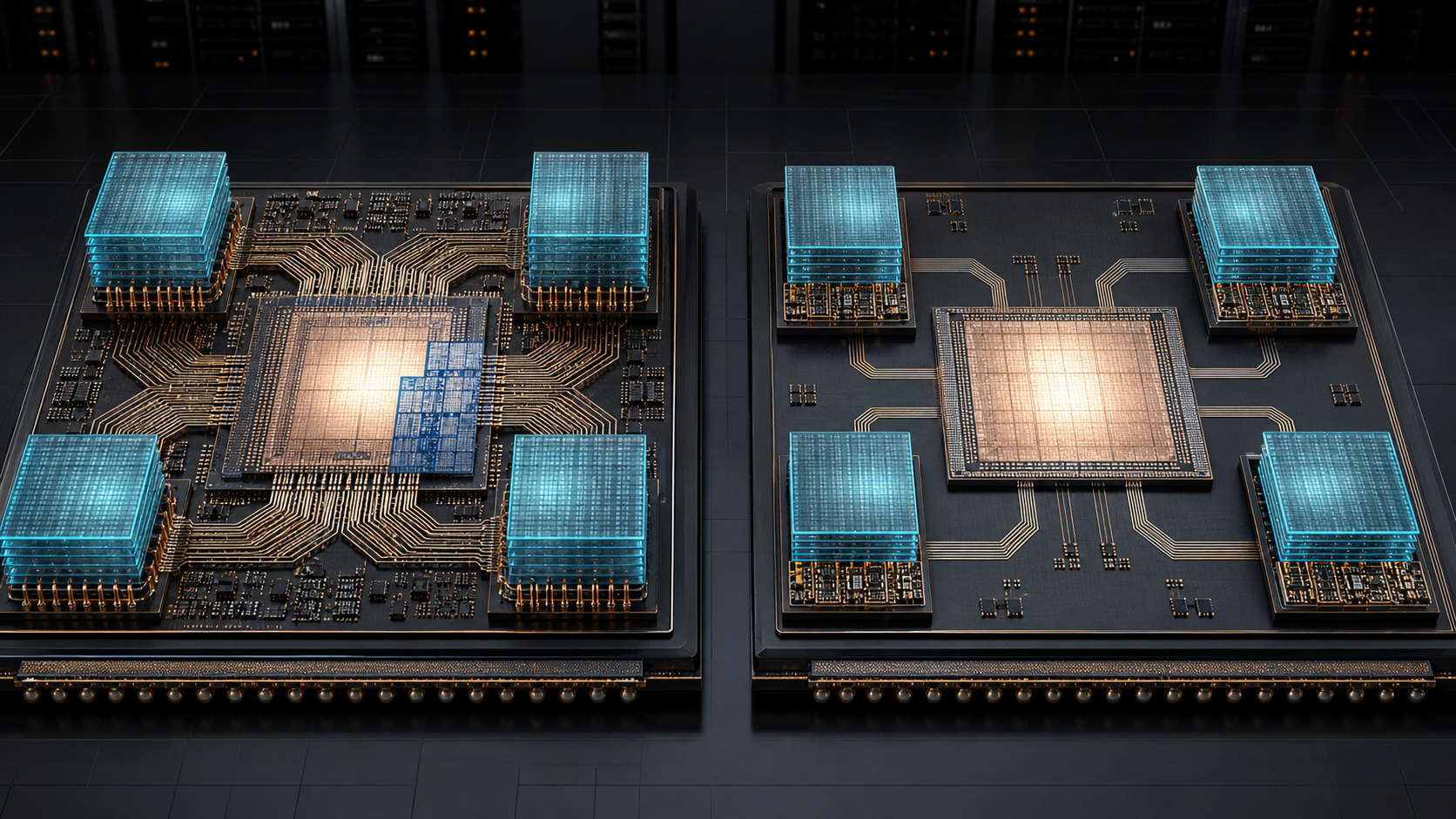
A claimed 30% memory-bandwidth gain is enough to make a procurement team wonder whether today's accelerator quote is already ageing. NVIDIA's new NVHBM announcement adds two more tempting figures: 15% lower HBM power use and up to 25% more XPU compute-die area than a design using standard HBM4E.
Those numbers deserve attention, but they do not support delaying a funded B300, GB300 or other current GPU project. NVHBM is a future custom memory implementation for companies designing their own AI accelerators around NVLink Fusion. NVIDIA has not announced an enterprise server containing it, a price, a delivery date or a field upgrade for existing GPUs.
The practical answer is simple: buy current infrastructure against the workload and deployment date you can verify. Track NVHBM if you are planning a custom XPU programme, a hyperscale service or a later-generation rack. Do not treat it as an orderable alternative to an HGX system.
GPUMachines sells and configures GPU infrastructure, so our commercial interest is clear. We have not tested NVHBM and cannot independently verify NVIDIA's projected gains. This article separates NVIDIA's published claims from what a buyer can reasonably conclude today.
The buying answer
Most enterprise and research buyers should not wait for NVHBM. Current B300 and GB300 platforms use HBM3e and can be bought now. NVIDIA lists 288 GB of HBM3e per Blackwell Ultra GPU in the GB300 NVL72, while the full rack combines 72 GPUs, 36 Grace CPUs and a 130 TB/s NVLink domain. That is a shipping system with published specifications, deployment requirements and a support route.
NVHBM belongs to a different purchasing horizon. Its first named collaborator is Amazon's Annapurna Labs, which plans to pair the technology with NVLink Fusion in future Trainium infrastructure. That tells us where the first deployment is likely to appear: inside a hyperscaler's own accelerator programme, not on a reseller's server configurator.
Pause a current purchase only if all four conditions apply:
- the project has no fixed deployment deadline;
- the workload will run through a provider rather than on customer-owned hardware;
- the team is prepared to qualify a future custom accelerator and its software stack;
- a measured memory bottleneck is large enough to outweigh schedule and platform risk.
Everyone else should treat NVHBM as road-map information.
What NVIDIA announced
NVHBM changes where part of the memory interface lives. A conventional accelerator design places the memory controller on the main XPU die. NVIDIA says its design moves that controller into the base die of the three-dimensional HBM stack and uses a custom physical interface. The narrower connection reduces the area required for memory I/O and interposer routing, leaving more of the main die available for compute, cache or workload-specific logic.
NVIDIA published the following comparisons with standard HBM4E:
| NVIDIA-reported measure | Claimed change | What a buyer can conclude | |---|---:|---| | Memory bandwidth per stack | Up to 30% higher | Promising for workloads that are genuinely limited by HBM traffic | | HBM power use | Up to 15% lower | Potential package and rack headroom, subject to full-system measurement | | XPU compute-die area | Up to 25% more | Custom-chip designers may allocate more silicon to compute or cache | | End-to-end XPU performance | Up to 30% higher | A vendor projection that still needs workload, system and independent test detail |
The word up to matters throughout. NVIDIA has not published a customer benchmark matrix, model list, batch policy, memory capacity per stack, package configuration or full-rack wall-power comparison. None of the percentages should be copied into a business case as guaranteed system improvement.
NVIDIA also says it intends to validate a common NVHBM implementation with several memory suppliers. That could reduce the engineering and qualification work faced by a custom-accelerator team. The announcement does not name those suppliers or confirm commercial volume.
NVHBM and NVLink Fusion solve different problems
The two names sit together in NVIDIA's announcement, but they operate at different levels.
NVHBM concerns memory local to an accelerator package. It affects how the XPU reaches stacked memory, how much die and package area the interface consumes, and how much power that memory subsystem uses.
NVLink Fusion connects a custom XPU or CPU to NVIDIA's rack-scale architecture. Partners can use NVLink chiplets, NVLink-C2C, NVLink switches, NVIDIA networking and MGX rack designs around their own silicon. Amazon previously selected NVLink Fusion for Trainium4; the new announcement adds NVHBM to that collaboration.
One does not replace the other. Faster local memory cannot fix a congested scale-out fabric, slow storage or poor expert placement. Equally, a fast rack interconnect cannot keep arithmetic units busy when local HBM cannot feed them. Buyers should resist turning either technology into a single-number explanation for application performance.
Our guide to NVLink and NVSwitch covers the distinction between accelerator links and the switching layer. Teams comparing proprietary cloud silicon with equipment they can move between sites should also read AWS Trainium or portable GPU infrastructure.
Which workloads might benefit?
Large-model inference is the obvious candidate. Serving engines repeatedly read weights and KV-cache data, while long contexts and concurrent users place sustained pressure on memory capacity and bandwidth. If compute units spend time waiting for those reads, higher local bandwidth can raise utilisation.
Mixture-of-experts models add another complication. Expert parallelism moves activations between accelerators, so performance depends on local HBM and the scale-up fabric. NVHBM may reduce one wait state while NVLink Fusion addresses communication across the rack. The final result will depend on routing balance, model placement, precision, serving software and batch behaviour.
Training can also become memory-bound during selected phases, but a blanket uplift is unlikely. Some kernels will remain limited by arithmetic, collective communication, host preparation, checkpoint writes or storage. A vendor's package-level improvement cannot tell a research team how much faster its complete training run will finish.
The same caution applies to KV-cache-heavy reasoning services. More bandwidth may improve tokens per second, yet capacity, latency, scheduler policy and quality targets still decide how many users the system can serve. Our article on B300 INT8 software support makes the related point: a promising hardware capability produces little value until the chosen model and software path can use it.
Why current B300 and GB300 buyers should keep moving
NVHBM is not an announced retrofit. A B300 baseboard, DGX B300 system or GB300 NVL72 rack cannot receive it as a later memory module swap. HBM sits inside an advanced accelerator package; changing the controller and physical interface means qualifying a different chip and package design.
Current platforms also solve procurement problems that the announcement leaves open. A buyer can examine GPU memory capacity, server form factor, host CPUs, network ports, local storage, operating power and support. The team can confirm whether its facility can accept the rack, whether the software supports the intended precision, and who repairs the system.
That operational certainty has value. Waiting for an unpriced technology can cost more than a later efficiency gain if researchers remain queued, a service launch slips or an existing cluster stays overloaded. The right comparison uses the cost of delay alongside equipment cost.
Browse current HGX server platforms only after establishing the workload, power and cooling envelope. A smaller PCIe server or hosted node may still be the better purchase. NVHBM does not make overbuying sensible.
Who should track NVHBM closely?
Hyperscalers and custom-XPU developers
These organisations choose memory interfaces years before a service reaches users. Reduced qualification effort, supplier choice and a common rack architecture can affect programme risk as much as a bandwidth figure. They should ask NVIDIA for interface specifications, packaging assumptions, supplier qualification status and production milestones.
AI cloud operators planning mixed silicon
NVLink Fusion points towards racks where custom XPUs and NVIDIA GPUs share parts of the same scale-up and operational architecture. That could simplify capacity planning, but it may also deepen dependence on NVIDIA interconnect IP and rack components. Portability should form part of the design review.
Enterprises buying a managed AI service
An enterprise may consume NVHBM without ever seeing the hardware. If a future Trainium service uses it, the buyer should compare service price, latency, availability and model support. The memory brand itself is secondary.
Research teams purchasing equipment
Watch the road map, but buy against funded work. Researchers usually need software access, model flexibility and the ability to reassign hardware between training, fine-tuning, simulation and inference. A future hyperscaler accelerator may complement that estate through cloud bursting; it does not automatically replace it.
What NVIDIA's 30% end-to-end claim does not show
NVIDIA says the combined bandwidth, area and power changes can produce a 30% end-to-end XPU performance increase. No independent system result accompanies that statement.
Before using the figure in a procurement model, ask for:
- the exact XPU, NVHBM stack count, capacity and memory speed;
- workload names, model sizes, precision, sequence lengths and concurrency;
- the comparison XPU and its HBM4E package configuration;
- power measured at the package, tray and rack rather than a calculated memory component;
- software versions, availability assumptions, error handling and sustained-run data.
Die-area savings need similar care. More available silicon does not guarantee that every partner will fill it with compute, nor that added compute will remain fed or cooled. A designer may spend the area on cache, interfaces, redundancy or yield-friendly layout. Those can be good choices, but they produce different application results.
A procurement test that works now
Do not ask whether NVHBM is better than HBM3e in isolation. Ask whether an available system meets the service requirement within the power, budget and deployment window.
Start with a representative model and record context length, input/output ratio, precision, concurrent users and latency target. Measure successful work at the wall, including host power and the relevant share of networking and cooling. Then document the cost of idle capacity, software, support and data movement.
For a future NVHBM-backed service, repeat the same test when access and pricing exist. If the service completes the workload at lower total cost without creating an unacceptable data, availability or portability dependency, use it. Until then, comparisons are architectural rather than commercial.
Buyers planning beyond one node can use the GPU Cluster Configurator to establish server, fabric and rack assumptions before requesting a detailed quotation. GPUMachines can also compare an on-premise design with hosted ownership where the customer needs a defined system but lacks suitable power or cooling.
When waiting could make sense
There is a narrow case for waiting. A company may be designing its own accelerator, planning a 2028-scale service or negotiating a long-term AWS capacity agreement tied to Trainium. Its deployment window already matches NVHBM's development horizon, and changing the memory architecture now may prevent an expensive redesign later.
That is a silicon-programme decision, not a general server-buying recommendation.
An enterprise with an uncertain workload may also delay hardware, but NVHBM is not the reason. The real issue is unproven utilisation. Run the pilot on rented capacity, measure demand, then choose a smaller server, a hosted private system or a cluster once the queue and data path are understood.
Frequently asked questions
What is NVIDIA NVHBM?
NVHBM is NVIDIA's custom high-bandwidth-memory implementation for NVLink Fusion partners. It moves the memory controller into the HBM base die and uses a custom physical interface intended to improve bandwidth, power use and package-area efficiency for future custom XPUs.
Is NVHBM the same as HBM4E?
No. NVIDIA compares NVHBM with standard HBM4E, but describes a custom base die, controller and PHY rather than a normal HBM4E implementation. Buyers should not assume compatibility or replaceability.
Does NVIDIA B300 or GB300 use NVHBM?
NVIDIA's current B300 and GB300 specifications list HBM3e. The NVHBM announcement does not identify either platform as using the new design.
Can NVHBM be installed in an existing GPU server?
No announced upgrade path exists. HBM forms part of the accelerator package, so NVHBM would require compatible silicon, packaging and system qualification rather than a field memory swap.
When will NVHBM systems be available?
NVIDIA announced Amazon's Annapurna Labs as the first collaborator on 26 August 2026. Neither company provided a customer availability date, system price or named instance type.
Will NVHBM make inference 30% faster?
NVIDIA reports up to 30% higher bandwidth and a 30% end-to-end XPU performance projection from the combined architecture. Actual inference gain will depend on whether the workload is memory-bound and on the XPU, model, software, interconnect and serving configuration. Independent results are not yet available.
Should I delay a B300 or GB300 purchase?
Not solely because of NVHBM. Delay only when the current workload, utilisation or facility case is unresolved. If the project is funded and the available platform passes a representative test, compare the cost of waiting with any unverified future efficiency gain.
Sources and further reading
- NVIDIA Technical Blog: NVLink Fusion brings NVHBM to next-generation AI infrastructure
- NVIDIA Blog: NVLink Fusion expands with NVHBM
- AWS and NVIDIA expanded infrastructure collaboration
- NVIDIA GB300 NVL72 specifications
- NVIDIA GB300 NVL72 enterprise reference architecture
Verdict
NVHBM is an important signal about NVIDIA's direction. The company wants its memory controller, scale-up fabric and rack architecture to support custom accelerators alongside its own GPUs. Amazon's participation gives that plan a credible first route into production infrastructure.
It still is not a product an enterprise can quote. NVIDIA's percentage gains remain vendor claims without an independent rack-level benchmark, price or availability date. Current buyers should keep B300 and GB300 decisions tied to measured workloads, software support, facility readiness and delivery requirements.
Track NVHBM. Do not wait for it by default.
GPUMachines can turn a model, concurrency target, data location and deployment boundary into a current on-premise or hosted GPU specification. Start with the GPU Cluster Configurator, then compare any future NVHBM-backed service against the same workload and service target.