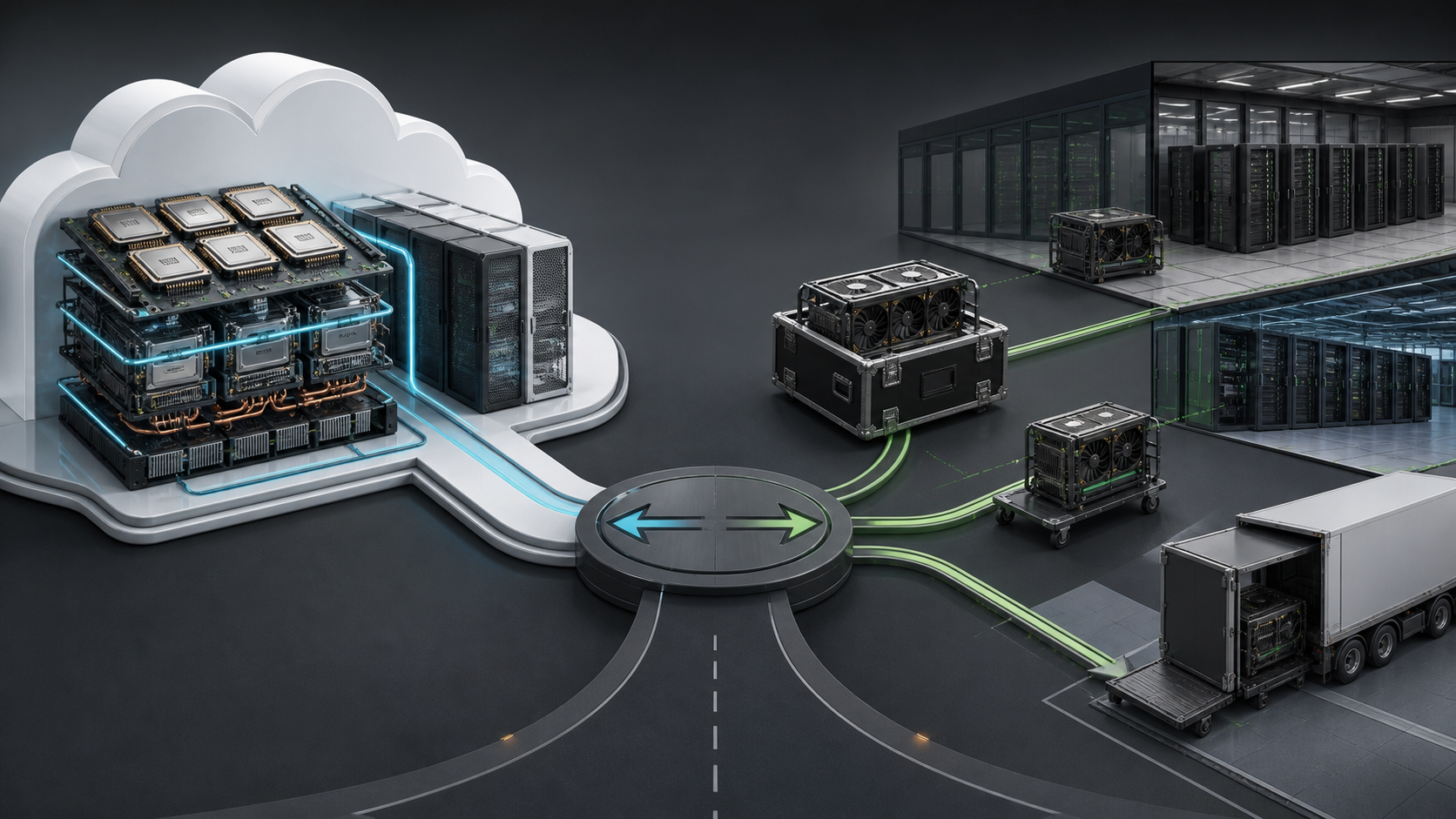
The uncomfortable part of an accelerator decision is not choosing the fastest chip. It is deciding which dependencies the business is prepared to own for the next three to five years.
AWS Trainium changes that discussion because it is not simply another device that can be installed in an arbitrary server. It is an AWS accelerator consumed through specific EC2 instance families and programmed through the AWS Neuron software stack. That tight integration can be useful. It can also make a workload harder to move than a conventional GPU deployment built around software and hardware available across several environments.
For an organisation already committed to AWS, the right answer may be Trainium. For a research group, regulated operator or infrastructure provider that needs to run the same workload on premises, in colocation and in more than one cloud, portability may be worth more than a promising cloud-specific price-performance claim.
This guide explains how to choose between those positions. It does not rank accelerators from a marketing slide. It sets out the questions a buyer should answer before approving a platform.
The decision in one page
Choose AWS Trainium for a workload when all of the following are broadly true:
- AWS is the intended production home rather than only the first test environment.
- The model, framework, operators and precision modes have been validated on the required Trainium instance and Neuron release.
- The team accepts AWS-specific tooling in exchange for an integrated managed environment.
- Capacity can be obtained in the required regions and availability zones.
- The commercial model still works after data transfer, storage, support and idle time are included.
Prefer portable GPU infrastructure when one or more of these conditions applies:
- The workload must move between on-premise, hosted and cloud capacity.
- Researchers frequently change frameworks, kernels, model architectures or serving engines.
- The organisation needs to own, finance, resell or redeploy the physical equipment.
- A second cloud or a disaster-recovery site must run the same build without a major port.
- Existing operations are centred on CUDA or ROCm and the cost of a second accelerator toolchain is material.
Neither choice removes dependency. A GPU stack still depends on drivers, libraries, container images, firmware and a vendor ecosystem. The distinction is the location and breadth of that dependency. Trainium binds the workload more closely to an AWS service and Neuron. A portable GPU design can run into software constraints of its own, but the physical platform and much of the application layer can be deployed in more places.
GPUMachines can help teams compare a cloud-specific accelerator plan with an owned or hosted GPU cluster design before either path becomes an expensive assumption.
What Trainium actually changes
Trainium is presented by AWS as a purpose-built accelerator for deep-learning training, with Trn instance families exposed through Amazon EC2. Developers use the Neuron SDK, which includes a compiler, runtime, profiling tools and framework integrations. That means the purchasing unit is not a card. It is an AWS instance, its surrounding services and the engineering work needed to keep a model compatible with Neuron.
This difference matters in procurement. A conventional GPU tender can specify server form factor, accelerator quantity, host CPUs, memory, local storage, network interfaces, support terms and a deployment location. A Trainium decision is closer to selecting a managed execution environment. Region, instance quota, supported software, reserved-use commitments and AWS service integration become part of the architecture.
The benefit is that AWS owns much of the physical stack. Buyers do not need to design rack power, cooling, spare strategy or hardware maintenance for those instances. Teams can provision capacity without waiting for a data-centre build. Where Neuron supports the workload well, that can reduce the amount of infrastructure work between a model and a training run.
The trade-off appears when a requirement falls outside the supported path. A custom operator, an unusual model component or a serving framework may behave differently from its GPU equivalent. The proper test is therefore not whether a framework name appears on a compatibility page. It is whether the exact model graph, compiler settings, checkpoint format, distributed strategy and observability stack work at the required scale.
Portability has several meanings
“Portable” is often used too loosely. A container image is not portable merely because it can be copied. A serious assessment should split portability into four parts.
Source portability
Can the same application code run on another accelerator after modest configuration changes, or does it contain device-specific operators and compiler workarounds? Framework abstractions help, but low-level optimisation can pull the code back towards one platform.
Model portability
Can checkpoints, tokenisers and model artefacts move without conversion or retraining? A conversion process may be acceptable for a stable production model and painful for a research team changing models every week.
Operational portability
Can monitoring, job scheduling, secrets, storage mounts, network policy and failure recovery be reproduced elsewhere? These components often create more friction than the model itself. A training job that depends on a particular object-store event flow or managed orchestration service is not operationally neutral.
Commercial portability
Can the organisation shift spend when capacity, contract terms or strategy changes? Owned GPU equipment can be depreciated, redeployed or hosted. Cloud capacity can scale down without leaving equipment idle, but committed-use discounts may introduce their own constraints. The comparison must use the contract that will actually be signed.
Portable GPU infrastructure wins only when the organisation preserves these options in practice. A badly documented CUDA environment tied to one cloud image can be less movable than a disciplined Neuron deployment with clean interfaces. Architecture and operating habits decide the outcome.
Where Trainium can be the better answer
Trainium deserves a proper proof of concept for teams with sustained AWS workloads and a reasonably stable model estate. It may be especially attractive when cloud access is already approved, datasets live in AWS and the surrounding pipeline uses AWS identity, storage and orchestration services.
Training jobs with known shapes are easier to qualify than open-ended research. If the model, sequence lengths, batch behaviour and precision policy are understood, the team can test compilation time, achieved throughput, scaling efficiency, checkpoint overhead and recovery. The result can be compared against an equivalent GPU instance using the same data and completion criteria.
AWS also removes the need to buy for a peak that occurs only occasionally. A business that trains quarterly may prefer temporary capacity even when an owned cluster has a lower hourly cost at high utilisation. The important measure is cost per completed, accepted run, not the advertised price of an accelerator hour.
There is a further strategic point. Reuters and TechCrunch reporting in June 2026 said Amazon was exploring ways to sell Trainium chips for deployment in customers’ data centres. That reporting is relevant because it suggests AWS is considering a broader delivery model. It is not a product announcement, a price list or a compatibility guarantee. Buyers should not design a current tender around unconfirmed on-premise availability.
Where portable GPUs retain an advantage
Research teams tend to expose platform limits quickly. They change model families, install new attention kernels, test fresh distributed libraries and use repositories whose accelerator support is uneven. A broad GPU software ecosystem can reduce the delay between a paper or repository appearing and a team reproducing it.
The case is also strong when data cannot leave a controlled facility. On-premise PCIe GPU servers and HGX systems allow the buyer to define the security boundary, network path and storage location. Hosting the same hardware through a specialist provider can preserve ownership while avoiding a new plant build.
Mixed estates are another reason to favour portability. An organisation may need a workstation for development, a four-GPU server for validation and a multi-node cluster for production. Consistent drivers, containers and orchestration across those tiers can be more valuable than the lowest cost for one isolated run.
Finally, physical ownership provides options that a service instance does not. Equipment can be reassigned from training to inference, moved to another rack, sold or used as loan capacity. Those options have value only if the hardware remains useful and the organisation can operate it, but they belong in the financial model.
A fair proof of concept
A useful trial compares completed work, not isolated kernel speed. GPUMachines recommends a test plan that records the following:
- Time and engineering effort required to reach a correct first run.
- Compile time and the frequency of recompilation after model changes.
- Training throughput at the intended global batch size.
- Scaling efficiency across the actual number of nodes.
- Checkpoint write time, restart time and behaviour after an interrupted worker.
- Model-quality parity using agreed evaluation data.
- Profiler coverage and the time required to identify a slow operator.
- Capacity availability in the deployment region.
- Total cost per accepted run, including storage, transfer, support and engineering time.
The GPU comparison should use an appropriate implementation rather than a default configuration. The Trainium run should receive the same treatment. A team experienced with one platform can otherwise produce a test that measures familiarity instead of platform fit.
Keep a portability log during the trial. Record every device-specific code path, container difference, unsupported operator, data movement step and operational integration. That log gives procurement a better view of switching cost than a general statement about lock-in.
Training is not the only workload
The title of the platform points towards training, but infrastructure plans rarely stop there. A model may be trained on one service and served elsewhere. Fine-tuning, evaluation, synthetic-data generation and batch inference may each have different economic and software profiles.
Before selecting Trainium, decide whether the organisation is comfortable with a split accelerator estate. If inference will use GPUs, test checkpoint transfer and numerical behaviour between environments. If a model is trained repeatedly but served continuously, inference cost may dominate the lifetime budget. The training accelerator should not force a poor serving design.
Data processing also matters. CPU preprocessing, object-store reads, metadata operations and checkpoint traffic can prevent either accelerator from reaching useful utilisation. A Trainium-versus-GPU trial that ignores the storage path is incomplete. The same is true of networking when a job spans nodes.
Questions for finance and procurement
A three-year comparison should include more than hourly rates.
For AWS, model on-demand, reserved or committed use separately. Add attached storage, snapshots, inter-region transfer, internet egress where applicable, support and the expected percentage of provisioned time that produces useful work. Include the labour needed to maintain Neuron compatibility.
For owned hardware, include purchase or lease cost, rack space, power, cooling, network ports, support, spares and the people required to run it. Apply a realistic utilisation rate. Include residual value only when there is a credible redeployment or resale path.
Buy & Host sits between these models. The customer owns the hardware while a hosting provider supplies the facility and operations. It can make sense when ownership and platform control matter but the buyer does not want to build high-density power and cooling. It is not automatically cheaper than cloud or on-premise deployment; the answer depends on utilisation, contract structure and system life.
Procurement should also define an exit test. How long would it take to run a representative model elsewhere? Which artefacts and data must move? What fees or engineering tasks would be triggered? A platform with a good entry price can still be costly if the exit route is unknown.
Who should choose which path?
An AWS-first product team with stable models, suitable Neuron support and variable training demand should qualify Trainium. The proof of concept should be strict, but there is no sound reason to reject the platform simply because it is not a conventional GPU.
A university lab, model research group or engineering organisation that experiments across many repositories will usually place more weight on software breadth and local control. Portable GPU infrastructure is often the safer default, particularly when the same environment must extend from deskside development to a cluster.
A regulated enterprise may choose either. Data residency does not automatically require owned hardware, and cloud use does not automatically satisfy governance. The decision turns on the approved security boundary, audit requirements, key ownership, incident response and the jurisdictions involved.
An infrastructure provider should be cautious about building a service around a platform that customers cannot request elsewhere. Demand, software support and supply terms need to be tested. Conversely, a provider serving AWS-native customers may find a specialised Trainium service useful if the commercial and support model allows it.
Risks buyers should not dismiss
Trainium risk is not limited to “lock-in”. It includes compiler behaviour, framework lag, a smaller pool of experienced engineers, regional capacity and dependency on one provider’s roadmap. None of those points proves the platform is unsuitable. They need priced mitigation.
GPU risk includes supply concentration, high capital cost, power density, cooling, driver and firmware management, and the possibility of buying more hardware than the workload can use. Portability can become an expensive slogan if the team never tests another environment.
The worst outcome is a hybrid plan assembled without ownership. Running development on GPUs, training on Trainium and inference on another GPU generation can be sensible. It can also create three release processes and unclear responsibility for numerical differences. Define who owns cross-platform validation before approving the design.
Frequently asked questions
Is Trainium a drop-in replacement for an NVIDIA or AMD GPU?
No. It uses the AWS Neuron SDK and specific EC2 instance families. Framework support does not remove the need to compile and validate the exact workload. Treat migration as an engineering project, even when the initial code changes appear small.
Does portable GPU infrastructure eliminate vendor dependency?
No. CUDA and ROCm are vendor ecosystems, and server designs depend on approved firmware, drivers and components. Portability means preserving credible deployment alternatives, not becoming independent of every supplier.
Should a proof of concept compare tokens per second?
Only as one measure. Training buyers should compare time to an accepted checkpoint, scaling efficiency, restart behaviour, model quality and total cost. Inference buyers should include latency percentiles, concurrency and service-level compliance.
Can Trainium be purchased for an on-premise server?
AWS currently presents Trainium through its cloud services. Reporting has said Amazon is exploring direct chip sales, but buyers should wait for an official product, terms and support model before treating that as available.
When does owned hardware usually make financial sense?
High, predictable utilisation strengthens the case. Power, facility, staffing and financing still matter. A model based only on accelerator purchase price will overstate the advantage.
Can GPUMachines compare both options?
GPUMachines can scope the GPU side, including servers, networking, storage, power and hosted deployment, and can help a buyer build a like-for-like evaluation framework against a cloud accelerator option. AWS service pricing and Trainium compatibility should be confirmed directly with AWS.
Verdict
Trainium is a reasonable candidate for AWS-committed workloads that fit Neuron and can be measured with a representative trial. It is a weaker default for teams whose advantage comes from rapid model experimentation, deployment choice or physical asset ownership.
Portable GPUs do not win merely because they can be installed in more places. They win when the organisation maintains the software, data and operating discipline needed to use that freedom. The procurement decision should therefore compare switching cost, engineering effort and completed-work economics alongside accelerator performance.
For a practical comparison, ask GPUMachines to scope a portable GPU cluster or hosted system against the workload, utilisation target and exit requirements you intend to put into the tender.
Sources and Further Reading
- AWS Trainium - official platform overview.
- Getting started with AWS Trainium - official Neuron and instance guidance.
- AWS guidance on vendor lock-in - AWS Prescriptive Guidance.
- Amazon is reportedly exploring direct Trainium chip sales - TechCrunch reporting; not an AWS product announcement.