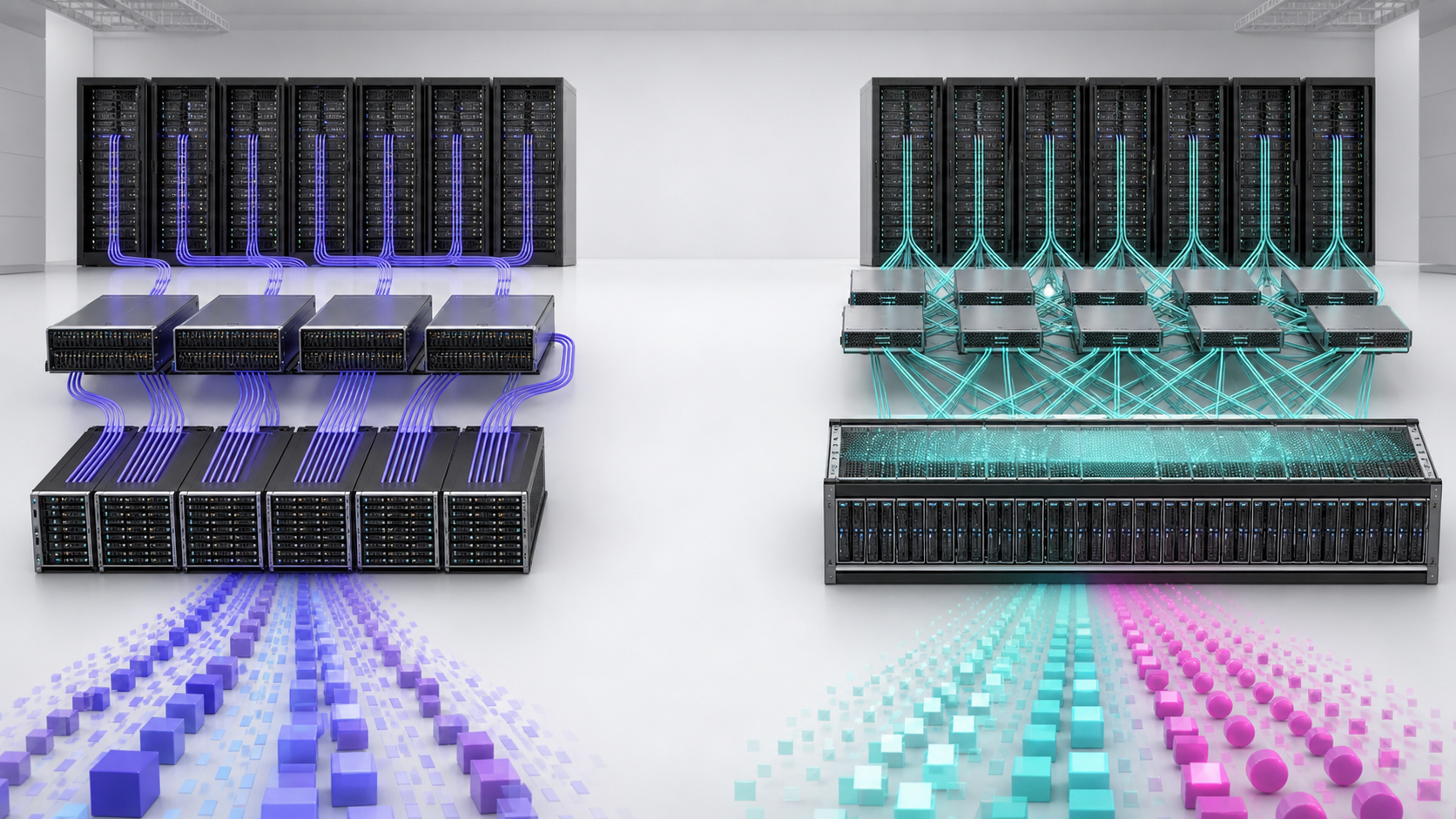
Lustre and VAST Data may appear on the same GPU-storage shortlist, but they usually arrive from opposite ends of the requirement. Lustre starts with parallel POSIX file access for compute clients. VAST starts with a commercial data platform that presents file and object access from a shared architecture and aims to consolidate more of the data estate. A buyer who needs fast scratch has a different problem from a buyer who wants one namespace for training, analytics and enterprise applications.
Executive summary
Choose Lustre when the main requirement is a dedicated parallel filesystem for AI training, HPC scratch, simulation or checkpointing; the team has strong Linux and fabric skills; and open software or hardware freedom matters. Its architecture is explicit, widely understood in HPC and can scale to very high aggregate bandwidth.
Choose VAST Data when the organisation wants a supported multiprotocol platform, all-flash capacity, independent scaling of service and media resources, and a broader route for file, S3 and data services. VAST's Disaggregated Shared Everything, or DASE, architecture differs sharply from Lustre's metadata and object-target model. Product and performance statements on VAST pages remain vendor claims until reproduced in the proposed environment.
Large estates may use both: Lustre for tightly managed scratch and checkpoints, VAST for the durable multiprotocol corpus. GPUMachines can test whether that separation earns its extra data movement as part of a scale-out storage design.
Quick comparison
| Decision area | Lustre | VAST Data | | --- | --- | --- | | Platform | Open source parallel filesystem | Commercial data platform based on VAST's DASE architecture | | Main access pattern | Native Lustre client and parallel POSIX namespace | NFS, SMB and S3 access, plus other platform services by release | | Storage model | Metadata and object-storage services backed by targets | Stateless service nodes access shared NVMe media over NVMe-oF | | Media | Flexible flash, HDD or array-backed targets | All-flash platform design using VAST-qualified media and configurations | | Operations | Site or support partner integrates the service | Vendor-supported product lifecycle and management | | Typical role | High-throughput project space, scratch and checkpoints | Shared enterprise and AI data platform, consolidation and active archive | | Source and hardware control | High | Governed by VAST product and support terms |
Two different ways to parallelise storage
Lustre splits responsibilities. Metadata Servers manage the namespace on Metadata Targets; Object Storage Servers manage file extents on Object Storage Targets. Clients retrieve layout information and move data directly to the relevant targets over LNet. Striping spreads large files and directories across resources.
VAST describes DASE as a disaggregated shared-everything design. Stateless compute or service nodes, called CNodes in VAST material, access shared persistent media held in DBoxes or related supported form factors over NVMe over Fabrics. Data and metadata state remain accessible across the service layer, so compute services and capacity can scale on different paths.
The contrast matters during sizing. Lustre architects count target bandwidth, server pairs, metadata capacity and client rails. VAST architects select enough front-end service, shared media and fabric for the required protocols and data reduction behaviour. Both depend on network arithmetic, but bottlenecks show up in different places.
Where Lustre is the cleaner answer
Dedicated scratch does not need to be a universal platform
An HPC or AI scratch tier has a short list of jobs: deliver files quickly, survive the failures defined by policy and let users discard data when the project ends. Lustre's narrow purpose can reduce architectural ambiguity. The namespace does not need to double as an enterprise database or general S3 platform.
That clarity helps when performance tuning. Stripe layouts, metadata targets and client behaviour map directly to file I/O. Operators can treat object storage, home directories and backup as separate services with separate service levels.
Open software and hardware freedom
Community Lustre lets a site select storage servers, media, networks and surrounding tools. It can put a small flash tier under metadata, use HDD for large sequential datasets and build a separate NVMe checkpoint tier. The site controls upgrades and can buy support without surrendering the upstream model.
VAST is software-defined, but buyers still procure and operate a supported VAST configuration and licence. That can simplify responsibility while limiting substitutions.
Native HPC operating practices
Lustre fits established Slurm, MPI, Linux and InfiniBand environments. Teams often have years of scripts, monitoring and user guidance around it. Replacing that operating knowledge carries cost even when a new platform benchmarks well.
Capacity tiers can use media other than flash
Lustre does not require an all-flash design. For large scientific datasets with friendly sequential access, HDD-backed OSTs can remain economical. Flash can serve the parts that need low latency. VAST positions low-cost flash and data reduction against capacity economics; the buyer should test its own data reduction and write pattern rather than assuming a vendor ratio.
Where VAST Data is the stronger candidate
Multiprotocol access
VAST's Element Store can present data through file and object interfaces, including NFS, SMB and S3 according to the product documentation. That helps enterprises whose data moves between user shares, training pipelines, object applications and analytics. A single data representation may reduce copies and gateway systems.
Lustre presents a parallel filesystem. Other protocols need gateways or separate platforms. That separation can be healthy for a dedicated compute tier, but awkward for a consolidated enterprise service.
Productised operations and support
VAST supplies the software, management environment, tested configurations and support relationship. The customer still owns client integration, network health, capacity policy and application behaviour, yet fewer layers sit outside the vendor boundary than in a community Lustre build.
Ask how upgrades affect protocols, client mounts and mixed hardware generations. Productisation reduces integration work; it does not remove maintenance windows and proof testing.
Independent service and capacity growth
DASE separates stateless processing resources from persistent shared media. In principle, an organisation can add service capacity for more protocol or compute demand without adding the same ratio of storage, or add capacity without duplicating a complete controller stack. Check the supported expansion increments and licence model in the actual proposal.
Lustre can also scale metadata and object services separately, although target ownership and balancing follow its own model. Neither platform makes growth free of data movement or rack constraints.
All-flash consolidation
VAST uses a persistent write-buffer and data-reduction design around flash media. It aims to make flash economical for large durable datasets, not only a small hot tier. This can remove the operational split between performance flash and capacity HDD for organisations whose data reduces well.
Research imagery, compressed checkpoints and encrypted data may reduce poorly. Request a sample-data assessment and use conservative capacity assumptions until measured.
NFS versus a native parallel client
VAST promotes high-performance NFS methods including multipathing, RDMA and GPUDirect-related configurations. NFS offers broad client familiarity and avoids installing a Lustre client module on every host. VAST's scale-out implementation is not equivalent to placing one conventional NFS head in front of an array.
Lustre's native client knows the filesystem layout and moves data directly to multiple targets. This model has long served large HPC client populations. It also ties compatibility to kernel and LNet support, which can complicate GPU-node image upgrades.
The better client path depends on operations as much as protocol. If an enterprise standardises on NFS and security tooling around it, VAST may reduce friction. If the cluster already manages Lustre clients and needs explicit striping controls, Lustre may be easier.
Training reads and checkpoint writes
Both platforms target high-throughput training data. Test the dataset at its real file-size distribution and concurrency. A few large shards create a different service from millions of JPEGs or genomic fragments.
For Lustre, examine stripe count, target balance, metadata load and LNet throughput. For VAST, examine NFS or native access mode, front-end service count, data placement, reduction overhead and network paths. Compare CPU use on the GPU host; data preparation may already need those cores.
Checkpoint testing should record job pause, write completion, durability point and restore time. VAST materials discuss high checkpoint throughput and GPUDirect, but those are vendor claims until the planned framework and client stack reproduce them. Lustre can spread large checkpoint files across OSTs, but a poor default layout can leave much of the system idle.
Metadata and small-file behaviour
Lustre metadata scaling requires deliberate MDT and directory design. A Metadata Server needs low latency, memory and CPU; multiple MDTs and directory striping can spread a large namespace. File packing may offer the cheapest improvement.
VAST stores namespace metadata in its shared architecture and distributes service work across CNodes. This avoids Lustre's visible MDS/MDT role, yet the service still has finite metadata rate and memory. Ask VAST to test file creation, lookup, directory enumeration and snapshot operations at the proposed scale.
No architecture can make billions of unnecessary file opens free.
Data reduction changes usable-capacity comparisons
Lustre normally protects blocks through the storage design behind OSTs; compression or deduplication depends on that layer or surrounding tools. Capacity planning can therefore be relatively direct, though RAID, spares and free-space policy reduce usable bytes.
VAST uses compression and global data-reduction techniques as part of its economics. Reduction may lower physical capacity, power and rack count when the data is suitable. It also makes a quote sensitive to the assumed ratio.
Ask for three models: no reduction, a measured conservative ratio and the vendor's expected ratio. Never size irreplaceable data to a marketing number without headroom.
Failure domains and recovery
A Lustre production design protects MDTs and OSTs and provides server failover. Storage rebuilds, target recovery and failover traffic can affect clients. The site owns the fencing, multipath and component matrix unless a commercial Lustre supplier covers it.
VAST's shared-everything model lets surviving service nodes access the persistent state when another CNode fails. Media protection and DBox-level failure handling follow the VAST design. Ask for measured client impact during node, device, enclosure and fabric failures, not simply a statement that the platform remains available.
Availability inside either cluster does not replace an independent backup or site-loss copy.
Security and tenant access
Lustre commonly serves controlled compute networks with Linux identity and cluster-level trust. It can form part of secure environments, but enterprise protocol controls, audit and multi-tenancy require site integration.
VAST supplies enterprise data-access and governance features across its protocols, with capabilities varying by release. Buyers should map identity, encryption, key management, audit export and tenant isolation to written requirements. Running several protocols against related data also raises permission-mapping questions that deserve a lab test.
Cost and procurement
Community Lustre costs include metadata and object servers, target storage, NICs, switches, spares, monitoring, testing and on-call engineering. Hardware freedom can produce a very efficient scratch tier. The model must include refresh and data migration, not only initial purchase.
VAST costs include the supported platform, software and support, network, expansion increments and professional services. The all-flash design may reduce rack space compared with an HDD-heavy Lustre system, especially if data reduction is strong. Licence and renewal terms matter over the full retention period.
Convert storage delay into GPU cost. A small improvement in checkpoint time can justify premium storage on a heavily used cluster; an inference estate with rare shared reads may never recover that premium.
Using Lustre and VAST together
A two-platform design can make sense when the enterprise corpus belongs on VAST while a tightly controlled supercomputing cluster uses Lustre scratch. Jobs stage selected data into Lustre, write temporary outputs there and return accepted artefacts to VAST.
The split contains scratch churn and lets each team keep familiar operating practices. It also creates duplicate capacity, staging delay and another failure boundary. Tie data movement to the scheduler so GPUs do not wait for a manual copy.
An alternative keeps all active data on VAST and removes Lustre. That deserves testing if VAST meets the workload and the organisation values consolidation more than filesystem independence.
Who should choose Lustre?
Lustre suits HPC and research teams with a clear parallel-file workload, experienced administrators, existing scheduler and fabric practices, and a desire to control hardware or software lifecycle. It is especially hard to displace when the current service already meets its objectives.
It is less suitable when the same platform must also be the enterprise S3 service, user NAS, data lake and governance layer.
Who should choose VAST Data?
VAST suits organisations seeking a supported multiprotocol data platform for AI and enterprise workloads, particularly when all-flash consolidation, NFS/S3 access and independent scaling of service and media resources matter. It can reduce the number of storage islands.
It is less suitable when the requirement is inexpensive disposable scratch, the team demands open source, or the commercial contract does not justify the added data services.
Who should choose neither?
A small GPU deployment may work well with local NVMe and a modest NFS or object service. Ceph may fit teams that need open block, object and file services. WEKA may fit buyers wanting a commercial NVMe-led parallel file tier with integrated object lifecycle.
Do not introduce a petabyte-scale data platform to solve a ten-terabyte project share.
Proof-of-concept checklist
Run identical application tests and preserve the raw results. Include:
- Training reads at expected worker and client concurrency.
- Checkpoint writes, sync behaviour and restore.
- Small-file creation, scans and deletion.
- Mixed workloads and noisy neighbours.
- Node, path and media failure with jobs active.
- Capacity and snapshot conditions close to the expected steady state.
- Client upgrade and mount recovery.
- Data export to a neutral target.
For VAST, test every required protocol and permission mapping. For Lustre, test stripe policies, MDT balance and LNet failover. Count operator steps during each fault.
GPUMachines technical view
Lustre is a filesystem choice. VAST is increasingly a platform choice. That is the most useful dividing line.
If the buyer needs fast parallel scratch and owns the skills, community Lustre can be the more disciplined architecture. If the buyer wants to consolidate durable AI data behind standard protocols and purchase a support boundary, VAST deserves the stronger look.
GPUMachines can size the storage and GPU estate together, including CPU sockets, memory channels, NVMe placement, NIC rails, Ethernet cluster design, InfiniBand, rack power and cooling. We can also compare on-premise, Buy & Host and cloud routes where data movement permits.
FAQ
Is VAST Data a parallel filesystem?
VAST is a commercial data platform with a scale-out shared architecture and high-performance file access, but it is not Lustre. It presents protocols such as NFS, SMB and S3 from its Element Store rather than using the Lustre client and target model.
Which is better for GPU checkpoints?
Both can serve checkpoint workloads. Lustre offers explicit parallel-file striping; VAST offers a flash-based scale-out platform and markets high-performance checkpoint paths. Test the actual framework, durability point and restore time.
Can VAST replace Lustre scratch?
Possibly. It must meet the service target at an acceptable cost and fit the cluster's client and security model. Disposable scratch may not need VAST's broader platform features.
Does Lustre support S3?
Not as a native general-purpose S3 service. Sites can use gateways or separate object storage and move data between them. VAST's multiprotocol model may reduce that integration.
Is VAST all flash?
VAST's platform is designed around flash media and data reduction. Check the current supported hardware and capacity model in the proposal, and test reduction with representative data.
Which platform is easier to operate?
VAST packages more lifecycle and support functions. Lustre can be straightforward for an experienced HPC team with established automation. Ease depends on what the organisation already knows.
Can both use InfiniBand or Ethernet?
Lustre uses LNet across supported transports. VAST supports specific Ethernet and InfiniBand-related configurations according to its product matrix. Validate every NIC, switch and client path in writing.
Do either protect against site loss?
Not by their mere presence. Build independent replication, backup or archive according to the recovery objective, then test restoration.
Verdict
Lustre wins when a dedicated open parallel filesystem is exactly what the compute service needs. VAST Data wins when storage must become a supported multiprotocol platform and the value of consolidation exceeds the licence and migration cost.
Do not ask which logo moves more bytes. Ask whether the organisation wants to operate a compute filesystem or buy a wider data service, then prove the chosen path under failure.
Compare Lustre and VAST Data designs with GPUMachines.
Sources and further reading
- Lustre Software Release 2.x Operations Manual
- Lustre project wiki
- VAST AI Operating System white paper
- VAST multiprotocol storage access overview
- VAST explanation of DASE for HPC storage
- VAST discussion of NFS access modes
VAST performance, scale and reduction statements are vendor claims. Validate them with the quoted release, proposed hardware and representative data.