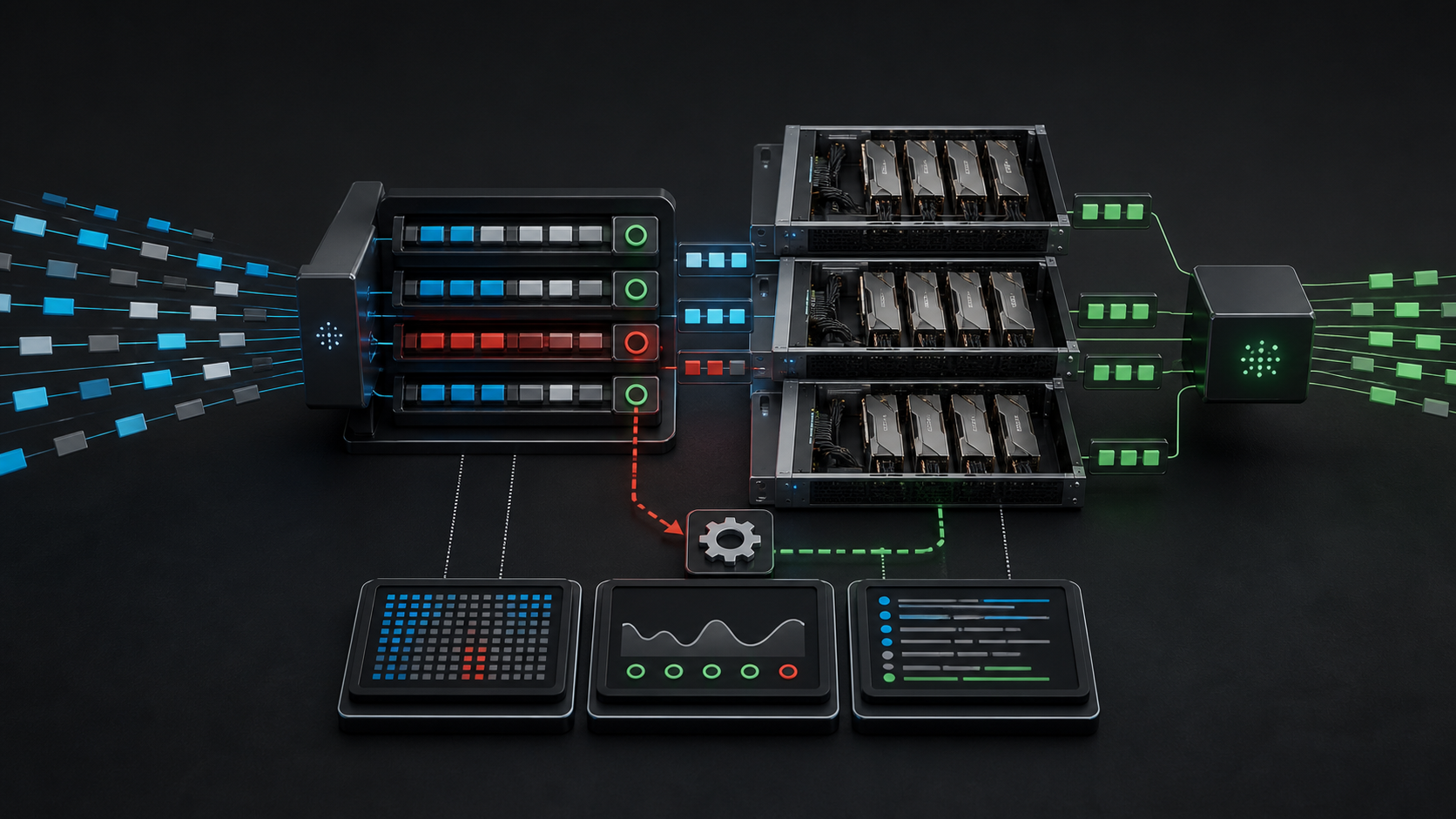
NVIDIA Triton Inference Server 26.08 is worth testing if your production service depends on dynamic batching, ordered responses or reliable model-readiness signals. It is not an automatic upgrade for every deployment. Teams using multi-GPU vLLM, CUDA shared memory from multithreaded clients, or GPU metrics on NVSwitch systems need to account for specific known issues before moving traffic.
That distinction matters. A serving-stack upgrade should answer a commercial question: will it reduce failed requests, wasted GPU time or operator effort without introducing a new failure mode? A newer container tag is not a result.
This guide turns the 26.08 release notes into an upgrade decision, a canary plan and a set of checks for teams running NVIDIA GPUs on premises or in hosted infrastructure.
The short answer
Triton 26.08 packages Triton 2.72.0 with CUDA 13.4.1, TensorRT 11.2.1.2, NCCL 2.30.7, ONNX Runtime 1.28.0, OpenVINO 2026.3.0 and vLLM 0.27.1. NVIDIA lists support for GPUs with CUDA compute capability 7.5 or later, covering Turing, Ampere, Ada, Hopper and Blackwell generations.
Upgrade through a canary if any of these conditions describes your service:
- dynamic batching sometimes leaves queued work waiting despite available execution capacity;
- clients depend on
preserve_orderingand response order has been a source of uncertainty; - model readiness needs to distinguish an unresolved model from one that is genuinely available;
- operators need server logs delivered through the Triton C or Python API;
- a non-batching TensorRT model uses CUDA graphs.
Hold the production rollout, or design around the issue first, if you use:
- vLLM tensor parallelism above one with the default distributed executor and explicit model control;
tritonclientCUDA shared-memory APIs from multithreaded code on CUDA 13;- vLLM or Ray endpoints exposed to an untrusted network;
- GPU metrics on an NVSwitch platform where the documented DCGM/NSCQ shutdown fault applies;
- a container workflow that assumes the TensorRT-LLM backend is included in the standard Triton image.
The practical answer is therefore not “upgrade” or “stay”. It is “canary the affected path, with an exit condition written before the test”.
What changed in 26.08
The following changes have direct operational consequences. They are more useful to a buyer than a long inventory of package versions.
| Change | What it can affect | What to test | |---|---|---| | Dynamic-batcher starvation fix | Queue delay and GPU idle periods under uneven request arrival | Mixed request sizes, priority levels and burst traffic | | Restored preserve_ordering behaviour | Applications that match responses to an ordered input stream | Out-of-order model completion with ordering enabled | | Readiness reporting changes | Health checks, load balancers and deployment automation | Missing, loading, failed and ready model states | | C and Python API log callback | Embedded Triton services and central log collection | Log level, message loss, callback failure and shutdown | | TensorRT CUDA-graph fix for non-batching models | Fixed-shape low-latency paths | Graph capture, repeated execution and fallback behaviour | | vLLM JSON parsing correction | Request handling through the vLLM backend | Structured request fields and rejected malformed input | | Model-load exception handling | Control-plane stability when a model fails to initialise | Invalid configuration, missing artefact and incompatible engine |
NVIDIA says the dynamic-batching fault was caused by drift in waiting_consumer_count. A scheduler could then believe that no consumer was waiting, even when work could be processed. That makes this more than a cosmetic queue statistic. Affected systems may show high tail latency while GPU utilisation looks lower than expected.
Do not turn that explanation into a promised performance gain. The fix removes one scheduler failure mode. Whether it changes your service depends on arrival pattern, batching rules, model duration and concurrency. Measure the queue and the GPU together.
Why readiness deserves its own test
A model server can have a healthy process while a required model is unavailable. If an orchestrator treats those states as equivalent, it can send live traffic to a process that cannot answer it.
Triton 26.08 changes readiness behaviour so errors are returned and an unresolved model can report ready=false. A production canary should verify at least four states:
1. Triton has started but the required model has not loaded. 2. A model configuration is invalid. 3. The model loads successfully and serves a known request. 4. The model is unloaded under explicit model control.
Record the HTTP or gRPC response, status code and body for each state. Then check what the load balancer, Kubernetes probe or service supervisor actually does with that response. A correct server signal does not help if the surrounding automation ignores it.
Readiness should also be tested during a slow model load. Large TensorRT engines and multi-GPU workers can take long enough for an impatient probe to restart an otherwise healthy deployment. Use startup, readiness and liveness checks for different purposes.
The component matrix is part of the change
Upgrading Triton changes more than the Triton binary. The 26.08 container includes a particular CUDA, TensorRT, NCCL, vLLM, ONNX Runtime and OpenVINO combination. Treat that set as a tested software unit until your own evidence says otherwise.
Before the canary, capture:
- the current Triton image digest, not only its mutable tag;
- NVIDIA driver versions on every target host;
- GPU model and compute capability;
- model repository version and TensorRT engine build details;
- backend-specific arguments and environment variables;
- client library versions;
- the exact vLLM launch and tensor-parallel settings;
- health-check and model-control mode;
- DCGM and GPU-metrics settings.
Use NVIDIA’s release notes and container support matrix to check the driver requirement for the chosen deployment. Do not assume that a host which runs an older CUDA container is ready for CUDA 13.4.1. Container compatibility reduces host-side dependency work, but the kernel driver still matters.
TensorRT engines also deserve attention. An engine generated under an earlier TensorRT build may not be the artefact you want to carry blindly into a new runtime. Keep the build recipe, calibration inputs where relevant and a known-good output set so the engine can be rebuilt and compared.
Multi-GPU vLLM is the main hold point
NVIDIA documents a 26.08 issue for vLLM tensor parallelism greater than one when the default distributed executor is used with explicit model control. Initialisation can fail. That combination is common enough to warrant a deliberate preflight check on PCIe GPU servers and dense HGX systems.
Write down the four relevant settings before testing:
- number of GPUs assigned to the model;
- tensor-parallel size;
- distributed executor backend;
- Triton model-control mode.
Then reproduce the full lifecycle: load, infer, unload, reload and restart after failure. A model that starts once is not enough evidence for explicit-control operations.
This issue does not mean that all multi-GPU vLLM use is broken. It describes a particular combination. NVIDIA tells users deploying vLLM with tensor parallelism above one to set distributed_executor_backend:ray in model.json. Apply that vendor guidance only after a separate performance, security and shutdown test; the same release notes warn against exposing Ray executors to untrusted networks. The safe choice depends on the service you already run.
For teams choosing between an H100 system and a current professional Blackwell GPU for inference, our H100 versus RTX PRO 6000 Blackwell guide covers memory, concurrency and platform considerations. The Triton version still has to be validated on the final machine.
Security notes that belong in the rollout ticket
The release notes flag vulnerabilities and unsafe exposure patterns involving the vLLM v0 API and Ray. NVIDIA’s advice is to avoid exposing Ray executors or vLLM hosts to untrusted networks and to restrict the XPUB TCP port.
That should translate into deployment controls, not a footnote:
- bind control and worker interfaces to a private network;
- restrict security groups and host firewalls to named peers;
- place the public API behind an authenticated gateway;
- keep Ray dashboards, object-manager ports and worker channels off the public internet;
- verify container and Python dependency scans against your organisation’s policy;
- rotate any credentials that have been present on an exposed host.
Do not infer that a private IP alone provides adequate isolation. Check the route table, ingress rules, lateral access and any tunnel or proxy that can reach the service.
Two other known issues to plan around
NVIDIA notes a CuPy problem with the CUDA 13 Device API in multithreaded contexts. The documented guidance is to avoid Triton client CUDA shared-memory APIs in that situation. A client can appear correct in a single-threaded test and fail only under production concurrency, so include a multithreaded case if your application shares GPU buffers.
The release notes also describe a possible shutdown segmentation fault on NVSwitch systems involving DCGM and NSCQ. The stated workaround is to start Triton with --allow-gpu-metrics false. That trades a crash risk for reduced built-in telemetry, so decide where replacement metrics will come from before adopting it. Host-level DCGM exporters, service metrics and request traces may cover different parts of the gap; verify rather than assume.
The standard 26.08 Triton container also does not include the Triton TensorRT-LLM backend container. If your build or deployment pipeline expects it, identify the correct image and version pairing before the maintenance window.
A production canary that answers the buying question
The canary should compare the present serving stack with 26.08 on the same class of hardware. If the systems differ, note the difference and avoid attributing every result to software.
Use a request set that represents the real service:
| Test | Evidence to collect | Failure threshold | |---|---|---| | Steady traffic | throughput, median and tail latency, GPU utilisation | agreed regression from current service | | Burst traffic | queue time, batch size, dropped and timed-out requests | sustained queue after capacity becomes available | | Mixed shapes or lengths | batch formation and per-class latency | one class starves another | | Ordered responses | request and response identifiers | any order violation with ordering enabled | | Model failure | readiness body, routing response and alert | traffic reaches an unready model | | Load and unload | control response, worker cleanup and memory recovery | failed reload or leaked allocation | | Process shutdown | exit code and crash trace | segmentation fault or hung worker | | Multi-threaded shared memory | correctness and client stability | corruption, crash or deadlock |
Set a rollback point. Keep the previous image digest, model artefacts and configuration available. Database or repository changes should be backward-compatible for the duration of the canary. If a new model engine cannot run on the previous stack, keep both engine versions rather than discovering that at rollback time.
The result should be a short decision record: workload, hardware, versions, test duration, pass criteria, observed faults and chosen action. “It looked fine” is not useful during the next incident.
Which hardware path fits the service?
Triton can serve one GPU or many, but the server form still follows workload evidence.
A single-GPU or small multi-GPU PCIe server suits services that need flexible accelerator choice, straightforward model isolation and conventional rack integration. It is often the easier place to run an upgrade canary because the test host can be isolated from the main pool.
An HGX platform becomes relevant when model placement, memory capacity and GPU-to-GPU communication require a tightly connected eight-GPU baseboard. The serving design must then account for NVSwitch, collective communication, failure domains and the metrics issue noted for 26.08.
Hosted infrastructure can suit bursty inference, a short migration test or a team without suitable power and cooling. GPUMachines Buy & Host provides a route for owned hardware in a managed facility. Compare it with public cloud using measured duty cycle, required reservation, data movement and operational control, not only an hourly headline.
For a new multi-node service, use the GPU Cluster Configurator to outline compute, fabric and storage before asking for a design review. Triton cannot compensate for an undersized network or a model repository that stalls every worker at once.
Upgrade, hold or investigate?
Upgrade through a canary when the scheduler, ordering, readiness or TensorRT fixes address a fault you have seen, and none of the known issues blocks your configuration.
Hold the production change when multi-GPU vLLM explicit control is central to the service, the driver and engine path has not been checked, or the security controls for vLLM and Ray are incomplete.
Investigate before buying more GPUs when tail latency is high but utilisation is low. Scheduler starvation, poor batching rules, slow model loading or client-side serialisation can waste installed capacity. A software and telemetry review may recover useful throughput without another accelerator.
Buy or host additional capacity when a clean canary shows that the service meets its software targets but misses throughput or latency goals under representative load. At that point, the request trace and GPU measurements give a much better hardware brief than a model name alone.
GPUMachines can size a PCIe, HGX or hosted inference platform from your model, precision, context, concurrency, latency target and Triton configuration. Bring the canary data. It is the fastest way to separate a software bottleneck from a capacity purchase.