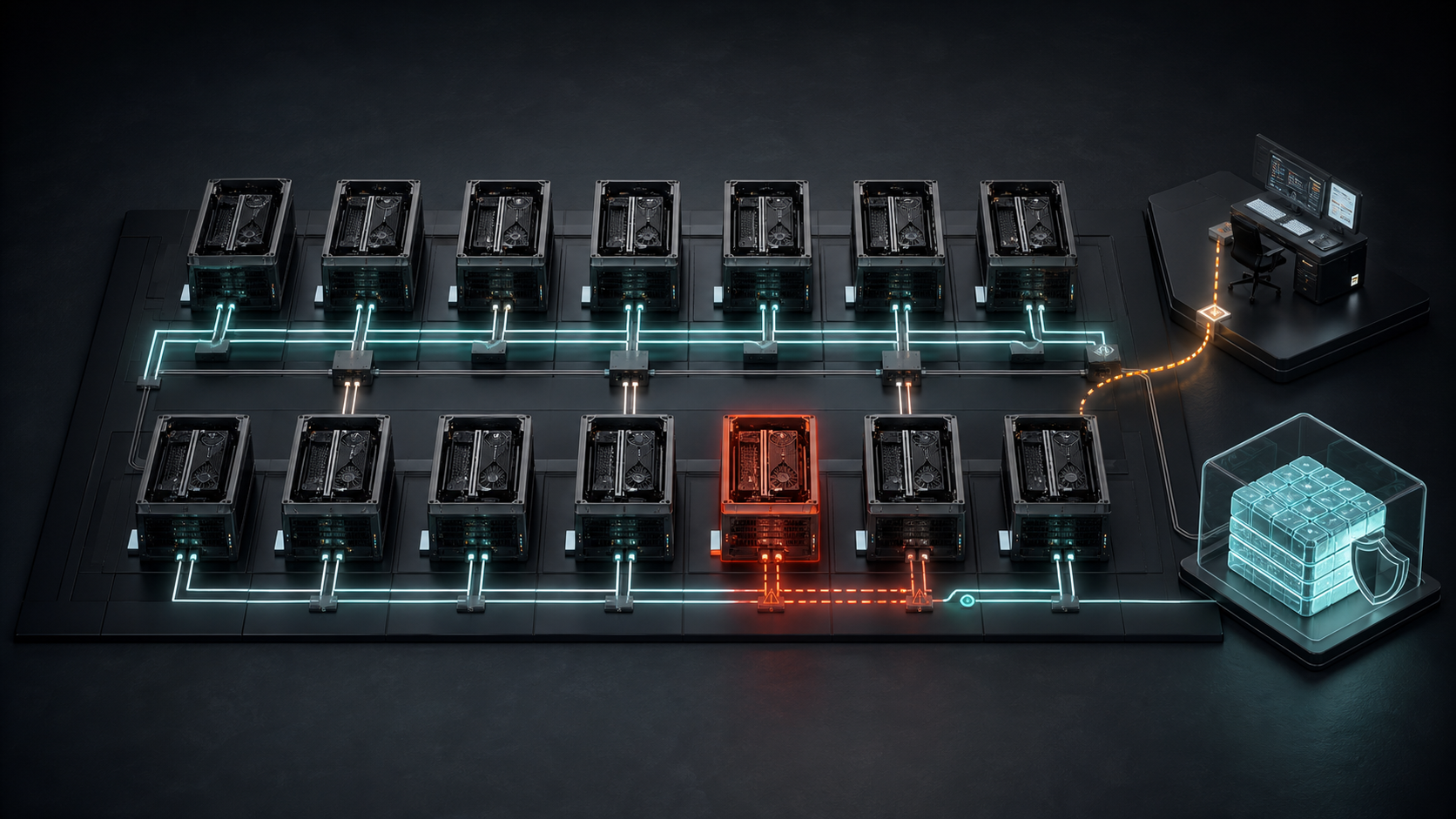
A synchronous training job can make one faulty rank look like a broken cluster. Every worker waits at the same collective, the logs end at roughly the same point, and a restart restores the same checkpoint without answering the expensive question: which rank failed first?
SCOUT is research aimed at that question. The framework compares equivalent training replicas, uses majority agreement to identify an outlier, and replays suspicious operations while the live process state is still available. It also tries to establish whether the latest checkpoint is clean enough to restore. That is more useful to an infrastructure buyer than another generic promise of "resilience". The purchase decision is whether a distributed training platform can produce evidence quickly enough to reduce failed-job diagnosis and checkpoint risk.
The short answer is that SCOUT is a promising diagnostic layer, not a replacement for GPU, fabric and system telemetry. Its authors report accurate localisation across their injected faults on a 16-GPU A100 testbed. They do not show production-scale behaviour on multi-rack RDMA fabrics, nor do they quantify full-job overhead and recovery economics. A buyer should treat it as a design pattern worth testing alongside NCCL RAS, DCGM, scheduler data and checkpoint validation.
The purchasing answer
If your training jobs fit on one server and failures are infrequent, start with good platform telemetry and deterministic restart procedures. Adding a research fault-localisation layer may cost more engineering time than it saves.
If jobs span several nodes, run for days, and write checkpoints that are expensive to validate, rank-level diagnosis becomes a procurement requirement. Ask the platform team to prove that it can separate four different events:
- a process that has stopped making progress;
- a rank that is still running but consistently slower;
- a rank that has produced numerically different state without crashing;
- an infrastructure fault outside the training process, such as a NIC, cable, switch path or host issue.
SCOUT addresses the first three more directly than the fourth. It can narrow the failure domain to a rank, GPU, node or communication peer group. The paper is clear that identifying the physical root cause may still require external telemetry. That boundary matters when buying a cluster: software localisation only pays off if the operations stack can map a suspect rank to hardware, fabric counters and a service action.
For teams moving beyond one chassis, the GPU cluster configurator is a useful place to frame node count, network topology and rack requirements. Buyers comparing dense scale-up systems can also review the GPUMachines HGX server range. Neither page substitutes for a fault-injection acceptance test, but both help define the platform that the test must cover.
What SCOUT actually does
SCOUT introduces Consensus Collective Communication, or C3. Equivalent replicas exchange evidence about progress, timing and numerical state. When most replicas agree and one differs, the framework treats the majority as a reference and identifies the outlier. This is not a comparison against a perfect external answer. It is a consensus judgement among workers that should be performing equivalent work.
That distinction explains both the appeal and the limit. Distributed training already creates repeated structure: data-parallel replicas often execute the same class of operation, and communication groups expose expected relationships. SCOUT uses those relationships as diagnostic redundancy. It does not require a second complete training cluster or a known-good model checkpoint for every comparison.
The design also includes an out-of-band CPU observer. GPU work can hang while the host process remains able to inspect progress. Keeping the observer off the main GPU execution path gives it a chance to report when the accelerator-side job cannot. A monitoring agent that depends on the stalled execution stream would be much less useful.
For a recurring straggler or suspected silent data corruption, SCOUT can replay an operation in situ. The live model state, allocations, kernels and resource pressure remain present. That is materially different from a small synthetic diagnostic run after the job has been killed. Reproduction inside the original environment can preserve the conditions that made the fault visible.
The checkpoint idea is equally important. A restart is only helpful if the restored state is trustworthy. SCOUT uses clean replay coverage as evidence that a checkpoint is eligible for recovery. In the authors' tests, the preceding model, optimiser and random-number-generator state was restored bit for bit across nine tested recovery cells. This remains an author-reported software-injection result, but it points to the right buyer question: what evidence sits between "checkpoint file exists" and "checkpoint is safe to resume"?
What the evaluation proves, and what it does not
The main testbed used two hosts with eight NVIDIA A100 SXM4 40 GB GPUs in each host. NVLink connected GPUs within a host. Inter-host NCCL and Gloo traffic used TCP because the environment did not have RDMA. The software stack included PyTorch, CUDA, NCCL, TorchTitan, Megatron-Core and DeepSpeed versions listed in the paper.
The authors injected faults into a deterministic three-block Transformer trained with AdamW under DDP, FSDP2 and a 4 by 4 HSDP arrangement. They also report a broader integration matrix covering several parallel training modes. Reported outcomes included:
- 344 of 344 dense numerical corruption cases localised, with 30 of 30 clean cases accepted;
- exact localisation of a recurring compute straggler after two confirmations in three tested runs;
- identification of the affected rank group in a communication-straggler case;
- exact localisation for the tested mixture-of-experts corruption cases;
- 120 of 120 primary hang or input-stall launches, plus 30 of 30 focused launches, passing the paper's checks;
- all nine 16-GPU checkpoint-recovery cells passing in the reported experiment.
Those figures should not be turned into a universal detection-rate claim. The faults were injected in software, the cluster was small by current pre-training standards, and the network did not resemble a production multi-rail InfiniBand or RoCE fabric. GPUMachines has not reproduced the results.
The paper also does not measure end-to-end training throughput across different replay cadences. It does not put a price on rollback distance, time to recovery or operator intervention. These omissions matter because a detector can be accurate yet too costly to run often. The right replay interval depends on job value, checkpoint interval, expected fault rate and the time needed to establish confidence.
One-shot faults that disappear before replay are outside the strongest part of the method. Arbitrary mixture-of-experts routing patterns may need their own templates. Some collectives hidden inside fused, compiled or framework-managed graphs may not be observable. A production trial therefore has to use the buyer's actual model stack, compiler settings and parallelism plan.
Why majority agreement is useful but not magic
Majority voting works when equivalent replicas exist and most are healthy. It becomes less decisive when several workers share the same fault, when a deterministic software bug affects every rank, or when ranks legitimately execute different work.
Consider a bad collective configuration that slows an entire rail. Every rank may report the same symptom. Consensus can show that the group is uniformly late, but it cannot invent an unaffected majority. Likewise, a corrupt input batch delivered consistently to all data-parallel workers may produce agreement around the wrong state.
This is why a buyer needs layered evidence:
- training-level comparison for rank progress and numerical signatures;
- NCCL and transport telemetry for collective health;
- GPU health, error and thermal data;
- host kernel, PCIe and memory events;
- switch, port, optic and cable counters;
- scheduler records that map job ranks to nodes and devices;
- checkpoint manifests, validation results and object-store integrity.
SCOUT belongs near the training layer. It can reduce the search space before an operator looks at the lower layers. It cannot certify the whole physical path by itself.
Infrastructure implications for buyers
Rank identity must survive the incident
The scheduler, container platform and monitoring system should preserve a stable mapping from job, host, process rank, GPU UUID, NIC and switch-facing port. "Rank 13 diverged" is actionable only if the team can discover where rank 13 ran and which communication path it used.
Ask vendors and integrators to demonstrate that mapping during acceptance. It should remain available after a pod, allocation or node has been recycled. Ephemeral labels that disappear with the job make post-incident analysis much harder.
The management plane needs its own path
An out-of-band observer is more credible when management traffic does not depend entirely on the same congested data path as training collectives. Separate management interfaces, reliable time synchronisation and central telemetry retention are basic design choices, not finishing touches.
On a multi-rack build, plan the management network and the high-speed compute fabric as separate operating domains. A cluster may still use shared physical infrastructure in some designs, but failure and congestion behaviour must be understood.
Checkpoint storage needs evidence as well as bandwidth
Checkpoint discussions often stop at write speed. Recovery also depends on versioning, atomicity, metadata, retention and validation. A very fast parallel file system can preserve a bad checkpoint just as efficiently as a good one.
The GPUMachines guide to storage for LLM training covers dataset and checkpoint paths in more detail. For SCOUT-like recovery, add an eligibility record to each checkpoint: training step, rank set, replay coverage, model and optimiser hashes, software version and storage verification. The exact schema can vary, but the recovery decision should not live only in an operator's memory.
Spare capacity changes the recovery plan
A cluster with no spare GPU or node may have to wait for repair before resuming at full scale. A platform with one compatible spare node can quarantine a suspect host and continue sooner, provided the topology and scheduler support replacement. That spare has a cost, but so does an idle training allocation.
For large jobs, model the economics of three routes: immediate restart on the same hardware, restart with a suspect node excluded, and migration to reserved hosted capacity. The right answer depends on job duration and queue policy rather than a generic availability percentage.
An acceptance test worth putting in the contract
Do not buy "fault tolerance" as a sentence in a proposal. Turn it into a witnessed test with pass criteria.
1. Run the intended training framework and parallelism arrangement across at least two nodes. 2. Record the rank-to-GPU-to-NIC mapping and prove it can be queried after the job ends. 3. Inject a process stall, a bounded compute slowdown and a reversible numerical perturbation using an agreed test harness. 4. Measure time to detection, time to localisation, false positives and the detail retained for the incident record. 5. Confirm whether the platform names a rank, a node, a communication group or a physical component. 6. Write a checkpoint before and after the injected event, then demonstrate the rule used to choose the recovery point. 7. Resume training and compare the recovered model, optimiser, scheduler and random state against the expected record. 8. Repeat the test while the fabric and storage system carry representative background traffic.
The point is not to recreate the SCOUT paper exactly. It is to find where the buyer's operating stack loses evidence. That gap may be in the training framework, the fabric, the scheduler, the storage path or the hand-off between teams.
When SCOUT is a good fit
SCOUT is most interesting for research groups and model developers running synchronous jobs where a single rank can hold the whole allocation. It also suits environments where checkpoint rollback is costly and silent numerical corruption is a serious concern.
It is less compelling for loosely coupled batch inference, independent rendering tasks or jobs where failed units can simply be retried without shared state. It may also be too much engineering for a small team operating one workstation or a single four-GPU server.
Teams with several training frameworks should check integration effort early. The paper reports operation without source modification across PyTorch, TorchTitan, Megatron-Core and DeepSpeed, but local wrappers, compilers and custom kernels can change observability. A proof of concept should include those real components.
What to ask GPUMachines
GPUMachines can help translate the failure model into a cluster configuration and acceptance plan. Useful inputs include the model family, job duration, parallelism scheme, node count, checkpoint interval, expected rollback cost and required recovery-time objective.
The infrastructure review can cover GPU topology, CPU and RAM headroom, local NVMe for staging, fabric choice, management separation, telemetry retention, spare-node policy and checkpoint storage. It can also identify whether an on-premise cluster, hosted dedicated system or staged deployment gives the team the clearest route to measured reliability.
Before requesting a quote, write down the failure that would be most expensive. Is it a dead GPU, a slow rail, a poisoned checkpoint, or a job that fails once every three days without a reproducible signature? That answer determines which evidence the platform must collect.
FAQ
Does SCOUT replace NVIDIA DCGM or NCCL diagnostics?
No. SCOUT observes behaviour at the distributed-training layer. GPU and communication diagnostics provide hardware and transport evidence that can explain the localised symptom.
Can it identify a bad switch port or cable?
Not reliably on its own. It may narrow the problem to a node or peer group. Port, cable, optic, HCA and switch attribution still needs fabric telemetry and topology mapping.
Does the paper prove that SCOUT scales to hundreds of GPUs?
No. The reported testbed had 16 A100 GPUs across two hosts. Multi-rack scale and RDMA fabrics remain open validation work.
Will replay slow training?
Any additional observation or replay has a cost. The paper does not provide a complete end-to-end overhead study across replay schedules, so buyers should measure it on representative jobs.
What makes a checkpoint safe to restore?
File existence is not enough. A recovery policy should combine storage integrity, model and optimiser state, software metadata and evidence that the preceding computation was not contaminated.
Should a small research team deploy this first?
Usually not before basic telemetry, deterministic environments and tested checkpoint recovery are in place. Those foundations often deliver the first operational gain.
Sources and Further Reading
- SCOUT research paper
- LMResiliency project repository
- PyTorch distributed communication documentation
- NVIDIA NCCL RAS documentation
Verdict
SCOUT asks the right operational question: when every worker appears stuck, which one produced the first bad evidence, and can the latest checkpoint still be trusted? Its majority-based comparison and in-situ replay are credible ideas for reducing ambiguity inside synchronous training.
The current evidence is not enough to buy a production reliability claim. The scale is limited, the faults are injected, and the cost of continuous use is not fully measured. Use the work to strengthen acceptance criteria. A serious training platform should connect rank-level evidence to GPU, fabric and storage records, then prove recovery with the buyer's own workload.
Bring GPUMachines the model, node count, parallelism plan and recovery target to plan a GPU cluster with diagnostic and checkpoint requirements.