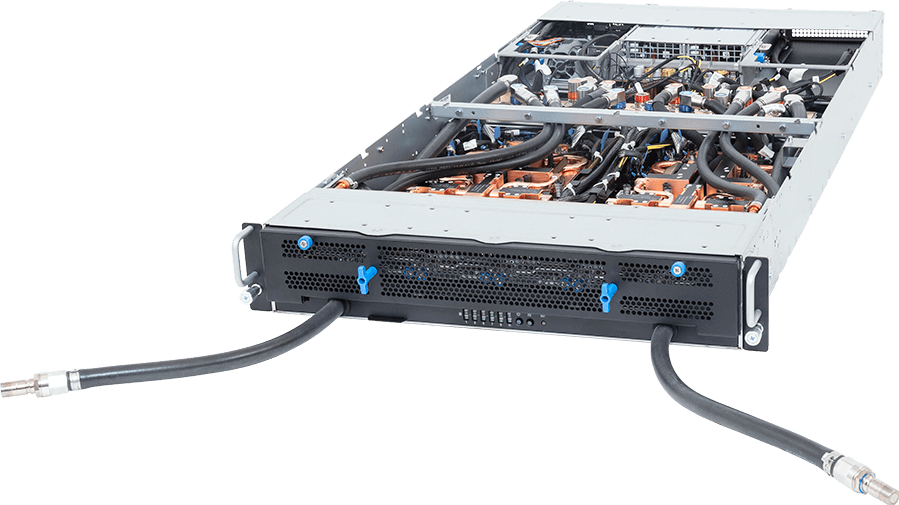
The expensive part of XN24-VC0-LA61 is easy to see; the harder question is whether the workload can use its scale-up architecture. Treat the base system as a design boundary, not a finished build; CPU, memory, storage, networking and facility choices still decide the outcome.
The buying decision is fairly narrow: choose XN24-VC0-LA61 when model parallelism and frequent GPU-to-GPU exchange make interconnect behaviour central to job time. It is poor value for lightly used inference replicas, single-GPU development or a site that cannot feed the node with enough power, cooling and data.
Review the XN24-VC0-LA61 configuration options on GPUMachines before treating the base chassis as a finished design.
Executive Summary
The XN24-VC0-LA61 is best suited to AI labs, enterprise platform teams, research groups, and service providers that need multi-GPU scale-up performance for training, fine-tuning, high-throughput inference, simulation, or private AI clusters.
The headline configuration story is NVIDIA GB200 NVL4 Grace Blackwell platform with two GB200 superchips and four Blackwell GPUs, backed by 2 CPU socket(s), integrated LPDDR5X/HBM memory, capacity configuration-dependent, 13 storage positions, and 2 PCIe expansion slots.
It is overkill for single-GPU development, occasional experiments, small inference endpoints, or teams that do not need high-speed GPU-to-GPU communication.
Start configuration here: configure the XN24-VC0-LA61 on GPUMachines.
Key Specifications
| Area | Specification | | --- | --- | | Form factor | 2U rackmount | | CPU platform | GB200 | | CPU sockets | 2 | | GPU support | NVIDIA GB200 NVL4 Grace Blackwell platform with two GB200 superchips and four Blackwell GPUs | | Memory | integrated LPDDR5X/HBM memory, capacity configuration-dependent | | Storage | 8 x liquid-cooled 2.5" Gen5 NVMe from ConnectX-8 SuperNIC™. Optional 4 x liquid-cooled 2.5" Gen5 NVMe from NVIDIA BlueField-3 DPUs. 1 x M.2 slot (2242/2260/2280/22110), PCIe Gen5 x4 from CPU_1. | | PCIe expansion | 1 x liquid-cooled FHHL x16 (Gen5 x16) from CPU_0 for DPUs; 1 x FHHL x16 (Gen5 x16) from CPU_1 | | Networking | 4 x 800 Gb/s liquid-cooled OSFP InfiniBand XDR or dual 400 Gb/s Ethernet, for GPU networking, via NVIDIA ConnectX-8 SuperNIC™. 1 x 1Gb/s LAN (1 x Intel I210-AT) supporting NCSI function. 1 x 10/100/1000 Mbps Management LAN. | | Power | 4 x 3200W 80 PLUS Titanium redundant power supplies | | Best-fit workloads | LLM pre-training and fine-tuning; multi-GPU inference with tensor parallelism; large batch training; simulation and scientific computing | | Dimensions | 438 x 87 x 900 mm |
Platform Highlights
- GPU platform: NVIDIA GB200 NVL4 Grace Blackwell platform with two GB200 superchips and four Blackwell GPUs. This matters because accelerator choice drives the rest of the configuration: CPU lanes, rack or chassis power, airflow, local storage, and network design.
- CPU and memory base: GB200 with integrated LPDDR5X/HBM memory, capacity configuration-dependent. The right CPU and memory plan should be sized around data preparation, host-side model work, and how many accelerators or services need to be kept busy.
- Storage layout: 8 x liquid-cooled 2.5" Gen5 NVMe from ConnectX-8 SuperNIC™. Optional 4 x liquid-cooled 2.5" Gen5 NVMe from NVIDIA BlueField-3 DPUs. 1 x M.2 slot (2242/2260/2280/22110), PCIe Gen5 x4 from CPU_1.. Local NVMe is useful for active datasets, checkpoints, scratch space, and staging work before data moves to shared storage.
- Expansion and networking: 1 x liquid-cooled FHHL x16 (Gen5 x16) from CPU_0 for DPUs; 1 x FHHL x16 (Gen5 x16) from CPU_1. NIC placement and PCIe lane planning are important when the system will connect to storage, other GPU nodes, or remote users.
- Power and cooling: 4 x 3200W 80 PLUS Titanium redundant power supplies. Final power draw is configuration-dependent, especially once GPUs, NICs, and NVMe devices are selected.
- Product-specific fit: The product-specific point to notice is direct liquid cooling, Blackwell B200 generation, 4-GPU PCIe density. That combination changes the buying conversation from a generic server choice into a decision about rack density, thermal design, accelerator fit, data movement, and operational support.
- Scale-up behaviour: HGX platforms are selected for high-speed GPU-to-GPU communication. NVLink and NVSwitch can be more important than raw GPU count when training, fine-tuning, or serving large models across multiple accelerators.
Our Technical View
In the GPUMachines portfolio, XN24-VC0-LA61 belongs in the top tier of scale-up AI systems. The reason to consider it is not simply that it can host many GPUs, but that the platform is designed for workloads where GPU-to-GPU communication, memory bandwidth, and predictable node behaviour matter.
This model is strongest when a team already understands that its workload can use a dense HGX node: LLM training, fine-tuning, high-throughput inference, simulation, or private AI cluster work. It may not be the best fit for early experimentation, occasional model runs, or teams that mostly need independent GPU workers. In those cases, a PCIe GPU server, workstation, or hosted GPU option may be more cost-effective.
The product-specific point to notice is direct liquid cooling, Blackwell B200 generation, 4-GPU PCIe density. That combination changes the buying conversation from a generic server choice into a decision about rack density, thermal design, accelerator fit, data movement, and operational support.
Best-Fit Workloads
Best-fit workloads include:
- LLM pre-training and fine-tuning
- multi-GPU inference with tensor parallelism
- large batch training
- simulation and scientific computing
- private AI cluster deployments
- managed GPU hosting and Buy & Host infrastructure
Who Should Consider It
The XN24-VC0-LA61 makes sense when the project needs a properly specified infrastructure node, not just a part number. For AI teams, that usually means thinking through data movement, GPU or CPU utilisation, local scratch, shared storage, network fabric, and how the server will be operated after delivery.
It is most relevant for buyers that already understand their workload profile, have a target deployment model, and need help turning that requirement into a balanced hardware configuration. That may mean on-premise ownership, a hosted system, a leased deployment, or part of a larger private AI cluster.
Who Should Not Buy It
This is not the right first system for small AI inference workloads, single-GPU development, classroom experimentation, or teams that have not yet proven that their models benefit from dense multi-GPU scale-up. A smaller PCIe GPU server, 4-GPU server, workstation, or hosted GPU instance may be a better starting point.
Architecture Notes
The main reason to choose this class of system is not just GPU count. It is the scale-up behaviour inside the node. Workloads such as LLM training, fine-tuning, large-batch inference, simulation, and model-parallel jobs are often limited by the speed at which GPUs, CPUs, memory, storage, and network adapters can keep each other supplied.
For XN24-VC0-LA61, that means the surrounding configuration matters: CPU selection, DIMM population, local NVMe, cluster NICs, rack power, and cooling should be designed together. In a multi-node deployment, the switching and storage fabric can be just as important as the server itself.
Configuration Guidance
Important configuration decisions include:
- Storage can be configured with 1TB NVMe M.2 SSD, 2TB NVMe M.2 SSD, 4TB NVMe M.2 SSD
- Networking options include high-speed Ethernet and InfiniBand adapters for cluster or storage traffic
- For multi-node deployments, plan the NICs, switches, storage, rack power, and cooling together rather than as separate line items
- confirm facility liquid-cooling readiness, service procedure, coolant loop responsibility, and fallback airflow expectations
- size networking, local NVMe, storage fabric, rack power, and cooling around accelerator utilisation rather than GPU count alone
- decide whether the platform is acting as scratch, dataset staging, checkpoint storage, shared storage, or a storage-adjacent service node
- confirm GPU length, slot spacing, riser layout, host lanes, NIC placement, and PSU headroom before finalising the build
For GPU-heavy deployments, pay close attention to rack power, airflow, service access, high-speed networking, and whether the node will run alone or as part of a cluster. GPUMachines can review the final configuration during quoting, but buyers should still define the intended workload, data sources, model size, user count, storage pattern, and network environment before selecting components.
Recommended Configuration Paths
- Best for AI training: prioritise the full GPU platform, balanced CPU selection, high-capacity memory, local NVMe for datasets and checkpoints, and high-speed networking for multi-node growth.
- Best for inference hosting: focus on GPU memory, network throughput, storage for model repositories, management separation, and enough host memory for concurrent services.
- Best for research or HPC: size CPU, memory, local scratch, and NICs around the mix of simulation, data preparation, and accelerator workloads.
- Best for hosted deployment: review rack power, cooling, remote management, and network design with GPUMachines before purchase.
Alternatives and Related Systems
Buyers should also compare the HGX server range with PCIe GPU servers if their workloads do not need NVLink/NVSwitch. For smaller local development, a tower GPU workstation may be more practical. For teams without suitable rack power or cooling, GPUMachines can also discuss hosted deployment and Buy & Host options.
Buying Through GPUMachines
The fastest next step is to use the XN24-VC0-LA61 configurator and select the CPU, RAM, storage, GPU, and networking options that match your workload. GPUMachines can then review the build for compatibility, thermals, power draw, lead time, and cluster fit.
For teams without suitable data centre space, GPUMachines can also discuss Buy & Host, leasing, and GPU Cloud alternatives. That is especially useful when the server needs high-density power, managed networking, or a private hosted environment.
Deployment Notes for HGX Buyers
XN24-VC0-LA61 should be treated as a shared AI platform, not a bigger version of a workstation. The question is how many jobs will use the GPUs together, how often those jobs run, and whether the surrounding data path can keep pace. If the workload is mostly single-GPU inference or occasional experimentation, the server may spend too much time waiting for work. If the workload needs model parallelism, large fine-tuning runs or high-throughput inference, the platform starts to justify its place in the rack.
The platform clue is NVIDIA GB200 NVL4 Grace Blackwell platform with two GB200 superchips and four Blackwell GPUs. That line should be read alongside CPU choice, DIMM population and network adapters. HGX systems are most useful when the GPUs communicate heavily, but the host still has to feed them. Under-sized system memory, slow model staging or a weak storage path can make an expensive accelerator platform look ordinary.
Storage planning starts with the published layout: 8 x liquid-cooled 2.5" Gen5 NVMe from ConnectX-8 SuperNIC™. Optional 4 x liquid-cooled 2.5" Gen5 NVMe from NVIDIA BlueField-3 DPUs. 1 x M.2 slot (2242/2260/2280/22110), PCIe Gen5 x4 from CPU_1.. That needs to be mapped to model staging, scratch space, checkpoint writes, logs and any shared dataset path before the system is ordered.
Networking also deserves early attention. The listed network path is 4 x 800 Gb/s liquid-cooled OSFP InfiniBand XDR or dual 400 Gb/s Ethernet, for GPU networking, via NVIDIA ConnectX-8 SuperNIC™. 1 x 1Gb/s LAN (1 x Intel I210-AT) supporting NCSI function. 1 x 10/100/1000 Mbps Management LAN., but the final choice should separate management, storage and workload traffic where the deployment needs that separation. In a cluster, that decision gets harder. InfiniBand, high-speed Ethernet, storage networks and management ports all have different jobs. GPUMachines can review this before configuration so the server does not arrive with the wrong NICs or a cabling plan that only works on paper.
Power is not a footnote here: 4 x 3200W 80 PLUS Titanium redundant power supplies. Before purchase, check the rack feed, redundancy plan, heat load and service process against the target site. HGX deployments also need space for service access, airflow or liquid-cooling support where relevant, spare strategy and monitoring. The safest buying path is to size the system against real model sizes, expected batch behaviour, context length, checkpoint pattern and user count, then decide whether on-premise, hosted or Buy & Host deployment is the cleaner route.
Before the quote is treated as final, check the boring pieces: rack depth, lift access, power connectors, cable reach, remote management, spare PSU policy, firmware ownership and who will be allowed to schedule jobs. Those details sound small beside an HGX spec, but they decide how quickly the system becomes useful after delivery.
FAQ
Is XN24-VC0-LA61 better for training or inference?
It is suitable for training and fine-tuning when the model and software stack can benefit from dense multi-GPU communication. It can also be specified for inference, but the final choice should be based on model size, concurrency, and networking.
How much RAM should I configure?
RAM is configuration-dependent. Match memory capacity to CPU count, dataset preparation, model serving processes, virtualisation needs, and whether the system will run storage or orchestration services alongside GPU workloads.
Does this system need InfiniBand or 400GbE?
High-speed networking depends on deployment design. Single-node systems may only need fast Ethernet, while multi-node training, shared storage, and hosted GPU environments often justify 100GbE, 200GbE, 400GbE, InfiniBand, or separate management networks.
Is this overkill for small AI workloads?
It can be. If the workload is a small inference endpoint, proof-of-concept project, or one-GPU development task, a smaller workstation, hosted GPU option, or lower-density server may be more practical.
Can GPUMachines host this system?
GPUMachines can discuss hosted deployment, leasing, and Buy & Host options where appropriate. This is especially useful when rack power, cooling, remote access, or data-centre operations are concerns.
What should I check before deploying it in a data centre?
Review rack depth, power feeds, cooling, service access, networking, management separation, storage integration, and whether the system needs to operate alone or as part of a cluster.
Verdict
The XN24-VC0-LA61 is a strong fit when you want a configurable HGX AI server that can be matched to a real AI, HPC, rendering, storage, or infrastructure workload. Its value is not only in the headline component list, but in how those components are selected and integrated.
Choose it when your team needs a serious infrastructure node with expert configuration support and a clear path to on-premise, hosted, or cluster deployment.
Configure it here: XN24-VC0-LA61 on GPUMachines.