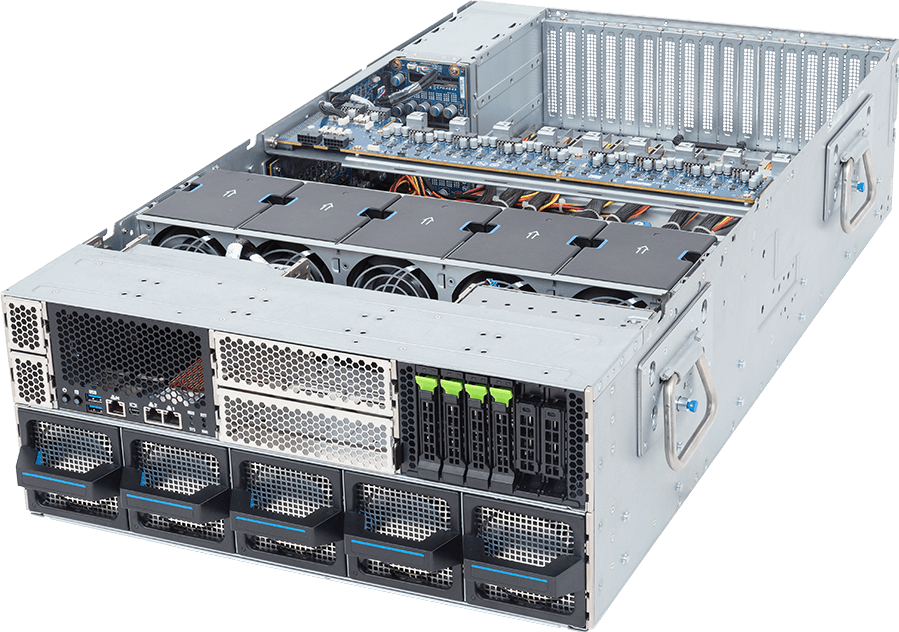
The GIGABYTE XL43-ZX0-AAS2 is a 4U NVIDIA MGX server for up to eight full-height, full-length, dual-slot PCIe 5.0 GPUs. It pairs that accelerator capacity with two AMD EPYC 9005 processors, 24 DDR5 DIMM slots and direct CPU-connected GPU lanes.
This is a configurable PCIe platform rather than a fixed HGX baseboard. It is most useful when buyers want freedom over accelerator choice, when jobs can be distributed across independent GPUs, or when a deployment may grow from a partially populated system. The final GPU set still needs to be checked for qualification, dimensions, cooling and power.
Configure the GIGABYTE XL43-ZX0-AAS2 on GPUMachines, or send us the intended cards, software and facility limits for compatibility review.
Platform overview
The eight GPU slots are split evenly across the two processors: four PCIe 5.0 x16 positions connect to CPU 0 and four to CPU 1. A ninth FHFL PCIe 5.0 x16 slot is available from CPU 1 for networking or another supported expansion device. This direct attachment makes CPU selection, NUMA placement and workload scheduling important parts of the build.
GIGABYTE lists two SP5 sockets for AMD EPYC 9005 processors with configurable TDP up to 500W. The memory subsystem provides 12 channels per CPU through 24 DDR5 RDIMM slots, with published support up to 6400MT/s.
Published system specification
- NVIDIA MGX 4U rackmount platform
- Up to eight FHFL dual-slot PCIe 5.0 x16 GPUs
- Two SP5 sockets for AMD EPYC 9005 processors
- 24 DDR5 RDIMM slots, 12 channels per processor
- Four hot-swap 2.5-inch PCIe 5.0 NVMe bays
- Two internal M.2 positions using PCIe 3.0 x2 and x1 links
- One additional FHFL PCIe 5.0 x16 expansion slot
- Two 10GbE RJ45 ports using Intel X710-AT2
- Separate management interfaces
- 3+1 redundant 3200W 80 PLUS Titanium power supplies
- Ten 80 x 80 x 80mm system fans
- Chassis dimensions of 438 x 176.6 x 802.5mm
MGX and PCIe GPU workload fit
NVIDIA MGX gives OEMs a modular server architecture, while this particular system exposes eight standard PCIe GPU positions. That provides more accelerator flexibility than an HGX server, where the GPUs and high-speed scale-up fabric are part of a fixed baseboard.
The XL43-ZX0-AAS2 is well suited to inference replicas, rendering, VFX, simulation, visual computing, virtual workstations and research environments where each GPU can run a separate job or container. It can also support training and fine-tuning, provided the workload does not depend on HGX-class NVSwitch communication between every GPU.
Before ordering, map the intended software to the actual accelerator topology. Confirm whether jobs stay within one GPU, communicate mainly over PCIe, or need to span several nodes. If a single model requires constant high-bandwidth exchange across all eight GPUs, compare the result with an HGX server. For independent workers, an HGX premium may add little value.
CPU, NUMA and memory planning
Each EPYC processor owns four GPU slots, so host placement matters. Processes should normally run close to the GPU and memory they use. Poor NUMA placement can create unnecessary traffic across the socket interconnect and reduce the value of the direct PCIe design.
Processor selection should reflect host-side work rather than maximum core count alone. Data loading, preprocessing, simulation, orchestration, storage services and virtualisation can all use substantial CPU resources. A pure inference worker may need fewer cores but still benefit from strong memory bandwidth and enough PCIe capability to keep its assigned GPUs busy.
The 24 DIMM slots provide one position for each of the 12 memory channels per CPU. Populate both sockets symmetrically and budget memory for the operating system, containers, model-loading processes, datasets, caches and user services. GIGABYTE publishes DDR5 RDIMM operation up to 6400MT/s, subject to processor and DIMM support.
Storage design
Four front hot-swap PCIe 5.0 NVMe bays can hold active datasets, model cache, checkpoints and scratch space. They are not intended to replace a shared storage architecture in a multi-node deployment, but they can reduce restart and staging time when the data lifecycle is planned properly.
Two internal M.2 positions provide additional boot or service-volume options. Their PCIe 3.0 x2 and x1 links are materially slower than the front Gen5 NVMe bays, so they should not be counted as equivalent high-performance data drives.
Drive endurance and failure handling matter. Training checkpoints and repeated model staging can generate sustained writes, while inference may be read-heavy after model loading. Size usable capacity after redundancy and decide which data can be recreated. For a cluster, measure aggregate storage demand across all nodes rather than multiplying a single-server estimate without considering contention.
Networking and expansion
The integrated Intel X710-AT2 provides two 10GbE RJ45 ports, and management interfaces support out-of-band administration. Ten gigabit Ethernet may be adequate for management, client traffic or modest single-node use, but it is unlikely to be the complete fabric for eight high-end GPUs in a distributed AI deployment.
The additional PCIe 5.0 x16 slot can host a supported high-speed Ethernet or InfiniBand adapter. Physical fit, CPU ownership, cabling and airflow must be checked with the final GPU population. A multi-node design should separate management, storage and accelerator traffic where the operational requirement justifies it.
Power, cooling and rack planning
Four 3200W 80 PLUS Titanium power supplies operate in a 3+1 redundant arrangement. Their rating describes available power, not a fixed server draw. Actual input depends on GPU limits, two processors, memory, NVMe, the network adapter and fan speed.
The chassis uses ten deep 80mm fans and has a published operating range of 10°C to 30°C. High-power GPU combinations can create a concentrated rack heat load, so confirm airflow, inlet temperature, PDU layout and the effect of adjacent servers. The 802.5mm chassis depth also needs adequate rear clearance for power and network cables.
Before deployment, calculate expected and worst-case draw from the selected parts. Validate voltage, redundant feeds, breaker capacity, PDU outlets and data-centre heat rejection.
Practical configuration profiles
Eight-GPU inference host
Choose qualified GPUs with sufficient memory for the deployed models, balanced CPU and RAM, front NVMe for model cache and a network adapter sized for request and model-loading traffic. The scheduler should distribute replicas across both CPU domains deliberately.
Rendering or virtual workstation platform
Select cards certified for the application and virtualisation stack. Size host memory for user density, allow fast project storage and confirm licensing. The direct GPU layout can work well when sessions or rendering jobs remain largely independent.
Research and mixed AI server
A partially populated chassis can leave room for future cards, but planned expansion must be compatible with the original PSU, airflow, CPU and network design. Mixed accelerators may introduce driver, cooling and support complexity; standardising the GPU set is often operationally cleaner.
Multi-node PCIe cluster
Specify the server, high-speed fabric, shared storage, scheduler and rack power as one system. Test whether the application scales efficiently over the selected network before committing to a larger node count.
Who should shortlist it?
The XL43-ZX0-AAS2 is a strong candidate for organisations that need up to eight configurable PCIe GPUs with a current AMD EPYC host. It fits AI service providers, enterprise platform teams, visual computing groups and research labs that can keep several accelerators occupied.
A smaller PCIe GPU server may be more economical when the target is two to four GPUs. A tower GPU workstation suits local development. For tightly coupled large-model training, compare HGX performance and total system cost before choosing the MGX PCIe route.
Frequently asked questions
How many GPUs does the XL43-ZX0-AAS2 support?
GIGABYTE specifies up to eight FHFL dual-slot PCIe 5.0 GPUs, with four slots connected to each processor. The exact cards require qualification and a final power and thermal check.
Which processors are supported?
The system uses two SP5 sockets for AMD EPYC 9005-series processors. GIGABYTE lists configurable TDP up to 500W per CPU.
How many DIMM slots are available?
There are 24 DDR5 RDIMM slots, providing 12 memory channels per processor. Balanced population across both sockets is recommended.
Is the server an HGX system?
No. It is an NVIDIA MGX platform with standard PCIe GPU slots. It does not use an eight-GPU HGX baseboard or NVSwitch fabric.
Does it include a high-speed cluster fabric?
Two 10GbE RJ45 ports are integrated. Faster Ethernet or InfiniBand is added through the remaining PCIe expansion slot and must be designed around the intended workload and switches.
How many NVMe bays are fitted?
The front provides four hot-swap 2.5-inch PCIe 5.0 NVMe bays. Two slower internal M.2 positions are also listed for boot or service storage.
Verdict
The GIGABYTE XL43-ZX0-AAS2 is an eight-GPU MGX platform with direct PCIe 5.0 connectivity, dual AMD EPYC 9005 processors and a practical 4U form factor. It offers real accelerator choice, but its performance depends on balanced NUMA placement, sufficient storage and a network designed for the actual job.
Open the GPUMachines configurator to prepare a build for technical review.
Source: GIGABYTE XL43-ZX0-AAS2 product page.