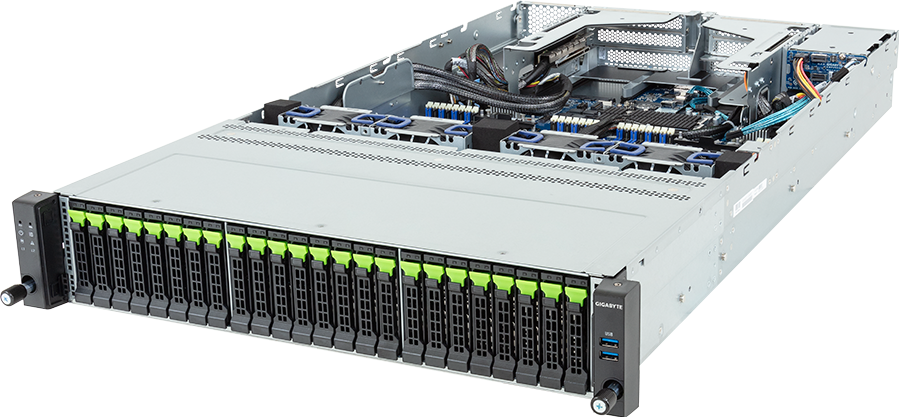
The GIGABYTE R284-S92-AAJ1 is a 2U, dual-socket Intel Xeon 6 server built around fast local storage and high-bandwidth PCIe expansion. It is not a GPU-dense training chassis. Its stronger use cases are NVMe data services, private-cloud infrastructure, software-defined storage, databases, virtualisation and CPU-side services that support larger AI clusters.
That distinction matters when comparing servers. The R284-S92-AAJ1 combines 24 front hot-swap bays, two rear hot-swap bays, 32 DIMM slots and three full-height PCIe Gen5 slots in a conventional 2U footprint. It can therefore place a substantial amount of compute, memory, storage and network bandwidth close together without consuming the rack space or power envelope of an eight-GPU platform.
Platform overview
GIGABYTE specifies two Intel Xeon 6700-series or 6500-series processors, with processor support up to 350 W TDP. The motherboard exposes eight DDR5 memory channels per CPU and 32 DIMM slots across the system. Both DDR5 RDIMM and MRDIMM are supported, allowing a build to favour capacity, bandwidth or a balance of both.
The chassis measures 438 x 87.5 x 815 mm. Power is supplied by a redundant 1+1 pair of 2000 W 80 PLUS Titanium units. Those specifications make the system suitable for normal data-centre racks, but rack depth, input power, power-cord selection and front-to-rear airflow should still be checked before ordering.
Storage layout
Storage is the main reason to consider this model. The front of the server provides 24 x 2.5-inch hot-swap bays supporting PCIe Gen5 NVMe, SATA or SAS-4. Two additional 2.5-inch SATA/SAS-4 hot-swap bays sit at the rear. Two internal M.2 slots provide PCIe Gen5 x4 connectivity for boot or service drives.
The front bays are hybrid interfaces, not 24 separate pools of capacity. A configured server still has 24 physical front positions in total. Mixing NVMe with SATA or SAS is possible only within the supported backplane, cabling and controller arrangement. A quote should therefore state the required drive mix, RAID or HBA choice and boot layout rather than simply listing the maximum for every media type.
For all-NVMe deployments, the platform can support high-throughput datasets, database tiers, model repositories and scratch space. SATA or SAS can be useful where capacity and predictable rebuild behaviour matter more than latency. The two rear bays can keep mirrored operating-system drives separate from the front data set when a SAS or SATA boot design is preferred.
CPU and memory choices
Xeon 6 selection should follow the workload. Core-dense CPUs suit virtualisation, container platforms and highly parallel services. Frequency-focused parts may be more appropriate for databases, software licensing tied to core count, or application stages that do not scale cleanly across many cores. Dual-socket operation also preserves the full memory and I/O topology expected from this platform.
Memory sizing should start with the software's working set and then respect channel population. Thirty-two DIMM slots provide room for capacity, but an efficient build normally populates memory symmetrically across both processors. MRDIMM can raise memory bandwidth for workloads that benefit from it, while conventional RDIMM configurations may offer a broader range of capacities and cost points. Exact speed depends on the selected processors, DIMM type, capacity and population pattern.
PCIe and networking
The R284-S92-AAJ1 provides two full-height, full-length dual-slot PCIe Gen5 x16 positions and one full-height, full-length single-slot PCIe Gen5 x16 position. It also includes an OCP NIC 3.0 PCIe Gen5 x16 slot. This is a useful allocation for high-speed network adapters, DPUs, storage accelerators or a limited number of PCIe devices.
The dual-slot positions can physically accommodate accelerator-class cards, but this should not be confused with a purpose-built multi-GPU server. GPU qualification depends on card dimensions, power, airflow, firmware and GIGABYTE's support list. For most deployments, the slots are more naturally used for 100, 200 or 400 Gb/s networking, storage adapters or specialised I/O.
Two onboard 1 Gb/s ports are provided through an Intel I350-AM2 controller, alongside dedicated management access through the BMC. Production data traffic will usually require an OCP or PCIe network adapter chosen for the target Ethernet or InfiniBand fabric.
Workloads that fit
The platform is a strong candidate for:
- high-density Gen5 NVMe storage nodes;
- database and analytics infrastructure;
- virtualisation and private-cloud compute;
- model repositories, checkpoints and data-preparation tiers;
- CPU-based inference or preprocessing services;
- metadata, orchestration and control-plane roles in AI clusters;
- software-defined storage where local media and fast fabric access are both important.
It is less suitable when the primary requirement is four or more double-width GPUs, an HGX baseboard, or direct liquid cooling. Those jobs call for a GPU-dense chassis designed around accelerator power and airflow.
Configuration points to settle before ordering
Start by confirming the front-drive topology. Record how many positions will use NVMe, how many will use SATA or SAS, and whether hardware RAID is required. Next, choose CPUs and memory together so that memory channels are populated sensibly and the processor I/O topology is not underused.
Network planning should include port speed, media type, switch compatibility and redundancy. A high-throughput NVMe system can easily be constrained by an undersized fabric. Finally, validate rack depth, rail clearance, supply voltage and the expected system load. The 2000 W PSU rating describes available power, not a fixed operating draw.
Frequently asked questions
Does the R284-S92-AAJ1 support 24 NVMe drives?
GIGABYTE specifies 24 front 2.5-inch hot-swap bays with Gen5 NVMe, SATA and SAS-4 support. The final mix depends on the chosen backplane, cabling and storage-controller design.
How many memory slots are available?
The server has 32 DIMM slots, with eight DDR5 channels per processor. It supports DDR5 RDIMM and MRDIMM.
Is this an Intel Xeon 6 platform?
Yes. GIGABYTE lists dual Intel Xeon 6700-series or 6500-series processors for this model.
Can it be configured as a GPU server?
It has two dual-slot PCIe Gen5 x16 positions, but it is primarily a CPU and storage platform. Any accelerator must be checked against the manufacturer's qualification list, power budget and airflow guidance.
What network ports are included?
Two 1 Gb/s Intel ports are onboard. Faster production networking can be added through the OCP NIC 3.0 slot or PCIe Gen5 expansion slots.
Source
Specifications were checked against the GIGABYTE R284-S92-AAJ1 product page. Final component support remains subject to GIGABYTE's current QVL, firmware and ordering documentation.