Buying more drive bays is an expensive response to the wrong diagnosis; R282-P91 needs a defined data path and workload before it needs a quote. The rest of the review tests that decision against workload fit, deployment constraints and the alternatives a buyer should price first.
The buying decision is fairly narrow: choose R282-P91 only after measuring the data path. A chassis with many drives does not fix a metadata bottleneck, a weak network or poor dataset placement; a smaller NVMe tier or a scale-out file system may be the sounder purchase.
Review the R282-P91 configuration options on GPUMachines before treating the base chassis as a finished design.
Executive Summary
The R282-P91 is best suited to AI and HPC teams that need fast, dense storage close to compute nodes, especially for datasets, checkpointing, shared project storage, and high-throughput scratch space.
The headline configuration story is single accelerator support for specialist expansion or light GPU workloads, backed by 2 CPU socket(s), 32 DIMM slots, DDR4, 29 storage positions, and 4 PCIe expansion slots.
It is not the right first purchase if the immediate bottleneck is GPU compute rather than dataset movement, shared storage, or checkpoint performance.
Start configuration here: configure the R282-P91 on GPUMachines.
Key Specifications
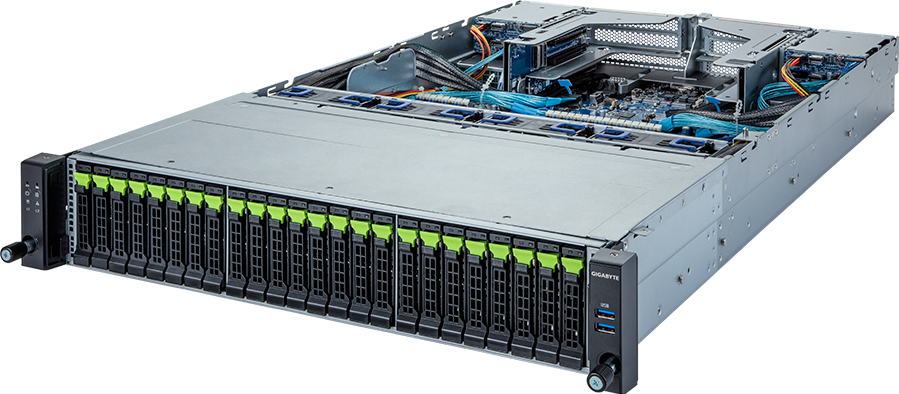
| Area | Specification | | --- | --- | | Form factor | 2U rackmount | | CPU platform | Ampere AmpereOne | | CPU sockets | 2 | | GPU support | single accelerator support for specialist expansion or light GPU workloads | | Memory | 32 DIMM slots, DDR4 | | Storage | 24 x 2.5" Gen4 NVMe hot-swap bays (front), 4 x 2.5" SATA hot-swap bays (rear), 1 x M.2 slot with PCIe Gen4 x4 interface | | PCIe expansion | 4 x FHHL PCIe Gen4 x16 slots; 2 x OCP NIC 3.0 (Gen4 x16), occupied for NVMe support | | Networking | 2 x 1Gb/s LAN ports via Intel I350-AM2 (Rear) + 1 x 10/100/1000 Mbps Management LAN (Rear) | | Power | 1+1 1600W 80 PLUS Platinum redundant power supplies (-100) or 1+1 1600W 80 PLUS Titanium redundant power supplies (-1T0) | | Best-fit workloads | AI dataset staging; checkpoint and model repository storage; NVMe-backed scratch space; shared project storage | | Dimensions | 438 x 87 x 815 mm |
Platform Highlights
- GPU platform: single accelerator support for specialist expansion or light GPU workloads. This matters because accelerator choice drives the rest of the configuration: CPU lanes, rack or chassis power, airflow, local storage, and network design.
- CPU and memory base: Ampere AmpereOne with 32 DIMM slots, DDR4. The right CPU and memory plan should be sized around data preparation, host-side model work, and how many accelerators or services need to be kept busy.
- Storage layout: 24 x 2.5" Gen4 NVMe hot-swap bays (front), 4 x 2.5" SATA hot-swap bays (rear), 1 x M.2 slot with PCIe Gen4 x4 interface. Local NVMe is useful for active datasets, checkpoints, scratch space, and staging work before data moves to shared storage.
- Expansion and networking: 4 x FHHL PCIe Gen4 x16 slots; 2 x OCP NIC 3.0 (Gen4 x16), occupied for NVMe support. NIC placement and PCIe lane planning are important when the system will connect to storage, other GPU nodes, or remote users.
- Power and cooling: 1+1 1600W 80 PLUS Platinum redundant power supplies (-100) or 1+1 1600W 80 PLUS Titanium redundant power supplies (-1T0). Final power draw is configuration-dependent, especially once GPUs, NICs, and NVMe devices are selected.
- Product-specific fit: The product-specific point to notice is dense NVMe or hybrid storage layout. That combination changes the buying conversation from a generic server choice into a decision about rack density, thermal design, accelerator fit, data movement, and operational support.
Our Technical View
In the GPUMachines portfolio, R282-P91 is a supporting infrastructure platform for AI and HPC environments. It should be considered when the performance bottleneck is data movement, shared storage, dataset staging, checkpoint storage, or local scratch capacity rather than raw accelerator compute.
Its strength is in helping GPU estates stay fed with data. It is not a substitute for a GPU training server, and it should be designed alongside the compute layer, network fabric, backup policy, and expected dataset growth.
The product-specific point to notice is dense NVMe or hybrid storage layout. That combination changes the buying conversation from a generic server choice into a decision about rack density, thermal design, accelerator fit, data movement, and operational support.
Best-Fit Workloads
Best-fit workloads include:
- AI dataset staging
- checkpoint and model repository storage
- NVMe-backed scratch space
- shared project storage
- data services for GPU clusters
- backup and replication targets
Who Should Consider It
The R282-P91 makes sense when the project needs a properly specified infrastructure node, not just a part number. For AI teams, that usually means thinking through data movement, GPU or CPU utilisation, local scratch, shared storage, network fabric, and how the server will be operated after delivery.
It is most relevant for buyers that already understand their workload profile, have a target deployment model, and need help turning that requirement into a balanced hardware configuration. That may mean on-premise ownership, a hosted system, a leased deployment, or part of a larger private AI cluster.
Who Should Not Buy It
This should not be bought as a shortcut to faster model training if the real limit is GPU capacity. It is also excessive for small teams with modest datasets that can live on workstation NVMe or a simpler NAS.
Architecture Notes
Storage servers become important when the GPU estate is waiting on data. Training datasets, checkpoints, model repositories, synthetic data, and shared project files can all create pressure on the storage layer.
For R282-P91, the right design depends on whether it will act as local scratch, shared storage, a dataset staging node, or part of a larger storage fabric. Drive type, network adapters, filesystem choice, and backup policy should be planned with the compute layer in mind.
Configuration Guidance
Important configuration decisions include:
- CPU choices include Ampere Altra Max M96-28 (96C, 2.8 GHz), Ampere Altra Max M96-30 (96C, 3.0 GHz), Ampere Altra Max M128-26 (128C, 2.6 GHz)
- Memory can be sized from options such as 16GB DDR5-4800 ECC REG, 32GB DDR5-4800 ECC REG, 64GB DDR5-4800 ECC REG
- Storage can be configured with 1TB NVMe M.2 SSD, 2TB NVMe M.2 SSD, 4TB NVMe M.2 SSD
- Networking options include high-speed Ethernet and InfiniBand adapters for cluster or storage traffic
- decide whether the platform is acting as scratch, dataset staging, checkpoint storage, shared storage, or a storage-adjacent service node
For storage-heavy deployments, focus on drive layout, networking, filesystem behaviour, replication, and how often training jobs need to read datasets or write checkpoints. GPUMachines can review the final configuration during quoting, but buyers should still define the intended workload, data sources, model size, user count, storage pattern, and network environment before selecting components.
Recommended Configuration Paths
- Best for dataset staging: prioritise NVMe or high-throughput drive layout, fast networking, and enough CPU capacity for file services.
- Best for checkpoint storage: plan write performance, usable capacity, redundancy, and network bandwidth around training job behaviour.
- Best for shared project storage: balance capacity, replication, backup, and access patterns instead of only maximising raw drive count.
Alternatives and Related Systems
If the bottleneck is accelerator compute rather than data movement, compare PCIe GPU servers, HGX systems, or a tower GPU workstation. If storage must sit close to hosted GPU nodes, GPUMachines can discuss hosted deployment options.
Buying Through GPUMachines
The fastest next step is to use the R282-P91 configurator and select the CPU, RAM, storage, GPU, and networking options that match your workload. GPUMachines can then review the build for compatibility, thermals, power draw, lead time, and cluster fit.
For teams without suitable data centre space, GPUMachines can also discuss Buy & Host, leasing, and GPU Cloud alternatives. That is especially useful when the server needs high-density power, managed networking, or a private hosted environment.
Data Path Notes
R282-P91 should be judged by how it protects the GPU estate from waiting on data. Storage systems do not make training runs faster by magic, but weak storage can make strong accelerators sit idle. The useful review starts with read pattern, write pattern, rebuild behaviour and how many clients will hit the system at once.
The starting detail is single accelerator support for specialist expansion or light GPU workloads. Capacity is only part of the answer. Dataset staging, checkpoint writes, user home directories, model repositories and logs all behave differently. A system that works for archive storage may struggle with many parallel training jobs, while a fast scratch design may be the wrong home for long-term retention.
Networking also deserves early attention. The listed network path is 2 x 1Gb/s LAN ports via Intel I350-AM2 (Rear) + 1 x 10/100/1000 Mbps Management LAN (Rear), but the final choice should separate management, storage and workload traffic where the deployment needs that separation. Storage traffic can become noisy fast. If the same network carries management, user access and checkpoint writes, troubleshooting becomes harder than it needs to be. GPUMachines can review whether the storage node should sit behind Ethernet, InfiniBand, a dedicated storage fabric or a simpler management path.
Power is not a footnote here: 1+1 1600W 80 PLUS Platinum redundant power supplies (-100) or 1+1 1600W 80 PLUS Titanium redundant power supplies (-1T0). Before purchase, check the rack feed, redundancy plan, heat load and service process against the target site. Drive service access, spare policy, firmware updates and monitoring matter more than they first appear. The buying decision should include how failed media will be replaced, how data will be protected during rebuilds and how the storage tier will grow when datasets double.
For AI teams, the most useful question is plain: will this system keep the GPUs fed during the week you actually have, not the benchmark you hoped for? If the answer is uncertain, run a smaller pilot or compare hosted capacity before scaling the storage layer.
Also check the operational rhythm. Who owns snapshots, quotas, failed drives, firmware, alerts and growth planning? Storage becomes political quickly when every team thinks its data is the urgent data. A good configuration gives those arguments somewhere sane to land: clear tiers, known limits and enough monitoring to catch trouble before the training queue stalls.
FAQ
Is R282-P91 better for training or inference?
It is not primarily a GPU training system. It is better viewed as supporting infrastructure around GPU workloads.
How much RAM should I configure?
RAM is configuration-dependent. Match memory capacity to CPU count, dataset preparation, model serving processes, virtualisation needs, and whether the system will run storage or orchestration services alongside GPU workloads.
Does this system need InfiniBand or 400GbE?
High-speed networking depends on deployment design. Single-node systems may only need fast Ethernet, while multi-node training, shared storage, and hosted GPU environments often justify 100GbE, 200GbE, 400GbE, InfiniBand, or separate management networks.
Is this overkill for small AI workloads?
It can be. If the workload is a small inference endpoint, proof-of-concept project, or one-GPU development task, a smaller workstation, hosted GPU option, or lower-density server may be more practical.
Can GPUMachines host this system?
GPUMachines can discuss hosted deployment, leasing, and Buy & Host options where appropriate. This is especially useful when rack power, cooling, remote access, or data-centre operations are concerns.
What should I check before deploying it in a data centre?
Review rack depth, power feeds, cooling, service access, networking, management separation, storage integration, and whether the system needs to operate alone or as part of a cluster.
Verdict
The R282-P91 is a strong fit when you want a configurable storage server that can be matched to a real AI, HPC, rendering, storage, or infrastructure workload. Its value is not only in the headline component list, but in how those components are selected and integrated.
Choose it when your team needs a serious infrastructure node with expert configuration support and a clear path to on-premise, hosted, or cluster deployment.
Configure it here: R282-P91 on GPUMachines.