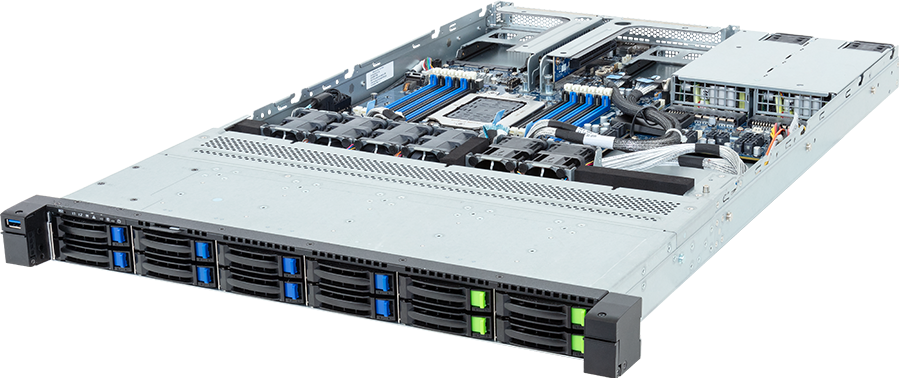
The GIGABYTE R143-E32-AAH1 is a short-depth 1U, single-socket server for storage, edge, telco and private-cloud roles. Its front panel has 12 hot-swap 2.5-inch bays, but they are not 12 interchangeable NVMe positions. Four bays accept PCIe Gen5 NVMe, SATA or SAS-4 drives. The other eight accept SATA or SAS-4. That physical split is the first fact to preserve when specifying the system.
The current 2026 platform supports AMD EPYC 8005 and EPYC 8004 processors in the SP6 socket, 12 DDR5 RDIMM slots, two full-height PCIe Gen5 x16 slots and two OCP NIC 3.0 Gen5 x16 positions. The AAH1 suffix identifies the version with 1+1 1300 W 80 PLUS Titanium power supplies. GIGABYTE's closely related AAC1 model uses Platinum-rated supplies, so the suffix must remain part of every quote and source check.
Configure the GIGABYTE R143-E32-AAH1 after deciding how the four hybrid bays, eight capacity bays, two OCP slots and two PCIe slots will be used. A reliable storage server begins with those shared physical limits, not a list of drive interfaces added together.
R143-E32-AAH1 specification summary
| Area | Current published specification | Design consequence | | --- | --- | --- | | Chassis | 1U, 438 x 43.5 x 710 mm | Short enough for many edge and communications racks, subject to rail and cable clearance | | Processor | One AMD EPYC 8005 or EPYC 8004 CPU, SP6 | A right-sized single-socket platform rather than a dual-socket compute node | | CPU power | Up to 225 W cTDP | Processor choice must remain inside the 1U cooling envelope | | Memory | 12 DDR5 RDIMM slots, six channels | Two DIMMs per channel are possible, with a speed trade-off at 2DPC | | Fast front storage | Four 2.5-inch Gen5 NVMe/SATA/SAS-4 hot-swap bays | Four shared positions, not four of each interface | | Capacity front storage | Eight 2.5-inch SATA/SAS-4 hot-swap bays | No published NVMe path in this second group | | Internal storage | One M.2 2280/22110 slot, PCIe Gen3 x4 | Suitable for a supported boot or service drive plan | | PCIe expansion | Two FHHL Gen5 x16 slots | Available for storage, security or network adapters | | OCP expansion | Two OCP NIC 3.0 Gen5 x16 slots with NCSI | Supports dense networking without consuming both standard PCIe slots | | Onboard network | One Intel I210-AT 1GbE port plus management LAN | Production data networking normally needs an OCP or PCIe NIC | | Power | 1+1 1300 W 80 PLUS Titanium supplies | Redundancy and maximum output depend on input voltage | | Management | ASPEED AST2600 BMC and GIGABYTE Management Console | Provides remote console, monitoring and firmware-management functions |
GIGABYTE's current ordering number for the barebone is 6NR143E32DR000AAH1. Older documents and regional pages may show the former EPYC 8004-only specification or a different chassis depth. Use the current AAH1 datasheet and support page for the build being quoted.
EPYC 8005 and 8004: why the update matters
AMD EPYC 8005 extends the SP6 single-socket range beyond the earlier EPYC 8004 generation. AMD lists 8005 models from 8 to 84 cores in a 70 to 225 W range, with six DDR5 memory channels and up to 96 PCIe Gen5 lanes. EPYC 8004 covers 8 to 64 cores and a lower top-end power envelope. Both families are designed for compact, single-socket systems rather than conventional dual-socket SP5 servers.
The 8005 option changes the value of this chassis. A newer Zen 5 CPU can raise per-core performance, core count and memory speed without forcing the buyer into a deeper or higher-power dual-socket platform. That can help storage services, edge virtualisation and network applications where rack depth, power or software licences matter as much as maximum socket count.
Select the processor from the work performed outside the drives:
- Software-defined storage can need CPU time for checksums, compression, erasure coding and encryption.
- A storage gateway may process file, block or object protocols while handling network interrupts.
- Edge virtualisation needs enough cores for guest workloads plus the host and storage services.
- A security or packet-processing appliance may favour clock speed and deterministic latency.
- A simple backup target may not benefit from the highest core count if disk and network throughput are the real limits.
Do not populate this SP6 server with an EPYC 9004 or 9005 CPU. Those processors use SP5 and a different memory and I/O design. The product configurator should expose the 8005 and 8004 families qualified for the ME33-DC0 motherboard, including the current processor generation rather than only the launch-era list.
Memory channels, slots and operating speed
The R143-E32-AAH1 has 12 RDIMM slots across six memory channels. That means it can run one DIMM per channel with six modules or two DIMMs per channel with 12. Capacity and bandwidth should be planned together.
GIGABYTE publishes these maximum memory rates:
- EPYC 8005: up to 6400 MT/s at one DIMM per channel and 5200 MT/s at two DIMMs per channel.
- EPYC 8004: up to 4800 MT/s at one DIMM per channel and 3600 MT/s at two DIMMs per channel.
The final speed also depends on the CPU, module part number, rank and firmware. Twelve DIMMs may deliver the required capacity but operate more slowly than a six-DIMM build. For a storage service that moves data through compression, encryption or erasure coding, using all six channels is usually more valuable than installing the fewest possible modules.
Size system memory around the workload rather than the raw drive count. File-system cache, metadata, virtual machines, containers, deduplication indexes and storage services can all compete for RAM. Where a software vendor gives a memory-per-terabyte or memory-per-service rule, apply it to the usable data set and protection scheme, not only the nominal sum of drive labels.
Use matched enterprise RDIMMs from the current GIGABYTE QVL. Record the exact module, quantity and expected operating rate in the configuration. A generic entry such as "DDR5 memory" is not enough to predict channel use or speed.
The 12-bay front is two different storage pools
The front backplane is the central feature of the server. It has two groups with different connectivity:
Four Gen5 hybrid bays
The first four positions can use PCIe Gen5 NVMe, SATA or SAS-4 drives. Each bay is still one physical slot. A build with two NVMe SSDs and two SATA SSDs has filled the four-bay group. It cannot add four SAS drives to the same positions.
These bays suit the highest-traffic tier. Possible uses include a mirrored NVMe metadata pair, a four-drive flash pool, database journals, cache devices or fast application data. The right choice depends on the storage software and failure model. Mixing interfaces should be done only where the backplane, controller and operating system support the intended arrangement.
Eight SATA or SAS-4 bays
The other eight positions support SATA or SAS-4. GIGABYTE does not publish an NVMe path for this group. These bays can provide a larger flash-capacity tier using enterprise SATA SSDs or a SAS tier with dual-port and controller features where the chosen design calls for them.
SAS operation requires an add-in SAS card. The barebone does not turn the ports into a managed SAS or RAID subsystem by itself. Include the controller, internal cabling, firmware policy and slot consumption in the quote.
One internal M.2 slot
An internal M.2 slot accepts 2280 or 22110 devices over PCIe Gen3 x4. It may be useful for a boot or service drive, but boot resilience must be designed. One internal device is not a redundant operating-system mirror. Where the platform or operating standard requires mirrored boot media, use a supported controller or front-bay arrangement and document the recovery process.
RAID, HBA and software-defined storage
GIGABYTE states that RAID requires add-in cards. This leaves the buyer with three broad approaches:
- A hardware RAID controller for firmware-managed virtual disks, cache and established enterprise operations.
- An HBA for direct drive access while the operating system or storage stack handles protection.
- Direct NVMe paths for software-defined storage that manages namespaces, replicas or erasure coding above the hardware.
None of these is universally best. Hardware RAID may fit a conventional virtualisation host or application server. An HBA can be preferable for ZFS, Ceph and other stacks that need direct knowledge of each drive. NVMe software-defined designs may avoid a traditional RAID controller altogether. The decision should follow the software vendor's support matrix and the required failure behaviour.
A controller also consumes one of the two full-height PCIe x16 positions. Check whether its connector layout and cables match both backplane groups. If the second conventional slot is needed for a high-speed NIC, the two OCP positions become particularly useful.
The configurator should not simply offer 12 NVMe drives or independent maximum quantities for NVMe, SATA and SAS. It should enforce a common limit of four across the hybrid group and a common limit of eight across the SATA/SAS group. RAID cards should remain selectable for this storage-category product without implying that every software-defined build needs one.
Two OCP slots change the network plan
The motherboard includes one 1GbE data port through an Intel I210-AT controller and a separate management connection. That onboard data interface is useful for initial access or a light service, but it is unlikely to carry the main traffic of a 12-bay storage node.
Two OCP NIC 3.0 positions each have PCIe Gen5 x16 connectivity and support NCSI. They allow the server to take modern Ethernet adapters without using the two standard full-height slots. Depending on the role, that can support:
- Separate client and storage networks.
- Redundant links to two switches.
- A high-speed storage fabric and an independent service network.
- Network functions that require a specific adapter or offload feature.
Choose link speed from the usable drive throughput and traffic pattern. A four-drive Gen5 NVMe tier can exceed the capacity of a single 10 or 25GbE connection. An eight-drive SATA tier may still justify 25, 50 or 100GbE when several clients access it concurrently. Faster port labels do not guarantee application throughput; the CPU, file system, protocol, switch and client paths must keep up.
For general Ethernet configurations, NVIDIA ConnectX adapters provide current 25, 100, 200 and 400GbE options where supported. Intel remains a sensible source for standard 10GbE SFP+ or RJ45 requirements. Confirm the exact OCP form factor, firmware and thermal qualification before ordering.
PCIe expansion and lane budgeting
The two full-height, half-length PCIe Gen5 x16 slots can host storage controllers, network adapters, accelerators or other supported devices. They are not evidence that the R143-E32-AAH1 is a GPU server. A 1U chassis has strict card-height, length, airflow and power limits, and GIGABYTE markets this system for networking and hybrid/private cloud roles.
Build a slot map before selecting parts. It should show:
1. Any SAS HBA or RAID controller and the backplane ports it serves. 2. The primary data NIC and whether it uses OCP or standard PCIe. 3. A redundant or separate storage NIC if required. 4. Any security, timing, compression or packet-processing card. 5. Cable routing and service access for every selected adapter.
The EPYC 8005/8004 platform supplies enough PCIe lanes for this layout, but a lane count alone does not settle device support. Use GIGABYTE's support list and confirm BIOS, firmware and airflow for the finished server.
Power, voltage and rack deployment
AAH1 uses two 1300 W 80 PLUS Titanium supplies in a 1+1 arrangement. The system can accept 100 to 240 V AC, but maximum output changes with the feed:
- At 100 to 127 V AC, the manual states a maximum of 1000 W per supply.
- At 200 to 240 V AC, the maximum rises to 1300 W per supply.
The default chassis is unlikely to need 2.6 kW of continuous power, and 1+1 does not mean both supplies should be treated as additive capacity. Size the build so one supply can carry the supported load when redundancy is required. Include CPU cTDP, memory, all drives, controllers, OCP adapters, motherboard and fan power in the estimate.
Six high-speed 40 mm fans cool the system: four 40 x 40 x 56 mm units and two 40 x 40 x 28 mm units. A 1U platform can be acoustically loud and should not be treated as an office or studio workstation. GIGABYTE gives a 10 to 35 C operating range, but the selected components and facility airflow determine the practical limit.
The chassis depth is 710 mm in the current datasheet. The included two-section rail kit does not support a cable-management arm; GIGABYTE lists a three-section rail kit and CMA as optional parts. Confirm rack-post spacing, rail compatibility, rear cable loops and PDU clearance for the intended cabinet.
Management and operational controls
An ASPEED AST2600 BMC provides out-of-band management through GIGABYTE Management Console. Remote console, sensor readings, event logs, firmware operations and media redirection help operators manage systems that are placed in edge sites or private data centres.
The management network should be separated from storage and user traffic. Restrict access, use named accounts, rotate credentials, keep BMC firmware current and send logs to the monitoring platform. NCSI support on the OCP interfaces may be useful, but sharing a physical data link with management should be an explicit design decision rather than the default.
Drive monitoring also needs attention. Hardware RAID, an HBA and direct NVMe can expose health data in different ways. Confirm how the chosen stack reports media errors, temperature, wear, predictive failure and controller events. A hot-swap bay is only operationally useful if the team can identify the failed device and replace it without ambiguity.
Suitable workloads
The R143-E32-AAH1 fits:
- A compact all-flash or mixed-media storage server with four fast NVMe positions.
- A backup, archive or repository node using enterprise SATA or SAS drives.
- A storage gateway connecting local media to a faster Ethernet fabric.
- Edge and telco applications that need enterprise x86 compute in a 710 mm chassis.
- Private-cloud infrastructure where OCP networking and two PCIe slots are more valuable than a second CPU socket.
- A virtualisation host with a moderate VM count and a carefully designed local storage pool.
- Network or security services that use SP6 efficiency and dedicated add-in cards.
It is a poor fit when:
- The design needs more than four front NVMe drives.
- Two CPU sockets or 12 memory channels are required.
- A GPU-dense compute chassis is the real requirement.
- The software needs a controller or drive model absent from the current support list.
- A single 1GbE connection is expected to serve the full storage workload.
- The rack cannot accommodate the rails, rear cables or 1U airflow.
For systems with a larger NVMe tier, compare the wider storage server range. If the workload is mainly general-purpose compute without the 12-bay requirement, the CPU server catalogue may offer a better balance.
Configuration checklist
Before approving the server, record:
1. The exact EPYC 8005 or 8004 processor and cTDP. 2. Six-channel or 12-DIMM memory population, module part number and expected speed. 3. Which four hybrid bays use NVMe, SATA or SAS. 4. Which eight capacity bays use SATA or SAS. 5. The purpose and protection method for the internal M.2 device. 6. HBA or RAID controller model, firmware, cabling and slot. 7. OCP and PCIe NIC models, link speeds, optics or cables and switch ports. 8. Software-defined storage, file system or RAID layout and usable capacity. 9. Failure-domain, spare-drive and rebuild policy. 10. Input voltage, PDU, power redundancy and measured load target. 11. Rail kit, optional cable-management arm and rear service clearance. 12. BMC network, access controls, monitoring and firmware process.
Acceptance testing should include drive discovery, hot-swap behaviour, controller failover where applicable, sustained storage traffic, network throughput, thermal readings and recovery from a failed power feed. A successful boot does not prove that a protected storage pool will behave correctly during a fault.
FAQ
Does the R143-E32-AAH1 support AMD EPYC 8005?
Yes. GIGABYTE's current 2026 datasheet lists both EPYC 8005 and EPYC 8004 server processors, with a single SP6 socket and cTDP support up to 225 W. Older pages may show only EPYC 8004 because they pre-date the update.
Are all 12 front bays NVMe capable?
No. Four bays support Gen5 NVMe, SATA or SAS-4. The other eight support SATA or SAS-4. The first group has a shared four-drive physical limit, and the second has a shared eight-drive limit.
Is a SAS or RAID controller included?
GIGABYTE states that SAS and RAID require add-in cards. Select a supported HBA or RAID controller according to the storage software, backplane cabling and protection method.
What is the difference between AAH1 and AAC1?
AAH1 is the 80 PLUS Titanium PSU version. AAC1 is the closely related Platinum PSU version. Keep the exact suffix in product names, source links and quotes because power-supply efficiency and ordering codes differ.
How many DIMMs should be installed?
Six DIMMs use one module in each memory channel. Twelve use two per channel and can raise capacity, but GIGABYTE publishes a lower maximum memory speed at 2DPC. Choose the population from capacity and bandwidth requirements together.
Does it include high-speed networking?
The onboard data port is 1GbE. Two OCP NIC 3.0 Gen5 x16 positions and two conventional Gen5 x16 slots allow faster supported adapters to be added. Production storage traffic should normally use one of those expansion paths.
Can it be used as a GPU server?
This is a storage, networking and private-cloud rack server, not a GPU-dense platform. The PCIe slots do not override the 1U mechanical, thermal and power limits. Use a qualified GPU server for accelerator-heavy workloads.
Verdict
The GIGABYTE R143-E32-AAH1 offers an unusually useful mix for a 710 mm-deep 1U server: current EPYC 8005/8004 support, 12 RDIMM slots, four Gen5 hybrid bays, eight SATA/SAS bays, two OCP positions and two standard PCIe slots. It can become a capable storage, edge or network node without the cost and power of a dual-socket platform.
Its value depends on respecting the boundaries. Only four front bays support NVMe, SAS and RAID need add-in hardware, the base data port is 1GbE and two-DIMM-per-channel memory runs at a lower maximum rate. A sound build maps each physical bay, slot and network path before parts are selected.
Open the R143-E32-AAH1 configurator and submit the intended storage software, usable capacity, protection method, network speed and rack constraints for review.
Technical sources
- GIGABYTE R143-E32-AAH1 product page
- GIGABYTE R143-E32-AAH1 qualified-component list
- GIGABYTE R143-E32-AAH1 2026 datasheet
- GIGABYTE R143-E32 system manual
- AMD EPYC 8005 server processor overview
- AMD EPYC 8004 architecture overview
Specifications, firmware and qualified components can change. Confirm the current GIGABYTE support list and supplier-approved bill of materials before ordering.