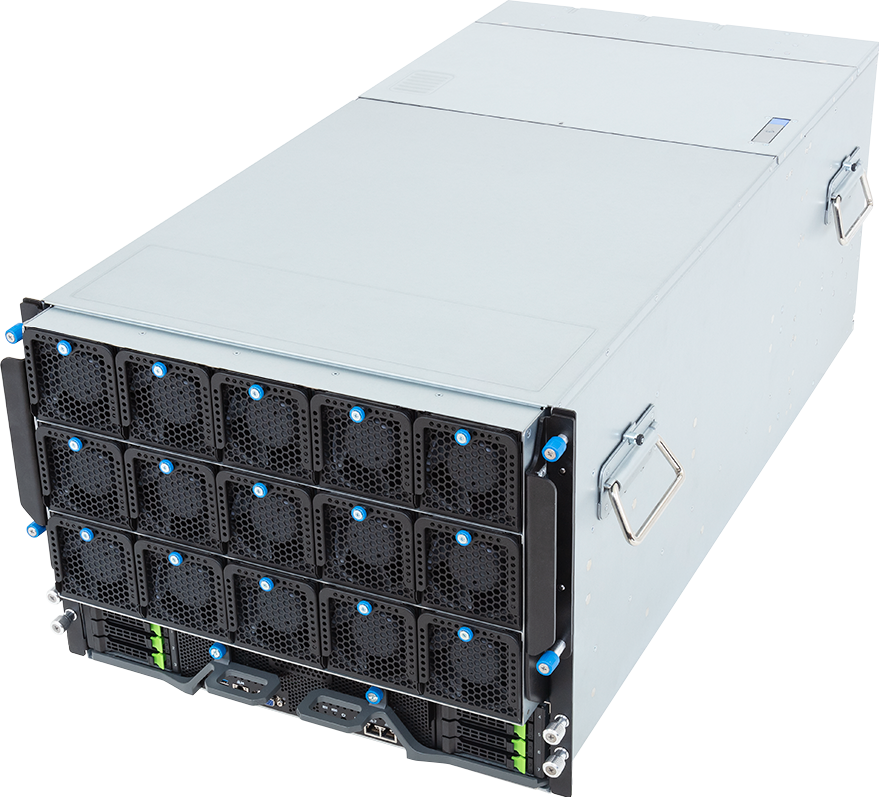
The GIGABYTE G894-SD1-AAX5 is an 8U NVIDIA HGX B200 server with eight Blackwell SXM GPUs, two Intel Xeon 6 processors and room for a substantial scale-out network configuration. It targets large-model training, fine-tuning, high-throughput inference and accelerated computing where all eight GPUs work as one scale-up node.
This is not an eight-card PCIe server. NVIDIA's HGX B200 baseboard links the accelerators through fifth-generation NVLink and fourth-generation NVSwitch, giving each GPU up to 1.8 TB/s of GPU-to-GPU bandwidth. The host chassis then supplies CPU, memory, local NVMe, network expansion, power and cooling around that fixed accelerator platform.
Configure the GIGABYTE G894-SD1-AAX5 or ask GPUMachines to turn a workload and rack brief into a checked quotation.
G894-SD1-AAX5 specifications
| Area | Manufacturer specification | | --- | --- | | Form factor | 8U, 447 x 351 x 923 mm | | GPU platform | NVIDIA HGX B200 with 8 x Blackwell SXM GPUs | | Scale-up fabric | Fifth-generation NVLink and fourth-generation NVSwitch | | GPU memory | Up to 1,440 GB HBM3E across the HGX baseboard | | Host processors | 2 x Intel Xeon 6700 or 6500 series, up to 350 W TDP | | CPU sockets | 2 x LGA 4710, Socket E2 | | System memory | 32 x DDR5 RDIMM or MRDIMM slots, eight channels per CPU | | Front storage | 8 x 2.5-inch hot-swap PCIe Gen5 NVMe bays | | Internal storage | 2 x M.2: one Gen5 x4 and one Gen5 x2 | | Expansion | 4 x dual-slot FHHL Gen5 x16 and 8 x single-slot FHHL Gen5 x16 | | Onboard network | 2 x 10GbE through Intel X710-AT2, plus management LAN | | Power supplies | 6+6 redundant 3,000 W, 80 PLUS Titanium | | Listed net weight | 91.6 kg |
Why HGX B200 is different from a PCIe GPU server
The eight B200 GPUs sit on NVIDIA's HGX baseboard rather than occupying the server's rear PCIe slots. NVIDIA lists up to 1,440 GB of HBM3E for the eight-GPU platform, equivalent to 180 GB per GPU, along with 14.4 TB/s aggregate NVLink bandwidth. That scale-up connection matters for jobs that split model layers, tensors or expert routing across several GPUs.
A PCIe server can be the better purchase when accelerators run mostly independent jobs. G894-SD1-AAX5 earns its place when communication inside the node affects training or inference time. Large parameter counts alone do not prove the case; profile the actual framework, parallelism method, batch pattern and context length.
The fixed HGX platform also changes maintenance and procurement. Buyers select a complete B200 baseboard and build the host around it. The rear slots remain available for approved network and storage devices, but they should not appear in the configurator as twelve extra user-selectable GPUs.
Xeon 6 host and system memory
GIGABYTE supports two Intel Xeon 6700 or 6500 series processors with a maximum TDP of 350 W each. Both CPUs must be installed for full access to memory and PCIe resources. The board has 32 DIMM slots, arranged across eight memory channels per socket.
With RDIMMs, the manufacturer lists speeds up to 6,400 MT/s at one DIMM per channel and 6,000 MT/s at two DIMMs per channel. Select Xeon 6 P-core processors can use MRDIMMs up to 8,000 MT/s in a one-DIMM-per-channel layout. The product configurator must keep those memory types and processor rules together; offering an MRDIMM with an unsupported CPU would create a plausible-looking but invalid build.
Capacity matters as much as speed. NVIDIA's current HGX AI Factory reference calls for at least 1.5 TB of host memory across both sockets, fully and symmetrically populated, for its H100, H200 and B200 node profile. That is a reference-architecture recommendation rather than GIGABYTE's minimum boot requirement, but it is a useful starting point for serious training nodes.
Local NVMe and expansion
Eight front 2.5-inch hot-swap bays connect as PCIe Gen5 NVMe through a switch. GIGABYTE also provides two internal M.2 sockets, one at Gen5 x4 and one at Gen5 x2. The layout supports mirrored boot media, model staging, checkpoint writes and fast scratch space, but the exact drive roles should be planned before choosing capacity.
Twelve FHHL Gen5 x16 slots provide four dual-width positions and eight single-width positions. GIGABYTE explicitly lists compatibility with NVIDIA BlueField-3 DPUs and ConnectX-7 adapters. Slot count alone does not define a valid network build, because cards still need the right risers, lane ownership, airflow, firmware and cable path.
Networking for one node and for a cluster
Two Intel X710-AT2 10GbE ports cover ordinary data or service connectivity, and the chassis has separate management interfaces. Those ports do not constitute a B200 training fabric. A standalone inference node might need only a modest north-south connection, while multi-node training can consume several high-speed links per server.
NVIDIA's HGX AI Factory reference describes up to eight BlueField-3 SuperNICs at up to 400Gb/s each for east-west traffic, plus a separate DPU. That is an architecture example, not a statement that these adapters ship in the G894-SD1-AAX5. GPUMachines should size adapter count and speed from the chosen topology, then check switches, transceivers, fibre or copper reach and port availability as part of the same bill.
Power, airflow and physical handling
The G894-SD1-AAX5 uses twelve 3,000 W Titanium PSUs in a 6+6 redundant arrangement. Six supplies form the active capacity and six provide redundancy under the specified input conditions. The 36 kW sum of all labels is not a wall-power estimate, nor is 18 kW a guaranteed operating draw. Rack planning needs a configuration-specific load for the HGX board, CPUs, DIMMs, drives, NICs and fans.
Cooling remains air based, with fifteen 80 x 80 x 80 mm fans in the GPU tray as well as separate motherboard and PCIe fan banks. The system requires 200 to 240 V input to obtain full PSU output, and GIGABYTE specifies C19 power cords. Confirm feeds, connectors, redundancy, hot-aisle capacity and acoustic restrictions with the intended site.
At 923 mm deep and 91.6 kg before a full site configuration, the server also needs confirmed rack depth, rails, service clearance and suitable lift equipment.
Suitable workloads
G894-SD1-AAX5 suits organisations that already know why they need an eight-GPU scale-up domain:
- Pre-training and continued training of large language or multimodal models.
- Fine-tuning jobs whose tensor or pipeline parallelism uses high intra-node bandwidth.
- High-throughput inference where model size, context length or concurrency fills B200 memory.
- Scientific computing and simulation built for CUDA and the Blackwell software stack.
- Shared private-AI services with scheduling, monitoring and sustained user demand.
It is hard to justify for independent single-GPU jobs, sporadic development work or sites that cannot supply the electrical and cooling envelope. A smaller PCIe GPU server can deliver better utilisation and simpler maintenance for those cases.
What to settle before quotation
Run a representative workload first, recording GPU memory use, inter-GPU traffic, host-memory pressure and storage throughput. Choose CPUs and DIMMs together under the RDIMM or MRDIMM rules, define each local drive's role, and map every DPU, SuperNIC or storage adapter to an approved slot and switch port. The site brief should state usable rack power, voltage, redundancy policy, cooling capacity and rack depth. For clusters, add oversubscription, storage traffic and management isolation.
Frequently asked questions
How many GPUs are in the G894-SD1-AAX5?
It contains an NVIDIA HGX B200 platform with eight Blackwell SXM GPUs. They form a fixed baseboard and communicate through NVLink and NVSwitch.
How much GPU memory is available?
NVIDIA specifies up to 1,440 GB of HBM3E across the eight-GPU HGX B200 baseboard. Software still allocates memory per GPU and coordinates it through the chosen parallelism method.
Does it support Xeon 6 MRDIMMs?
Yes, with restrictions. GIGABYTE lists MRDIMM speeds up to 8,000 MT/s for select Xeon 6 P-core processors at one DIMM per channel. The CPU, memory type, quantity and speed must form a supported combination.
Are BlueField-3 and ConnectX-7 cards included?
GIGABYTE lists the server as compatible with them, but the final adapter set depends on the ordered configuration. Do not assume that a barebone includes the scale-out fabric.
Can the onboard 10GbE ports run a B200 cluster?
They can handle management or modest service traffic, but they are not a sensible fabric for communication-heavy multi-node training. Select the high-speed network from measured workload and topology requirements.
Verdict
The G894-SD1-AAX5 packages NVIDIA HGX B200 into an expandable 8U Intel platform with 32 DIMM slots, eight front Gen5 NVMe bays and twelve Gen5 adapter slots. It is built for buyers who can use eight tightly connected Blackwell GPUs and operate the surrounding infrastructure properly. For that audience, the flexible host and network layout are useful; for lighter work, they add cost and facility demand without enough return.
Build a GIGABYTE G894-SD1-AAX5 configuration and have GPUMachines check memory rules, network placement, rack power and storage before a quote is finalised.