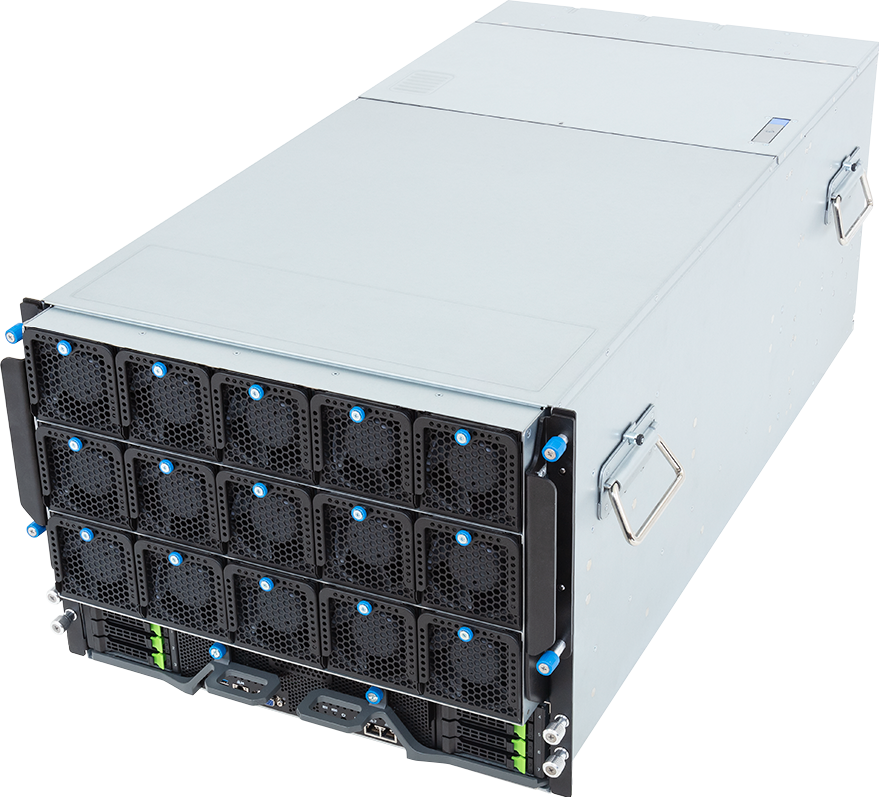
The GIGABYTE G893-ZX1-AAX3 is an 8U accelerator server built around eight AMD Instinct MI350X OAM GPUs. It combines the fixed eight-GPU compute module with two AMD EPYC processors, 24 DDR5 DIMM slots, eight front Gen5 NVMe bays and substantial PCIe Gen5 expansion. This is a scale-up AI and HPC platform for organisations that need one large GPU node, not a conventional PCIe server with individually selected cards.
The model suffix matters. GIGABYTE uses closely related G893 variants for different AMD Instinct generations. AAX3 denotes MI350X, while other variants in the family may use MI300X, MI325X or MI355X. Procurement documents, software validation and power planning should name the complete G893-ZX1-AAX3 model rather than referring only to the chassis family.
Eight AMD Instinct MI350X accelerators
The server contains eight AMD Instinct MI350X GPUs in OAM form. These accelerators are part of an integrated compute platform and are not chosen from the same menu as ordinary PCIe cards. The value of this design is the tightly connected GPU complex, which supports large training, inference and HPC jobs that need fast communication across all eight accelerators.
A buyer should validate the intended framework, ROCm release, model precision and distributed strategy before ordering. Peak hardware capability does not remove the need for software qualification. Libraries, container images, collective communication settings and workload-specific kernels determine how effectively an application uses the node.
The system is suitable for large-language-model training and fine-tuning, high-throughput inference, scientific simulation, computational chemistry, weather and engineering workloads, and other parallel applications already supported on AMD Instinct. It may be less suitable where the software stack is tied exclusively to CUDA or where a smaller number of replaceable PCIe cards would provide enough capacity.
EPYC host platform and memory
GIGABYTE specifies dual AMD EPYC 9005 or 9004 series processors, with CPU support up to 500 W cTDP. Each processor has twelve DDR5 memory channels, and the server provides 24 DIMM slots in total. EPYC 9005 configurations support DDR5 RDIMM speeds up to 6400 MT/s, while the published EPYC 9004 limit is lower.
Host CPU selection should reflect data preparation, storage traffic, networking and application orchestration rather than simply maximising core count. GPU-heavy jobs can still stall when tokenisation, decompression, graph preparation or checkpoint handling cannot keep pace. Memory should be populated symmetrically across both sockets so the platform retains balanced bandwidth and NUMA behaviour.
Local storage
Eight front hot-swap 2.5-inch bays provide PCIe Gen5 NVMe connectivity. They are well suited to operating datasets, checkpoint staging, local scratch space and cache tiers. Two internal M.2 positions, one at PCIe Gen3 x4 and one at Gen3 x1, can be used for boot or service storage.
Eight local NVMe drives do not replace a cluster storage design. A training estate may still need a high-throughput shared filesystem, object storage or a data pipeline capable of feeding multiple nodes. Local drives are most useful when their role is explicit: fast staging, repeatable datasets, checkpoint recovery or spill capacity.
Expansion and networking
The G893-ZX1-AAX3 provides four full-height, full-length dual-slot PCIe Gen5 x16 positions and eight full-height, full-length single-slot Gen5 x16 positions through its PCIe bridge architecture. GIGABYTE also states compatibility with the AMD Pensando Pollara 400 AI NIC. This gives designers room for high-speed fabric adapters, DPUs and specialised I/O without consuming the accelerator module.
Two onboard 10 Gb/s Ethernet ports use an Intel X710-AT2 controller. Those ports are useful for management or service traffic, but they are not an adequate training fabric for an eight-GPU node. Production designs should define the number and speed of fabric links, switch topology, rail mapping, transceivers and cables as part of the system configuration.
For multi-node training, network design must be considered alongside the GPU topology. A server quoted without its fabric attachment is not a complete cluster design.
Power, cooling and rack planning
This is a high-power 8U system. GIGABYTE lists a 6+6 arrangement of 3000 W 80 PLUS Titanium power supplies and specifies C19 power cords. The supply rating is not the same as normal consumption, but it signals the class of electrical and cooling infrastructure required.
The server is 447 mm wide, 351 mm high and 923 mm deep. Its cooling system includes dedicated motherboard, PCIe and GPU-tray fans. The published operating temperature range tops out at 30 degrees C, so inlet temperature and airflow should be treated as design constraints rather than afterthoughts.
Before purchase, confirm rack depth, rail support, floor loading, rack power density, supply voltage, connector type, redundant feed arrangement and available cooling. Capacity planning should use a measured or vendor-approved system power profile for the final CPU, memory, storage and network configuration.
Who should consider it
The G893-ZX1-AAX3 fits teams that:
- require eight MI350X accelerators in one coherent server platform;
- have validated their software on AMD ROCm and Instinct;
- need a scale-up node for training, inference or scientific computing;
- can provide high-speed fabric connectivity and fast data storage;
- operate a rack environment designed for high power density;
- want current EPYC 9005 or established EPYC 9004 host options.
A smaller PCIe GPU server may be a better fit for departmental inference, software development, visualisation or workloads that rarely communicate between accelerators. NVIDIA HGX remains a separate architecture and software choice; it should not be presented as an interchangeable label for this AMD OAM platform.
Configuration checklist
A useful quote should identify the exact MI350X variant, both EPYC processors, DIMM population, boot design, eight-drive NVMe plan, fabric adapters and media. It should also state the expected rack input, cooling requirement and support scope. For multi-node deployments, include switch ports, optics or cables, management networking and acceptance testing.
Frequently asked questions
How many GPUs are in the G893-ZX1-AAX3?
It contains eight AMD Instinct MI350X OAM GPUs as a fixed accelerator platform.
Which processors does it support?
GIGABYTE lists dual AMD EPYC 9005 and 9004 series processors on socket SP5.
How much system memory can be installed?
The chassis has 24 DDR5 RDIMM slots, arranged as twelve memory channels per processor. Final capacity and speed depend on the supported DIMMs and population rules.
How many NVMe bays are available?
There are eight front hot-swap 2.5-inch Gen5 NVMe bays, plus two internal M.2 positions for boot or service storage.
Does the onboard 10 GbE replace an AI fabric?
No. The two onboard 10 GbE ports are useful for service traffic, but an eight-GPU training node normally requires dedicated high-bandwidth adapters and a planned Ethernet or InfiniBand fabric.
Is this an NVIDIA HGX server?
No. It is an AMD Instinct MI350X OAM platform. Its accelerator hardware and software ecosystem should be described and validated as AMD.
Source
Specifications were checked against the GIGABYTE G893-ZX1-AAX3 product page. Final support depends on GIGABYTE's current firmware, QVL and ordering documentation.