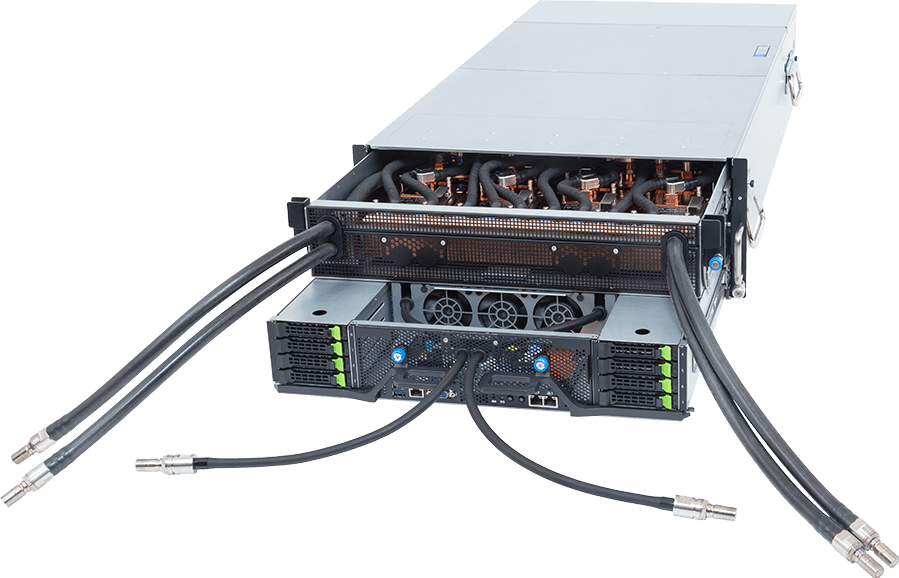
The GIGABYTE G4L4-SD3-LAX7 is a 4U liquid-cooled NVIDIA HGX B300 server for large-scale AI training, fine-tuning, high-throughput inference and accelerated computing. It combines eight Blackwell Ultra SXM GPUs with NVIDIA NVLink and NVLink Switch, a dual-socket Intel Xeon 6 host and onboard ConnectX-8 networking.
This is a scale-up platform, not a deskside system or a conventional collection of PCIe cards. Its value depends on whether the workload can use the shared eight-GPU domain and whether the facility can support direct liquid cooling, high rack power and very fast external fabrics.
Configure the GIGABYTE G4L4-SD3-LAX7 on GPUMachines, or send us the model, dataset, cluster size and site conditions for a full design review.
What the platform provides
At the centre of the server is an NVIDIA HGX B300 baseboard with eight SXM GPUs. GIGABYTE specifies 1.8TB/s of GPU-to-GPU bandwidth through NVIDIA NVLink and NVLink Switch. That high-bandwidth scale-up fabric is the reason to choose HGX over an eight-card PCIe server when a job needs frequent communication between GPUs.
The server uses an integrated-manifold direct liquid-cooling system with leak detection. The host supports two Intel Xeon 6 processors from the 6700 and 6500 series, with processor TDP up to 350W. There are 32 DDR5 DIMM slots, eight memory channels per CPU, and support for both RDIMM and selected MRDIMM configurations.
Published system specification
- 4U rackmount NVIDIA HGX B300 platform
- Eight NVIDIA Blackwell Ultra SXM GPUs
- NVIDIA NVLink and NVLink Switch with 1.8TB/s GPU-to-GPU bandwidth
- Integrated-manifold direct liquid cooling with leak detection
- Two LGA 4710 sockets for Intel Xeon 6 6700/6500-series processors
- 32 DDR5 RDIMM/MRDIMM slots
- Eight hot-swap 2.5-inch PCIe 5.0 NVMe bays
- Two internal M.2 positions, one PCIe 5.0 x4 and one PCIe 5.0 x2
- Four FHHL PCIe 5.0 x16 expansion slots
- Eight 800Gb/s OSFP ports for XDR InfiniBand or dual 400Gb/s Ethernet GPU networking through ConnectX-8 SuperNICs
- Two 10GbE RJ45 ports using Intel X710-AT2, plus management interfaces
- Compatibility with NVIDIA BlueField-3 DPUs
- 5+5 redundant 3000W 80 PLUS Titanium power supplies
- Chassis dimensions of 447 x 175.5 x 901mm
Why HGX B300 changes the buying decision
A PCIe GPU server can be the right answer when accelerators run separate inference workers, rendering jobs or research containers. The G4L4-SD3-LAX7 is aimed at a different problem: workloads that benefit from a large, coherent scale-up GPU domain and fast communication between all eight accelerators.
That includes large-model training, distributed fine-tuning within a node, scientific simulation and inference services where model size or throughput justifies the complete HGX platform. The server can also become a building block in a larger AI cluster, using its ConnectX-8 interfaces for scale-out communication.
Do not choose it only because B300 is the newest accelerator generation. A lightly used service, a single-user development workload or a model that fits comfortably on one PCIe GPU may be cheaper and simpler on a smaller platform. The useful comparison is time-to-result, utilisation and operational cost, not peak specification alone.
CPU and memory design
The two Xeon 6 processors handle storage, networking, job control, preprocessing and host-side application work. GIGABYTE lists support for the Intel Xeon 6700 and 6500 series on LGA 4710, with dual processors required to expose the complete memory and I/O design.
The 32 DIMM slots provide 16 positions per CPU. Published memory support includes DDR5 RDIMM and MRDIMM, with achievable speed determined by processor selection and DIMM population. Balanced channel population is important. A large GPU memory pool does not remove the need for sufficient host RAM: data pipelines, CPU preprocessing, containers, caches and management services all consume it.
Size the host around measured workload behaviour. Excess CPU core count can add cost without improving GPU utilisation, while too little memory bandwidth or RAM capacity can leave the accelerators waiting. For a cluster, standardising CPU and DIMM layouts across nodes also simplifies scheduling and support.
Local and shared storage
Eight hot-swap PCIe 5.0 NVMe bays provide local capacity for active datasets, model cache, checkpoints and scratch work. Two internal M.2 slots can support boot or service volumes. The correct drive count and endurance class depend on how much data is written, how quickly jobs must restart and whether local storage is treated as temporary or persistent.
An eight-GPU B300 server should not be specified in isolation from shared storage. Training jobs may stream datasets into several nodes while writing large checkpoints back out. Aggregate bandwidth, metadata behaviour, network paths and failure recovery matter more than the capacity of one drive. GPUMachines can size local NVMe and the storage fabric together once dataset size, checkpoint frequency and node count are known.
ConnectX-8 networking and cluster scale-out
The rear GPU networking fabric provides eight OSFP ports through NVIDIA ConnectX-8 SuperNICs. GIGABYTE lists XDR InfiniBand at up to 800Gb/s per port or dual 400Gb/s Ethernet operation, depending on the selected network design. This is the high-speed path used to connect multiple HGX nodes or reach a compatible storage and AI fabric.
The system also includes two 10GbE RJ45 ports for general connectivity and separate management interfaces. NVIDIA BlueField-3 DPU compatibility provides another option for infrastructure services, isolation or accelerated networking where the software design calls for it.
Direct liquid cooling and rack power
The G4L4-SD3-LAX7 uses direct liquid cooling for the HGX B300 platform and host components. Its integrated manifold and leak-detection features simplify the server-side connection, but the data centre still needs a compatible coolant distribution unit, water temperatures, flow, pressure, water quality and monitoring plan.
GIGABYTE lists ten 3000W power supplies in a 5+5 redundant arrangement. These ratings describe power-delivery capacity, not a single fixed consumption figure. Actual input power depends on GPU and CPU power limits, memory, drives, network devices, coolant conditions and workload. C19 power cords are required and must be selected for the site.
Deployment profiles
Single-node AI system
One server can provide an eight-GPU scale-up domain for a research team or enterprise AI platform. Pair it with sufficient local NVMe, a reliable management network and storage fast enough to avoid wasting GPU time. This profile works when the target models fit within one HGX node.
Multi-node training cluster
Use the ConnectX-8 fabric to scale across several servers. Design switching, rail mapping, optics, storage and scheduling as one architecture. Consistent node configurations make distributed jobs and maintenance easier to manage.
High-throughput inference factory
B300 can support demanding inference where model size, context length or concurrency requires substantial GPU memory and compute. Validate batching, model-parallel behaviour and expected token demand before assuming that an eight-GPU node will be fully utilised.
Who should shortlist it?
The G4L4-SD3-LAX7 belongs on the shortlist for AI labs, cloud providers, research organisations and enterprises deploying large models on owned or hosted infrastructure. It is especially relevant where eight-GPU NVLink scale-up performance and a modern 800Gb/s fabric are explicit requirements.
A configurable PCIe GPU server may be more economical for independent jobs or staged GPU expansion. A smaller workstation is better for local development. The HGX B300 system earns its place when reduced training time, model capacity or cluster throughput can justify the facility and operational commitment.
Frequently asked questions
Is the G4L4-SD3-LAX7 a GB300 desktop system?
No. It is a 4U rackmount NVIDIA HGX B300 server with eight liquid-cooled SXM GPUs. GIGABYTE's product page identifies it as an HGX B300 DLC platform.
How many GPUs are included?
The modular GPU platform contains eight NVIDIA Blackwell Ultra SXM GPUs on the HGX B300 baseboard.
Does it need liquid-cooling infrastructure?
Yes. The server has an integrated-manifold direct liquid-cooling solution, but the site still needs compatible coolant distribution, monitoring and heat-rejection infrastructure.
Can it be connected with InfiniBand or Ethernet?
Yes. The onboard ConnectX-8 networking is specified for eight 800Gb/s OSFP XDR InfiniBand ports or dual 400Gb/s Ethernet operation. The complete fabric must be designed around the chosen mode.
How much rack power should be reserved?
Do not derive consumption by simply adding PSU ratings. GPUMachines should calculate expected and worst-case input power from the final component limits, workload and cooling configuration, then validate it against the rack and data-centre feeds.
Is it suitable for a single small inference service?
Usually not. Smaller PCIe servers or hosted capacity are often more economical unless the service can use the B300 memory, throughput and eight-GPU scale-up domain consistently.
Verdict
The GIGABYTE G4L4-SD3-LAX7 is a purpose-built HGX B300 node for buyers who need eight Blackwell Ultra GPUs, high-bandwidth NVLink scale-up and ConnectX-8 scale-out in a compact 4U liquid-cooled design. Its technical strengths are substantial, but so are its facility requirements.
Start with the workload and cluster topology, then validate host memory, storage, network rails, coolant and rack power together. Open the GPUMachines configurator to prepare a specification for technical review.
Source: GIGABYTE G4L4-SD3-LAX7 product page.