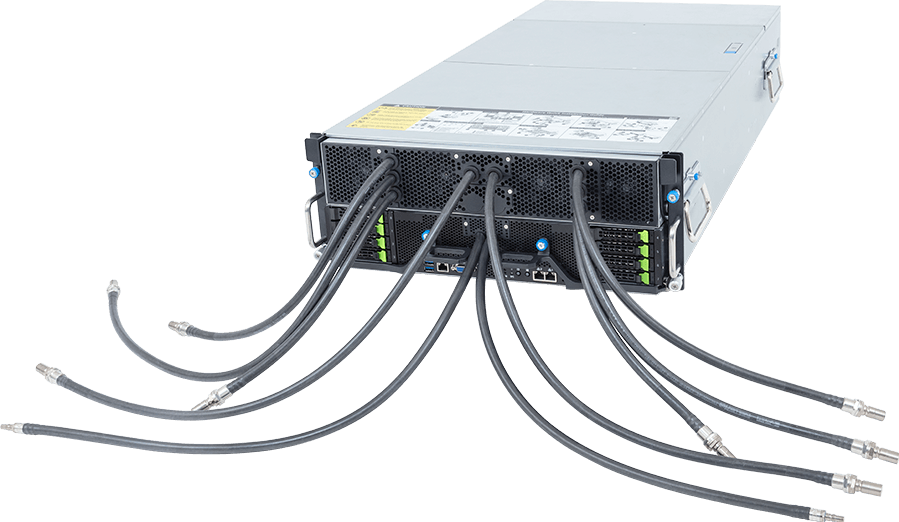
The GIGABYTE G4L3-ZX1-LAT4 is a 4U, direct-liquid-cooled server built around the eight-GPU AMD Instinct MI355X platform. That distinction matters. It is not an NVIDIA HGX system, and its accelerators are not ordinary PCIe add-in cards. Eight OAM modules sit on an AMD UBB 2.0 platform, while the server's PCIe slots remain available for network, storage and data-processing adapters.
For buyers comparing dense AI systems, the G4L3-ZX1-LAT4 offers a clear proposition: 2.3 TB of aggregate HBM3E, dual AMD EPYC host processors and a large amount of Gen5 expansion in a 4U chassis. The harder question is whether the data centre can support it. Power distribution, liquid cooling, model staging and fabric design all need answers before this machine belongs on a purchase order.
Configure the GIGABYTE G4L3-ZX1-LAT4 or send the intended workload to GPUMachines for a checked build.
G4L3-ZX1-LAT4 specifications
| Area | Manufacturer specification | | --- | --- | | Form factor | 4U, 447 x 175.5 x 901 mm | | GPU platform | 8 x liquid-cooled AMD Instinct MI355X OAM modules on UBB 2.0 | | GPU memory | 288 GB HBM3E per GPU; 2.3 TB across the platform | | Host processors | 2 x AMD EPYC 9005 or EPYC 9004, up to 500 W cTDP | | System memory | 24 x DDR5 RDIMM slots, 12 channels per CPU | | Front storage | 8 x 2.5-inch hot-swap PCIe Gen5 NVMe bays | | Internal storage | 2 x M.2: one PCIe Gen3 x4 and one PCIe Gen3 x1 | | Expansion | 4 x dual-slot FHHL Gen5 x16 and 8 x single-slot FHHL Gen5 x16 | | Onboard network | 2 x 10GbE through Intel X710-AT2, plus management LAN | | Power supplies | 3+3 redundant 5,200 W, 80 PLUS Titanium | | Cooling | Direct liquid cooling for CPUs and GPUs, with leak detection |
What the MI355X platform changes
Each MI355X carries 288 GB of HBM3E and AMD quotes 8 TB/s of peak theoretical memory bandwidth per OAM. Across eight accelerators, the platform provides 2.3 TB of HBM3E. That capacity is useful for large language models, long-context inference, scientific datasets and other jobs that otherwise spill frequently into slower host memory.
AMD rates each MI355X at up to 1,400 W board power. Eight modules can therefore account for as much as 11.2 kW before the CPUs, memory, NVMe drives, network cards, fans and conversion losses enter the calculation. That is a ceiling rather than a promise of typical wall draw, but it shows why this server needs a facility-level power and cooling review.
The MI355X platform uses fourth-generation AMD CDNA architecture and a fully connected scale-up fabric between the eight accelerators. Buyers considering it for distributed training should still test the real framework, model and collective-communication pattern. A large HBM pool helps only when the software stack, kernels and data path can keep the accelerators occupied.
Dual EPYC host platform and memory
GIGABYTE supports two AMD EPYC 9005 or 9004 processors in SP5 sockets, with a maximum cTDP of 500 W per CPU. The 24 DIMM slots expose 12 DDR5 channels per processor. EPYC 9005 configurations support memory speeds up to 6,400 MT/s, while GIGABYTE lists up to 4,800 MT/s for EPYC 9004.
Populate memory symmetrically across both sockets. Sparse or uneven DIMM layouts can leave host bandwidth unused, which is a poor compromise in a server bought to feed eight expensive accelerators. Capacity should cover data preparation, CPU-side preprocessing, orchestration processes and any in-memory caching that runs beside the GPU job.
NVMe storage and PCIe expansion
Eight front hot-swap 2.5-inch bays accept PCIe Gen5 NVMe drives. They suit local datasets, model caches, checkpoints and scratch workloads, though eight drives do not replace a shared storage plan for a multi-node cluster. The two internal M.2 sockets are better suited to operating-system or service volumes; one runs at Gen3 x4 and the other at Gen3 x1.
The twelve FHHL expansion slots are separate from the fixed OAM accelerator platform. Four slots accept dual-width cards and eight accept single-width cards, all with Gen5 x16 lanes according to GIGABYTE. In practice, likely occupants include high-speed Ethernet or InfiniBand adapters, DPUs and specialist storage interfaces. Do not interpret those slots as support for twelve additional GPUs without a manufacturer-approved configuration.
Onboard Intel X710-AT2 networking provides two 10GbE ports, plus dedicated management connectivity. That is useful for administration and ordinary service traffic, but it is not the scale-out fabric for an eight-GPU training cluster. Multi-node deployments need a separate design for east-west GPU traffic, storage access and management. Adapter choice, switch radix, optics, cable reach and rail placement should be worked out as one topology.
Direct liquid cooling is part of the purchase
Both processors and all eight MI355X modules use direct liquid cooling, and the server includes leak detection. GIGABYTE does not turn that into a complete facility loop by itself. The project still needs confirmed coolant quality, inlet temperature, flow, pressure, quick-disconnect standard, coolant distribution unit capacity and responsibility for commissioning.
GIGABYTE specifies six 5,200 W Titanium power supplies in a 3+3 redundant arrangement. Redundancy topology and available output depend on the site feed, so the PSU label must not be used as the rack-planner consumption figure. Use a measured or engineered load for the selected CPUs, memory, drives and adapters, then retain headroom for workload peaks and component ageing.
Workloads that fit this server
The strongest use cases share one trait: they can keep eight MI355X accelerators busy as a tightly connected node.
- Large-model pre-training and continued training where HBM capacity and GPU-to-GPU traffic affect job time.
- Fine-tuning and high-throughput inference for models that need more memory than smaller PCIe nodes provide.
- Scientific computing, numerical simulation and mixed-precision HPC written for AMD ROCm and CDNA.
- Private AI clusters whose operators can support liquid cooling, high-speed networking and shared storage.
- Hosted accelerator services with enough demand to maintain useful utilisation.
It is a poor match for a first AI development server, lightly used departmental inference or software that depends on an NVIDIA-only feature. Teams moving from CUDA should validate framework support, kernels, container images, monitoring and operational tooling on MI355X before committing to a fleet.
Configuration decisions to settle before ordering
Start with software, not the bill of materials. Confirm the ROCm release, framework version and model behaviour on CDNA 4. Size the CPUs and DIMMs around the measured input pipeline, use local NVMe for active work, and design a shared tier that can deliver data without stalling the node. The facility review must record usable rack power, redundancy policy, coolant delivery, CDU failure behaviour and service ownership. Twelve Gen5 slots create welcome choice, but NICs and DPUs still need balanced placement.
Frequently asked questions
Is the G4L3-ZX1-LAT4 an HGX server?
No. HGX is an NVIDIA platform. This GIGABYTE server uses the AMD Instinct MI355X eight-GPU UBB 2.0 platform. It serves a similar class of dense scale-up AI and HPC workload, but the accelerator architecture, software stack and interconnect are AMD technologies.
How much GPU memory does it provide?
Each MI355X has 288 GB of HBM3E. The eight-GPU platform therefore carries 2.3 TB in aggregate. Applications see and use that memory according to their process layout and communication model; it is not one ordinary system-memory pool.
Can the twelve PCIe slots hold more GPUs?
The published expansion slots support FHHL Gen5 cards, but the eight MI355X accelerators already form the fixed GPU platform. Treat the slots as capacity for approved NICs, DPUs and storage adapters unless GIGABYTE certifies another use.
Does the server run on air cooling alone?
No. GIGABYTE specifies direct liquid cooling for the CPUs and GPUs. A compatible facility or rack-level liquid loop forms part of the deployment.
What network speed should a cluster use?
There is no honest answer without the model, node count and storage design. The onboard 10GbE ports cover basic connectivity; scale-out training will normally require dedicated high-speed Ethernet or InfiniBand selected from measured communication demand.
Verdict
The G4L3-ZX1-LAT4 is a serious AMD scale-up node, not a generic 4U GPU chassis. Its eight MI355X modules, 2.3 TB HBM3E pool, dual EPYC host and twelve Gen5 expansion slots make sense for organisations with proven large-model or HPC demand. The purchase only works when ROCm validation, liquid cooling, rack power, storage and fabric engineering receive the same attention as the GPUs.
Build a GIGABYTE G4L3-ZX1-LAT4 configuration and ask GPUMachines to check component compatibility, facility fit and cluster networking before quotation.