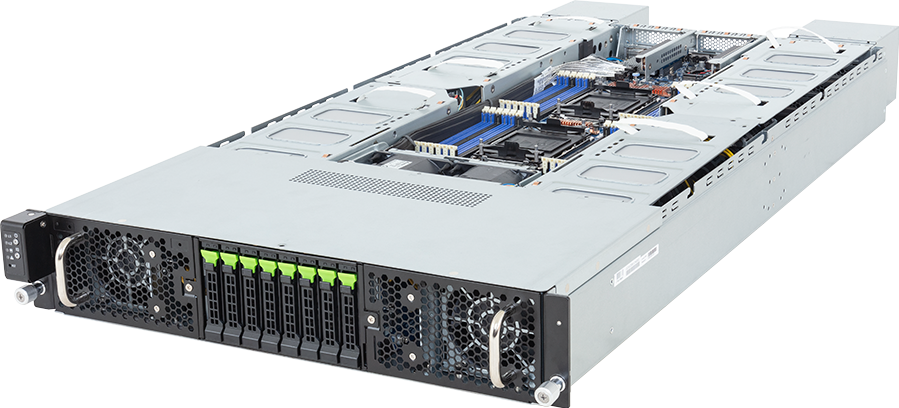
Counting GPU slots is the easy part of specifying G294-S42-AAP2; lane ownership, airflow and workload placement decide whether those slots are useful. The rest of the review tests that decision against workload fit, deployment constraints and the alternatives a buyer should price first.
Choose G294-S42-AAP2 for inference replicas, rendering, simulation or mixed accelerator work where PCIe flexibility matters. If the model must behave as one tightly coupled multi-GPU job, compare an HGX system before committing.
Review the G294-S42-AAP2 configuration options on GPUMachines before treating the base chassis as a finished design.
Executive Summary
The G294-S42-AAP2 is best suited to teams that need flexible GPU density for rendering, inference, model development, virtual workstations, simulation, and mixed accelerator workloads without stepping into full HGX pricing.
The headline configuration story is up to 8 PCIe GPUs, including NVIDIA H200 NVL or RTX PRO 6000 Blackwell options, backed by 2 CPU socket(s), 24 DIMM slots, DDR5, 24 storage positions, and 10 PCIe expansion slots.
It may be more than you need if your workload only needs one or two GPUs, a desk-side workstation, or short-lived cloud capacity.
Start configuration here: configure the G294-S42-AAP2 on GPUMachines.
Key Specifications
| Area | Specification | | --- | --- | | Form factor | 2U rackmount | | CPU platform | LGA4710 | | CPU sockets | 2 | | GPU support | up to 8 PCIe GPUs, including NVIDIA H200 NVL or RTX PRO 6000 Blackwell options | | Memory | 24 DIMM slots, DDR5 | | Storage | 8 x 2.5" Gen5 NVMe/SATA/SAS-4 hot-swap bays (4 x NVMe from CPU_0, 4 x NVMe from CPU_1). Storage card required for SATA and SAS. Optional M.2 storage kit available for SATA. | | PCIe expansion | 8 x FHFL PCIe x16 (Gen5 x16) for GPUs, 2 x LP PCIe x16 (Gen5 x16) | | Networking | 2 x 10 Gb/s LAN via Intel X710-AT2, 1 x 10/100/1000 Mb/s Management LAN | | Power | Dual 3000 W 80 PLUS Titanium redundant power supplies. AC Input: 100-127V~/ 15.5A, 50-60Hz; 200-220V~/ 15.5A, 50-60Hz; 220-240V~/ 15.5A, 50-60Hz. DC Input: 240Vdc/ 15.5A (China only). DC Output: Max 1000W/ 100-127V~ (+12.2V/ 81A, +12Vsb/ 3A); Max 2600W/ 200-220V~ (+12.2V/ 213A, +12Vsb/ 3A); Max 3000W/ 220-240V~ or 240Vdc Input (+12.2V/ 245A, +12Vsb/ 3A). | | Best-fit workloads | multi-GPU inference; rendering and VFX pipelines; model development and fine-tuning; GPU virtualisation and remote workstations | | Dimensions | 448 x 87.5 x 962 mm |
Platform Highlights
- GPU platform: up to 8 PCIe GPUs, including NVIDIA H200 NVL or RTX PRO 6000 Blackwell options. This matters because accelerator choice drives the rest of the configuration: CPU lanes, rack or chassis power, airflow, local storage, and network design.
- CPU and memory base: LGA4710 with 24 DIMM slots, DDR5. The right CPU and memory plan should be sized around data preparation, host-side model work, and how many accelerators or services need to be kept busy.
- Storage layout: 8 x 2.5" Gen5 NVMe/SATA/SAS-4 hot-swap bays (4 x NVMe from CPU_0, 4 x NVMe from CPU_1). Storage card required for SATA and SAS. Optional M.2 storage kit available for SATA.. Local NVMe is useful for active datasets, checkpoints, scratch space, and staging work before data moves to shared storage.
- Expansion and networking: 8 x FHFL PCIe x16 (Gen5 x16) for GPUs, 2 x LP PCIe x16 (Gen5 x16). NIC placement and PCIe lane planning are important when the system will connect to storage, other GPU nodes, or remote users.
- Power and cooling: Dual 3000 W 80 PLUS Titanium redundant power supplies. AC Input: 100-127V~/ 15.5A, 50-60Hz; 200-220V~/ 15.5A, 50-60Hz; 220-240V~/ 15.5A, 50-60Hz. DC Input: 240Vdc/ 15.5A (China only). DC Output: Max 1000W/ 100-127V~ (+12.2V/ 81A, +12Vsb/ 3A); Max 2600W/ 200-220V~ (+12.2V/ 213A, +12Vsb/ 3A); Max 3000W/ 220-240V~ or 240Vdc Input (+12.2V/ 245A, +12Vsb/ 3A).. Final power draw is configuration-dependent, especially once GPUs, NICs, and NVMe devices are selected.
- Product-specific fit: The product-specific point to notice is H200 generation, Intel Xeon 6 / Granite Rapids CPU platform, 8-GPU PCIe density. That combination changes the buying conversation from a generic server choice into a decision about rack density, thermal design, accelerator fit, data movement, and operational support.
- PCIe flexibility: PCIe GPU servers are useful when workloads can be split across independent GPUs, but slot spacing, airflow, cable routing, and NIC placement should be checked before committing to a dense build.
Our Technical View
In the GPUMachines portfolio, G294-S42-AAP2 is best understood as a flexible PCIe GPU platform rather than a fixed appliance. Its value comes from the ability to match the GPU mix, CPU platform, storage, and networking to the workload instead of paying for an HGX topology that may not be required.
This model is strongest when workloads can run across independent accelerators: inference workers, rendering jobs, virtual workstations, simulation batches, or development environments. It may be less suitable for tightly coupled training jobs where NVLink/NVSwitch communication is the deciding factor.
The product-specific point to notice is H200 generation, Intel Xeon 6 / Granite Rapids CPU platform, 8-GPU PCIe density. That combination changes the buying conversation from a generic server choice into a decision about rack density, thermal design, accelerator fit, data movement, and operational support.
Best-Fit Workloads
Best-fit workloads include:
- multi-GPU inference
- rendering and VFX pipelines
- model development and fine-tuning
- GPU virtualisation and remote workstations
- simulation and batch processing
- cost-conscious AI infrastructure
Who Should Consider It
The G294-S42-AAP2 makes sense when the project needs a properly specified infrastructure node, not just a part number. For AI teams, that usually means thinking through data movement, GPU or CPU utilisation, local scratch, shared storage, network fabric, and how the server will be operated after delivery.
It is most relevant for buyers that already understand their workload profile, have a target deployment model, and need help turning that requirement into a balanced hardware configuration. That may mean on-premise ownership, a hosted system, a leased deployment, or part of a larger private AI cluster.
Who Should Not Buy It
This is not ideal when the workload needs HGX-class GPU-to-GPU communication, or when the buyer only needs one local GPU for development. In those cases, consider an HGX system for tightly coupled training, or a tower workstation for desk-side development.
Architecture Notes
PCIe GPU servers are about flexibility. They are often the better fit when each GPU can run an independent inference worker, rendering job, simulation task, or development workload. Compared with HGX, they usually give buyers more control over accelerator choice and a more approachable cost structure.
For G294-S42-AAP2, the practical design question is balance: enough CPU lanes, airflow, power, local storage, and network bandwidth to keep the selected PCIe GPUs productive. That is where expert configuration matters.
Configuration Guidance
Important configuration decisions include:
- GPU selection: Hopper
- CPU choices include Intel Xeon 6710E (64 cores, E-Core), Intel Xeon 6740E (96 cores, E-Core), Intel Xeon 6780E (128 cores, E-Core)
- Memory can be sized from options such as 128GB DDR5-5600 ECC REG, 128GB DDR5-6400 ECC REG, 128GB DDR5-8800 MCR DIMM
- Networking options include high-speed Ethernet and InfiniBand adapters for cluster or storage traffic
- For PCIe GPU builds, leave enough CPU lanes, airflow, and power headroom for the final accelerator mix
- size networking, local NVMe, storage fabric, rack power, and cooling around accelerator utilisation rather than GPU count alone
- decide whether the platform is acting as scratch, dataset staging, checkpoint storage, shared storage, or a storage-adjacent service node
- confirm GPU length, slot spacing, riser layout, host lanes, NIC placement, and PSU headroom before finalising the build
For PCIe GPU deployments, confirm final accelerator length, slot spacing, cooling path, PSU headroom, and network bandwidth before ordering. GPUMachines can review the final configuration during quoting, but buyers should still define the intended workload, data sources, model size, user count, storage pattern, and network environment before selecting components.
Recommended Configuration Paths
- Best for inference hosting: configure Hopper, enough CPU lanes for the selected cards, NVMe sized for operating system, active datasets, scratch space, and checkpoints, and networking sized for model traffic.
- Best for rendering or visualisation: choose GPUs based on application support and VRAM needs, then check slot spacing, airflow, and storage for project assets.
- Best for cost-controlled deployment: start with fewer GPUs and leave room for expansion, while ensuring the PSU, cooling path, and PCIe layout can support the future target.
- Best for mixed AI development: use Intel Xeon 6710E (64 cores, E-Core) or Intel Xeon 6740E (96 cores, E-Core), balanced RAM population, fast local NVMe, and a NIC layout that does not block future GPU expansion.
Alternatives and Related Systems
Compare this platform with other PCIe GPU servers if you need a different GPU count or chassis layout. If the workload needs tighter GPU-to-GPU communication, review the HGX server range. For desk-side development, a tower GPU workstation may be easier to operate.
Buying Through GPUMachines
The fastest next step is to use the G294-S42-AAP2 configurator and select the CPU, RAM, storage, GPU, and networking options that match your workload. GPUMachines can then review the build for compatibility, thermals, power draw, lead time, and cluster fit.
For teams without suitable data centre space, GPUMachines can also discuss Buy & Host, leasing, and GPU Cloud alternatives. That is especially useful when the server needs high-density power, managed networking, or a private hosted environment.
What Makes This PCIe System Work
G294-S42-AAP2 should be specified around the way its GPUs will be divided. PCIe GPU servers often shine when several jobs can run independently: inference workers, rendering queues, fine-tuning experiments, computer vision jobs or research containers. If the plan is one huge model stretched tightly across every GPU, compare HGX before committing.
The headline detail is up to 8 PCIe GPUs, including NVIDIA H200 NVL or RTX PRO 6000 Blackwell options. The less visible parts decide the result: PCIe lane layout, slot spacing, fan pressure, CPU memory channels, NVMe placement and NIC choice. A server can advertise a high GPU count and still be awkward if the cards are thermally crowded or the network adapter sits on a poor path.
Storage planning starts with the published layout: 8 x 2.5" Gen5 NVMe/SATA/SAS-4 hot-swap bays (4 x NVMe from CPU_0, 4 x NVMe from CPU_1). Storage card required for SATA and SAS. Optional M.2 storage kit available for SATA.. That needs to be mapped to model staging, scratch space, checkpoint writes, logs and any shared dataset path before the system is ordered.
Networking also deserves early attention. The listed network path is 2 x 10 Gb/s LAN via Intel X710-AT2, 1 x 10/100/1000 Mb/s Management LAN, but the final choice should separate management, storage and workload traffic where the deployment needs that separation. For inference hosting, the NIC decision should follow expected traffic and model-loading strategy. For research teams, management access and user isolation usually matter more than peak bandwidth alone.
Power is not a footnote here: Dual 3000 W 80 PLUS Titanium redundant power supplies. AC Input: 100-127V~/ 15.5A, 50-60Hz; 200-220V~/ 15.5A, 50-60Hz; 220-240V~/ 15.5A, 50-60Hz. DC Input: 240Vdc/ 15.5A (China only). DC Output: Max 1000W/ 100-127V~ (+12.2V/ 81A, +12Vsb/ 3A); Max 2600W/ 200-220V~ (+12.2V/ 213A, +12Vsb/ 3A); Max 3000W/ 220-240V~ or 240Vdc Input (+12.2V/ 245A, +12Vsb/ 3A).. Before purchase, check the rack feed, redundancy plan, heat load and service process against the target site. With PCIe systems, GPUMachines normally checks GPU power, cable routing, cooling envelope and expansion headroom together. The best configuration is rarely the most populated one; it is the one that can run its weekly workload without throttling, starving the GPUs or becoming painful to service.
Before ordering, decide how the server will be shared. A lab box used by four researchers needs a different storage, user-access and monitoring plan from an inference host running one service. If the same machine will do both, leave headroom for the messy middle: logs, containers, model cache, failed jobs and users who forget to clean up scratch space.
FAQ
Is G294-S42-AAP2 better for training or inference?
It is usually stronger for inference, rendering, development, and workloads that can use independent GPUs. For tightly coupled training, compare an HGX system.
How much RAM should I configure?
RAM is configuration-dependent. Match memory capacity to CPU count, dataset preparation, model serving processes, virtualisation needs, and whether the system will run storage or orchestration services alongside GPU workloads.
Does this system need InfiniBand or 400GbE?
High-speed networking depends on deployment design. Single-node systems may only need fast Ethernet, while multi-node training, shared storage, and hosted GPU environments often justify 100GbE, 200GbE, 400GbE, InfiniBand, or separate management networks.
Is this overkill for small AI workloads?
It can be. If the workload is a small inference endpoint, proof-of-concept project, or one-GPU development task, a smaller workstation, hosted GPU option, or lower-density server may be more practical.
Can GPUMachines host this system?
GPUMachines can discuss hosted deployment, leasing, and Buy & Host options where appropriate. This is especially useful when rack power, cooling, remote access, or data-centre operations are concerns.
What should I check before deploying it in a data centre?
Review rack depth, power feeds, cooling, service access, networking, management separation, storage integration, and whether the system needs to operate alone or as part of a cluster.
Verdict
The G294-S42-AAP2 is a strong fit when you want a configurable PCIe GPU server that can be matched to a real AI, HPC, rendering, storage, or infrastructure workload. Its value is not only in the headline component list, but in how those components are selected and integrated.
Choose it when your team needs a serious infrastructure node with expert configuration support and a clear path to on-premise, hosted, or cluster deployment.
Configure it here: G294-S42-AAP2 on GPUMachines.