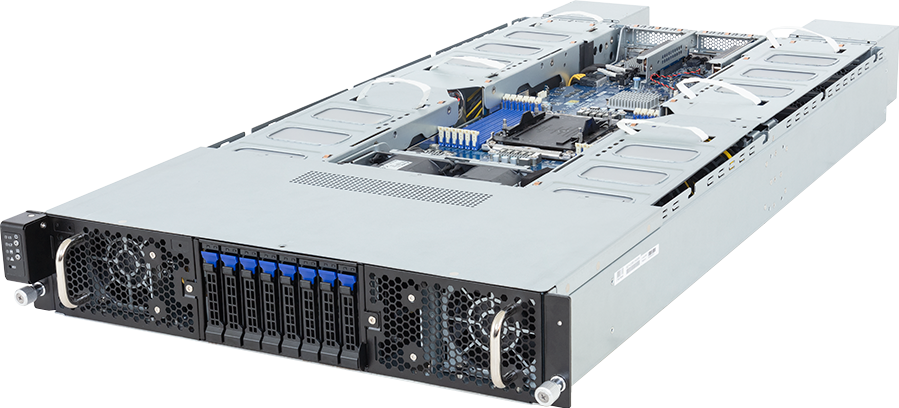
Eight GPU slots appear in the GIGABYTE G294-A22-AAP2 headline, but the current supported configurations stop at four named cards. GIGABYTE validates four NVIDIA H200 NVL GPUs as two bridged pairs, or four RTX PRO 6000 Blackwell Server Edition GPUs, at a 25 C ambient condition. A buyer who reads only the slot count could specify twice the qualified accelerator quantity.
That detail defines the server. G294-A22-AAP2 is a 2U, single-socket Intel Xeon 6 platform with PCIe switches, 12 DDR5 channels, eight front SATA/SAS bays and two low-profile Gen5 slots for additional adapters. It can pack serious inference, visual computing or simulation capability into 2U, yet it does not provide the all-to-all GPU fabric of an HGX baseboard.
Configure the GIGABYTE G294-A22-AAP2 after choosing the workload and GPU topology. The configurator should reflect the current qualified cards, while final quantities and part numbers still need checking against the live GIGABYTE matrix.
Exact system covered by this review
The model suffix and order code should travel together through the quote. This page covers G294-A22-AAP2 with ordering code 6NG294A22DR000AAP2* and MA24-G20 motherboard. GIGABYTE publishes the following base specification:
| Area | Published specification | Buying consequence | | --- | --- | --- | | Chassis | 2U, 448 x 87.5 x 962 mm including rear fans | Deep 2U installation with rear clearance to check | | Processor | One Intel Xeon 6900E+ or 6900-series CPU, LGA7529, up to 500 W | Single NUMA domain, but a demanding CPU and cooling envelope | | Memory | 12 DDR5 RDIMM/MRDIMM slots, 12 channels | One DIMM per channel when fully populated | | GPU positions | Eight FHFL Gen5 x16 slots through PEX89048 | Mechanical maximum is not the same as current GPU qualification | | Named GPU layouts | Four H200 NVL or four RTX PRO 6000 Blackwell Server Edition | Uniform GPU model, 25 C ambient condition | | Additional expansion | Two LP Gen5 x16 slots | Space for network or storage adapters | | Front storage | Eight 2.5-inch SATA/SAS-4 hot-swap bays | Shared eight-drive pool; SAS needs a card | | Internal storage | Two M.2 2280 Gen4 x4 positions, occupied for SATA | Not two spare front NVMe bays | | Onboard network | Two 10GbE Intel X710-AT2 ports and one management port | High-speed storage or cluster fabric is separate | | Power | Two 3000 W Titanium redundant PSUs | C19 feeds and finished-build power calculation required |
Some regional product pages still describe the system as pending release, while GIGABYTE has a current product page, manual, datasheet and accelerator matrix. Confirm orderability, firmware and the precise qualified bill of materials before treating a web specification as stock availability.
One Xeon 6900 socket feeds the whole system
The MA24-G20 motherboard carries one LGA7529 socket. GIGABYTE now lists Intel Xeon 6900E+ as well as the established Xeon 6900 series, with processor TDP up to 500 W. A single socket simplifies memory locality compared with a two-socket host: every GPU, DIMM and host process belongs to one processor domain. It also puts all preprocessing, storage queues, network interrupts and management services on that one CPU.
The right processor depends on the work around the GPUs. Image and video pipelines may decode or transform data before the accelerator sees it. Retrieval-augmented generation can run document parsing, embedding services and search components on the host. Simulation workflows may alternate between CPU and GPU phases. Buying the largest core count by default is wasteful if the workload remains GPU-bound, but an undersized host can starve four expensive accelerators.
Xeon 6900E+ and 6900 P-core parts also have different memory paths. Intel lists 12 memory channels for both families. Current 6900E+ processors such as the 6990E+ support DDR5 RDIMM at up to 8000 MT/s with one DIMM per channel. The 6900 P-core platform supports standard DDR5 up to 6400 MT/s and MRDIMM up to 8800 MT/s. GIGABYTE limits MRDIMM support to selected P-core CPUs.
Do not mix the headline speeds into one generic memory claim. A quote needs an exact CPU, memory technology, module part number, capacity and expected operating rate. Twelve matched modules use every memory channel. Fewer DIMMs can meet a capacity target while leaving bandwidth unused, which may matter in CPU-heavy data preparation or simulation.
H200 NVL is two pairs, not a four-GPU fabric
The H200 NVL layout uses four PCIe GPUs, each with 141 GB of HBM3e. Raw accelerator memory across the server is therefore 564 GB before CUDA context, communication buffers, framework allocations, KV cache and other overhead.
GIGABYTE arranges the four cards as two separate two-GPU sets. Each set receives a two-way NVLink bridge. GPU 1 can exchange data with GPU 2 over its bridge, and GPU 3 can do the same with GPU 4; traffic between the pairs follows the PCIe topology. The system does not create one four-card NVLink island and it has no NVSwitch.
That topology can work well when jobs fit on one card, one pair or two mostly independent pairs. Model serving can place replicas on separate GPUs. Two teams can each use a bridged pair. Some inference and HPC applications can divide work without constant cross-pair exchange.
Tightly coupled training is a harder fit. If tensor, pipeline or expert parallelism sends frequent traffic among all four cards, the boundary between the two NVLink pairs becomes part of performance. An NVIDIA HGX system gives its SXM GPUs a different scale-up network through NVSwitch. That costs more and consumes more facility power, but it is the honest alternative where the model needs fast all-to-all GPU communication.
H200 NVL's large HBM capacity remains useful for memory-bound jobs. The card can hold models, KV cache or scientific data sets that exceed the memory of smaller PCIe GPUs. Capacity alone does not settle the purchase: batch size, precision, sequence length, concurrency and communication pattern decide whether four cards in two pairs are sensible.
RTX PRO 6000 Blackwell serves a different workload mix
The second named qualification is four NVIDIA RTX PRO 6000 Blackwell Server Edition GPUs. Each card provides 96 GB of ECC GDDR7, a 512-bit memory interface and roughly 1.6 TB/s of published memory bandwidth. Four cards provide 384 GB of raw GPU memory when workloads use them as separate devices.
RTX PRO adds professional graphics and ray-tracing hardware alongside CUDA and Tensor cores. That makes the G294-A22 relevant to render farms, engineering visualisation, simulation, virtual workstations, synthetic-data generation and AI inference. A studio or engineering team can schedule independent jobs across the cards without paying for an HGX fabric that its software does not use.
GIGABYTE qualifies the uniform four-card layout at 25 C ambient. The server's rear geometry prevents access to GPU display outputs, so the cards should be treated as data-centre accelerators rather than local desktop graphics outputs. Remote display and virtual workstation software need their own licensing, support and user-concurrency design.
NVIDIA rates the air-cooled Server Edition card at up to 600 W, with a configurable power range. Four fully powered GPUs can therefore account for a large share of the node's electrical and thermal load before the 500 W CPU, memory, drives, adapters and fans are included. Set power limits only with measured application behaviour; reducing a label does not guarantee acceptable throughput or latency.
The GIGABYTE chassis advertises up to eight dual-slot Gen5 GPU positions, but its current page names four RTX PRO 6000 cards. NVIDIA publishes eight-card RTX PRO reference systems elsewhere; that does not make this exact AAP2 chassis an eight-card validated RTX PRO node. Platform qualification belongs to the exact OEM model.
Eight Gen5 positions and the PCIe switch topology
Eight full-height, full-length x16 slots connect through PEX89048 switches. GIGABYTE describes the links as Gen5 x16, while the manual also notes that some arrangements may operate as eight x16 physical slots with Gen5 x8 electrical links. The final topology, firmware and card population should be checked before a performance-sensitive purchase.
PCIe switches let one CPU host more accelerator slots than a direct-lane layout would normally permit. They do not turn PCIe cards into an HGX fabric. GPU-to-host traffic, peer-to-peer paths and other cards share the switch design, so storage and network planning should reflect the application's data flow.
Two low-profile Gen5 x16 slots remain for add-in cards. Possible uses include a high-speed Ethernet or InfiniBand adapter, storage HBA or RAID controller. There is no OCP slot in the published specification. Slot count alone is not enough; confirm card height, cooling direction, firmware, cable exit and whether the card remains accessible after the GPU power cabling is installed.
The public GPUMachines configurator previously offered H100 PCIe, H100 NVL and several smaller RTX PRO Blackwell cards without an exact current qualification on the G294-A22 page. The reviewed product record now keeps H200 NVL and RTX PRO 6000 Blackwell Server Edition. It should not infer support merely because a card fits a dual-slot connector.
Storage is SATA or SAS, not a bank of front NVMe
Eight front 2.5-inch hot-swap bays support SATA or SAS-4. The same eight positions serve either interface; the server does not provide eight SATA plus eight SAS bays. SAS requires an add-in SAS card. Hardware RAID also requires a controller, while GIGABYTE provides a VROC key header for supported Intel storage arrangements.
The backplane description mentions PCIe Gen5 electrical capability on some source material, and an older regional page discussed optional cabling for a limited NVMe arrangement. The current UK product specification and December 2025 datasheet list the front bays as SATA/SAS-4. A current quote should therefore treat front NVMe as unconfirmed unless GIGABYTE supplies the exact supported cable, backplane revision and firmware combination.
Two internal M.2 2280 positions use Gen4 x4 connections, yet GIGABYTE marks them as occupied for SATA. They are not two free hot-swap NVMe positions in the standard storage count. Ask how the boot volume is implemented and how it will be replaced after failure.
SATA SSDs can hold the operating system, logs and moderate local data. SAS may suit established enterprise storage practices where a controller and drive qualification already exist. Four fast GPUs can outrun a modest local drive set during data-heavy training or analytics, so external storage and its network path may matter more than the nominal bay count.
Networking requires a separate plan
Two Intel X710-AT2 10GbE RJ45 ports provide the base data network, and a separate 1GbE port connects to the ASPEED AST2600 management controller. That is adequate for provisioning, administration and many ordinary service paths. It is not an automatic match for a multi-node GPU fabric or a shared storage system feeding several high-end accelerators.
A stand-alone rendering node may use onboard 10GbE and a low-profile storage adapter. Distributed inference could need 100 or 200GbE for service and model movement. Clustered training, parallel storage or remote direct memory access can justify 200, 400 or 800GbE NVIDIA ConnectX adapters, BlueField DPUs or a suitable InfiniBand generation. Speed should follow measured traffic and topology rather than the newest card in the catalogue.
Record the network as a port map before ordering. Assign management, user traffic, storage and inter-node communication; then record the NIC model, slot, switch port, optic or cable, link mode and failure path. One fast adapter connected to the wrong switch tier does not solve a data-path problem.
Power, cooling and physical installation
The 2U chassis is 962 mm deep when its 112 mm rear fan section is included. Net weight is about 27 kg before GPUs, drives, adapters, rails and cables. Verify rack-post spacing, door clearance, rear PDU position and the bend radius of C19 and network cables. A nominally deep rack can still fail once rear power hardware occupies the same space.
Eight 80 x 80 x 80 mm fans move air through the server. GIGABYTE publishes a 10 to 30 C operating range, and the named four-GPU configurations carry a 25 C ambient condition. Use the tighter value for the accelerator build unless the vendor confirms another limit. Inlet temperature is the relevant measurement, not a room thermostat on the other side of the aisle.
Two 3000 W 80 PLUS Titanium supplies provide redundancy. They require C19 power cords, and GIGABYTE says those cords are not included. A redundant pair does not mean the system can consume 6000 W continuously; each feed and PDU must support the intended failover rule and the completed configuration.
The current GPUMachines record assigns 1450 W to the barebone chassis before configurable CPUs, GPUs, memory, drives, NICs and controllers. That figure represents fans, motherboard, PCIe switches, BMC, backplane and other platform components. It should remain an engineering estimate until measured data for the exact fan policy and load becomes available. Rack planning should add every configured component and a sensible operating margin, then compare the result with actual commissioning measurements.
Who should buy it
G294-A22-AAP2 suits buyers who need four large PCIe accelerators in 2U and prefer one Xeon 6900 host. Useful deployments include:
- H200 NVL inference where a model or KV cache benefits from 141 GB per GPU.
- Two independent H200 NVL pairs for separate workloads or teams.
- RTX PRO rendering, simulation and virtual workstation services.
- Mixed professional graphics and AI inference on RTX PRO 6000 Blackwell.
- A compact research server where removable PCIe cards matter more than NVSwitch.
It is a poor choice for an eight-GPU training job that assumes one fast scale-up domain. The eight-slot label does not supply that topology, and the currently named GPU layouts use four cards. An HGX server is the cleaner comparison for tightly coupled training. A smaller two- or four-GPU PCIe chassis can also cost less to power and cool when the team will not use four high-end cards continuously.
Hosted deployment may be more sensible where the office lacks C19 feeds, rear rack depth or enough cooling for a sustained four-GPU load. Ownership, hosting and cloud capacity should be compared using expected utilisation, data movement, support responsibility and the period for which the workload is likely to remain stable.
Browse the PCIe GPU server range to compare other slot, CPU and storage layouts. Buyers whose jobs depend on NVSwitch should compare the HGX server catalogue instead.
Configuration checklist
Before approving a quote, record:
1. Exact G294-A22-AAP2 model and 6NG294A22DR000AAP2* ordering code. 2. Current GIGABYTE CPU and GPU qualification-list revisions. 3. Xeon 6900E+ or 6900 processor, TDP and expected host workload. 4. Twelve-DIMM population, RDIMM or MRDIMM technology and operating speed. 5. Four H200 NVL cards in two bridged pairs, or four uniform RTX PRO 6000 cards. 6. Front SATA/SAS drive count, controller and RAID policy. 7. Boot-media implementation for the two M.2 positions marked as occupied for SATA. 8. Add-in NIC or storage card model and low-profile slot position. 9. Switch ports, optics or cables and traffic separation. 10. C19 feeds, PDU failover capacity and complete system power estimate. 11. 25 C accelerator ambient limit, rack airflow and heat-removal route. 12. Rack depth, rails, rear fan section, cable clearance and service method.
Acceptance testing should use the intended software. Confirm GPU link topology, host-to-GPU paths, memory speed, storage behaviour, network throughput, power failover and sustained inlet temperatures. A short boot test will not expose data starvation or cross-pair communication costs.
FAQ
How many GPUs does the G294-A22-AAP2 support?
The chassis has eight dual-slot Gen5 GPU positions. GIGABYTE's current named qualifications are four H200 NVL GPUs or four RTX PRO 6000 Blackwell Server Edition GPUs at 25 C. Treat the slot count and qualified card count as separate facts.
Are four H200 NVL cards connected together by NVLink?
They form two independent two-GPU groups. Each pair uses one two-way NVLink bridge. Traffic between the pairs crosses the PCIe topology; there is no NVSwitch.
Can the system use H100 or smaller RTX PRO Blackwell cards?
Do not assume so from physical fit. The current G294-A22-AAP2 page names H200 NVL and RTX PRO 6000 Blackwell Server Edition. Any other card needs an exact entry in GIGABYTE's current qualification data for this model.
What is the difference between Xeon 6900E+ and 6900 memory support?
Current 6900E+ parts support 12-channel RDIMM up to 8000 MT/s. Xeon 6900 P-core systems support RDIMM up to 6400 MT/s or MRDIMM up to 8800 MT/s, subject to the processor and memory qualification list.
Does it have front NVMe bays?
The current UK specification lists eight front SATA/SAS-4 bays. Older material refers to other backplane capabilities, but a quote should not include front NVMe until GIGABYTE confirms the exact revision, cable and support status.
What network ports are included?
The motherboard provides two Intel X710-AT2 10GbE RJ45 ports and one 1GbE management port. High-speed Ethernet or InfiniBand for storage and cluster traffic is optional.
Is this an HGX server?
No. It uses removable PCIe GPUs and PCIe switches. HGX systems use a fixed SXM baseboard with NVLink and NVSwitch, which better suits workloads that need frequent communication across all GPUs.
What power connections are required?
The server has two 3000 W Titanium redundant supplies and requires C19 power cords. GIGABYTE states that the cords are not included. Final feed and PDU sizing depends on the configured CPU, GPUs, memory, drives, adapters and fan load.
Verdict
G294-A22-AAP2 puts four qualified high-memory PCIe GPUs into a compact Xeon 6 server. H200 NVL gives it a useful two-pair layout for memory-heavy inference and selected HPC, while RTX PRO 6000 Blackwell opens a wider mix of AI, rendering, simulation and virtual workstation work. Twelve memory channels and two spare low-profile Gen5 slots give the host a credible supporting platform.
The eight-slot headline needs discipline. The present OEM specification names four GPUs, the H200 cards form two separate NVLink pairs, and the current storage definition is SATA/SAS rather than a front NVMe pool. Buyers who need one tightly coupled eight-GPU domain should choose HGX; teams that can schedule independent jobs across four PCIe cards can make far better use of this chassis.
Open the G294-A22-AAP2 configurator and submit the target workload, accelerator choice, memory plan, storage needs, network topology and rack constraints for a checked configuration.
Technical sources
- GIGABYTE G294-A22-AAP2 product page
- GIGABYTE G294-A22-AAP2 datasheet
- GIGABYTE G294-A22-AAP2 manual
- GIGABYTE NVIDIA PCIe GPU qualification matrix
- Intel Xeon 6 product brief
- Intel Xeon 6990E+ specification
- NVIDIA RTX PRO 6000 Blackwell Server Edition
Specifications and qualification lists can change. Confirm the exact processor, memory modules, accelerator quantity, firmware and storage hardware before ordering.