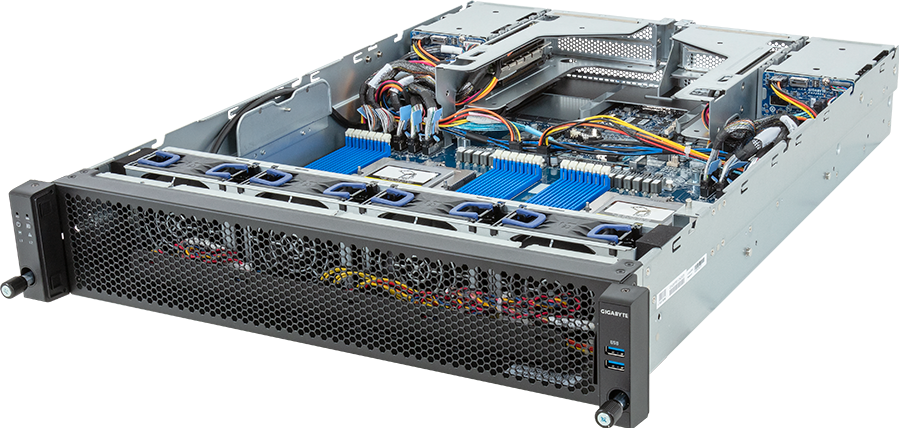
E283-Z91-AAD1 belongs in an AI design only when its preprocessing, orchestration or data-service role is explicit. The rest of the review tests that decision against workload fit, deployment constraints and the alternatives a buyer should price first.
The buying decision is fairly narrow: choose E283-Z91-AAD1 when preprocessing, orchestration, storage services or application backends need dedicated capacity. Do not buy it as a substitute for GPU compute when accelerator work is the real bottleneck.
Review the E283-Z91-AAD1 configuration options on GPUMachines before treating the base chassis as a finished design.
Executive Summary
The E283-Z91-AAD1 is best suited to infrastructure teams that need reliable CPU capacity, NVMe storage, and expansion for services that sit around GPU clusters, including data staging, orchestration, management, and application backends.
The headline configuration story is not primarily designed as a GPU-dense platform, backed by 2 CPU socket(s), 24 DIMM slots, DDR5, 7 storage positions, and 6 PCIe expansion slots.
It is not intended to replace a GPU-dense training server when the main bottleneck is accelerator compute.
Start configuration here: configure the E283-Z91-AAD1 on GPUMachines.
Key Specifications
| Area | Specification | | --- | --- | | Form factor | 2U rackmount | | CPU platform | SP5 | | CPU sockets | 2 | | GPU support | not primarily designed as a GPU-dense platform | | Memory | 24 DIMM slots, DDR5 | | Storage | 4 x 2.5" SATA/SAS-4 hot-swap bays, 2 x M.2 (2280/22110) PCIe Gen3 x4, 1 x M.2 (2280/22110) PCIe Gen3 x2 | | PCIe expansion | 6 x FHHL PCIe Gen5 x16 slots, 2 x OCP NIC 3.0 PCIe Gen5 x16 slots | | Networking | Configurable networking options | | Power | Dual 1600W 80 PLUS Platinum redundant power supply. AC Input: 100-120V~/ 12A, 50/60Hz; 200-240V~/ 10A, 50/60Hz. DC Input (for China): 240Vdc/ 10A. | | Best-fit workloads | application backends; data preprocessing; orchestration and management nodes; storage-adjacent services | | Dimensions | 438 x 87.5 x 625 mm |
Platform Highlights
- GPU platform: not primarily designed as a GPU-dense platform. This matters because accelerator choice drives the rest of the configuration: CPU lanes, rack or chassis power, airflow, local storage, and network design.
- CPU and memory base: SP5 with 24 DIMM slots, DDR5. The right CPU and memory plan should be sized around data preparation, host-side model work, and how many accelerators or services need to be kept busy.
- Storage layout: 4 x 2.5" SATA/SAS-4 hot-swap bays, 2 x M.2 (2280/22110) PCIe Gen3 x4, 1 x M.2 (2280/22110) PCIe Gen3 x2. Local NVMe is useful for active datasets, checkpoints, scratch space, and staging work before data moves to shared storage.
- Expansion and networking: 6 x FHHL PCIe Gen5 x16 slots, 2 x OCP NIC 3.0 PCIe Gen5 x16 slots. NIC placement and PCIe lane planning are important when the system will connect to storage, other GPU nodes, or remote users.
- Power and cooling: Dual 1600W 80 PLUS Platinum redundant power supply. AC Input: 100-120V~/ 12A, 50/60Hz; 200-240V~/ 10A, 50/60Hz. DC Input (for China): 240Vdc/ 10A.. Final power draw is configuration-dependent, especially once GPUs, NICs, and NVMe devices are selected.
- Product-specific fit: The practical buying question for E283-Z91-AAD1 is not only whether the chassis fits the rack, but whether its CPU, memory, storage, networking, and management options match the way the workload will actually run.
Our Technical View
In the GPUMachines portfolio, E283-Z91-AAD1 is a practical infrastructure node for the services that sit around GPU systems. These supporting systems often matter more than buyers expect: orchestration, storage control, data preparation, application services, monitoring, and access management all need reliable CPU and I/O capacity.
This model is strongest when the requirement is balanced infrastructure rather than maximum accelerator density. It may not be the right choice if the main bottleneck is GPU compute, in which case a GPU workstation, PCIe GPU server, HGX system, or hosted GPU option should be considered instead.
The practical buying question for E283-Z91-AAD1 is not only whether the chassis fits the rack, but whether its CPU, memory, storage, networking, and management options match the way the workload will actually run.
Best-Fit Workloads
Best-fit workloads include:
- application backends
- data preprocessing
- orchestration and management nodes
- storage-adjacent services
- virtualisation
- supporting infrastructure for AI clusters
Who Should Consider It
The E283-Z91-AAD1 makes sense when the project needs a properly specified infrastructure node, not just a part number. For AI teams, that usually means thinking through data movement, GPU or CPU utilisation, local scratch, shared storage, network fabric, and how the server will be operated after delivery.
It is most relevant for buyers that already understand their workload profile, have a target deployment model, and need help turning that requirement into a balanced hardware configuration. That may mean on-premise ownership, a hosted system, a leased deployment, or part of a larger private AI cluster.
Who Should Not Buy It
This is not the right purchase when the main requirement is dense GPU acceleration. Buyers focused on LLM training, GPU rendering, or multi-GPU inference should compare GPU workstations, PCIe GPU servers, HGX systems, or hosted GPU options before selecting a CPU-focused node.
Architecture Notes
The practical value of this system depends on balance. CPU infrastructure around an AI platform often handles orchestration, data preprocessing, application services, storage control, monitoring, authentication, and management workloads.
For E283-Z91-AAD1, the right version for a model-training team may look very different from the right version for web services, edge workloads, storage control, or management infrastructure.
Configuration Guidance
Important configuration decisions include:
- CPU choices include AMD EPYC 9115 (16C/32T, 3.0 GHz), AMD EPYC 9124 (16C/32T, 3.0 GHz), AMD EPYC 9175F (16C/32T, 4.2 GHz)
- Memory can be sized from options such as 128GB DDR5-5600 ECC REG, 128GB DDR5-6400 ECC REG, 16GB DDR5-5600 ECC REG
- Storage can be configured with 1TB NVMe M.2 SSD, 2TB NVMe M.2 SSD, 4TB NVMe M.2 SSD
- Networking options include high-speed Ethernet and InfiniBand adapters for cluster or storage traffic
For CPU infrastructure, size the processors, memory, boot media, network adapters, and management access around the services this node will run. GPUMachines can review the final configuration during quoting, but buyers should still define the intended workload, data sources, model size, user count, storage pattern, and network environment before selecting components.
Recommended Configuration Paths
- Best for supporting AI infrastructure: choose AMD EPYC 9115 (16C/32T, 3.0 GHz) or AMD EPYC 9124 (16C/32T, 3.0 GHz), enough memory for orchestration or application services, and resilient boot/storage media.
- Best for data services: prioritise local NVMe, network throughput, and management separation.
- Best for cost-controlled deployment: keep the CPU, RAM, and storage practical, then reserve budget for the GPU nodes or hosted GPU capacity that will do the accelerator work.
Alternatives and Related Systems
If the requirement is accelerator-heavy, compare PCIe GPU servers, HGX systems, or tower GPU workstations. If the system will support edge services, the edge AI server range may also be relevant.
Buying Through GPUMachines
The fastest next step is to use the E283-Z91-AAD1 configurator and select the CPU, RAM, storage, GPU, and networking options that match your workload. GPUMachines can then review the build for compatibility, thermals, power draw, lead time, and cluster fit.
For teams without suitable data centre space, GPUMachines can also discuss Buy & Host, leasing, and GPU Cloud alternatives. That is especially useful when the server needs high-density power, managed networking, or a private hosted environment.
Buyer Notes
E283-Z91-AAD1 should be matched to the job it will run most often. The model name and chassis class narrow the choice, but the final configuration still depends on memory footprint, storage path, network design and who will operate it.
The useful starting detail is not primarily designed as a GPU-dense platform. Read that alongside the deployment plan. A system for one lab group can be configured very differently from a system that will sit in a hosted environment or serve many internal teams.
Storage planning starts with the published layout: 4 x 2.5" SATA/SAS-4 hot-swap bays, 2 x M.2 (2280/22110) PCIe Gen3 x4, 1 x M.2 (2280/22110) PCIe Gen3 x2. That needs to be mapped to model staging, scratch space, checkpoint writes, logs and any shared dataset path before the system is ordered.
Networking also deserves early attention. The listed network path is Configurable networking options, but the final choice should separate management, storage and workload traffic where the deployment needs that separation.
Power is not a footnote here: Dual 1600W 80 PLUS Platinum redundant power supply. AC Input: 100-120V~/ 12A, 50/60Hz; 200-240V~/ 10A, 50/60Hz. DC Input (for China): 240Vdc/ 10A.. Before purchase, check the rack feed, redundancy plan, heat load and service process against the target site. GPUMachines can review the configuration before purchase, including whether a smaller server, hosted GPU capacity or a different platform class would be a cleaner fit.
The last check is ownership. Decide who will administer the system, where logs and backups live, how access is granted, and what counts as a failed deployment. Hardware can be correct on paper and still disappoint if those decisions are left until the week it arrives.
Final Sizing Check
For E283-Z91-AAD1, the storage line starts with 4 x 2.5" SATA/SAS-4 hot-swap bays, 2 x M.2 (2280/22110) PCIe Gen3 x4, 1 x M.2 (2280/22110) PCIe Gen3 x2. Treat that as a layout to test, not a promise that every dataset or checkpoint pattern will behave well. The network line starts with Configurable networking options, so check how that maps to management access, storage traffic and user workloads. The last useful exercise before purchase is a plain workload walk-through. Pick one normal week: who logs in, what data moves, where models are staged, how failures are noticed and who has permission to change the configuration.
That exercise often changes the build. Sometimes it means more RAM and fewer drives. Sometimes it means a different NIC, a hosted deployment, or a smaller server bought sooner. GPUMachines can help make that trade before the order is placed, which is cheaper than discovering the mismatch after delivery.
Final Host Sizing Check
For E283-Z91-AAD1, the storage line starts with 4 x 2.5" SATA/SAS-4 hot-swap bays, 2 x M.2 (2280/22110) PCIe Gen3 x4, 1 x M.2 (2280/22110) PCIe Gen3 x2. Treat that as a layout to test, not a promise that every dataset or checkpoint pattern will behave well. The network line starts with Configurable networking options, so check how that maps to management access, storage traffic and user workloads. The last useful exercise before purchase is a plain workload walk-through. Pick one normal week: who logs in, what data moves, where models are staged, how failures are noticed and who has permission to change the configuration.
That exercise often changes the build. Sometimes it means more RAM and fewer drives. Sometimes it means a different NIC, a hosted deployment, or a smaller server bought sooner. GPUMachines can help make that trade before the order is placed, which is cheaper than discovering the mismatch after delivery.
FAQ
Is E283-Z91-AAD1 better for training or inference?
It is not primarily a GPU training system. It is better viewed as supporting infrastructure around GPU workloads.
How much RAM should I configure?
RAM is configuration-dependent. Match memory capacity to CPU count, dataset preparation, model serving processes, virtualisation needs, and whether the system will run storage or orchestration services alongside GPU workloads.
Does this system need InfiniBand or 400GbE?
High-speed networking depends on deployment design. Single-node systems may only need fast Ethernet, while multi-node training, shared storage, and hosted GPU environments often justify 100GbE, 200GbE, 400GbE, InfiniBand, or separate management networks.
Is this overkill for small AI workloads?
It can be. If the workload is a small inference endpoint, proof-of-concept project, or one-GPU development task, a smaller workstation, hosted GPU option, or lower-density server may be more practical.
Can GPUMachines host this system?
GPUMachines can discuss hosted deployment, leasing, and Buy & Host options where appropriate. This is especially useful when rack power, cooling, remote access, or data-centre operations are concerns.
What should I check before deploying it in a data centre?
Review rack depth, power feeds, cooling, service access, networking, management separation, storage integration, and whether the system needs to operate alone or as part of a cluster.
Verdict
The E283-Z91-AAD1 is a strong fit when you want a configurable edge AI server that can be matched to a real AI, HPC, rendering, storage, or infrastructure workload. Its value is not only in the headline component list, but in how those components are selected and integrated.
Choose it when your team needs a serious infrastructure node with expert configuration support and a clear path to on-premise, hosted, or cluster deployment.
Configure it here: E283-Z91-AAD1 on GPUMachines.