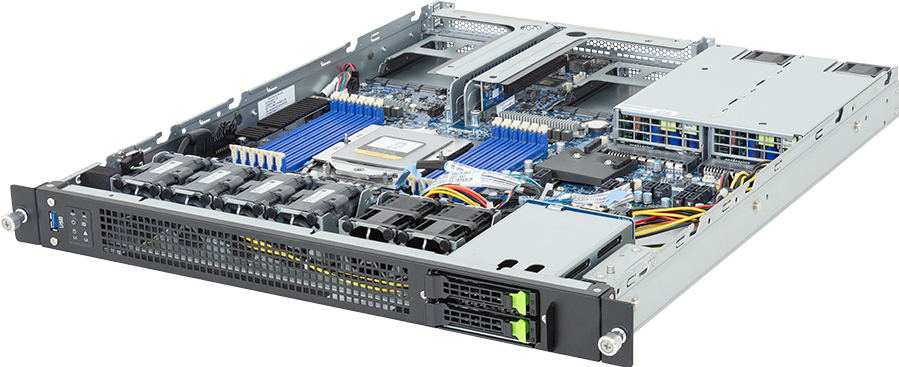
The GIGABYTE E163-Z34-AAH1 is an edge server, but that label does not make it a GPU appliance. The exact Rev. 3.x specification describes a short-depth 1U CPU platform with no qualified GPU position. Its strengths sit elsewhere: one AMD EPYC 9005 or 9004 processor, twelve DDR5 channels and four high-bandwidth expansion positions in a 520 mm chassis.
That distinction matters for search intent and purchasing. A buyer looking for a compact local-inference GPU server should choose a chassis with explicit accelerator support. A network team needing substantial CPU, memory and I/O in a shallow rack may find the E163-Z34-AAH1 much more useful than its old generic AI copy suggested.
This source-based technical review checks the exact physical resources, CPU conditions, storage layout and deployment constraints. GPUMachines has not claimed hands-on benchmark testing.
Configure the GIGABYTE E163-Z34-AAH1 or compare the wider edge server range.
E163-Z34-AAH1 Rev. 3.x specification
| Area | Verified specification | | --- | --- | | Form factor | 1U short-depth edge server, 438 x 43.5 x 520 mm | | Motherboard | GIGABYTE MZ33-DC1 | | Processor | 1 x SP5 socket; qualified AMD EPYC 9005 or 9004 | | CPU thermal boundary | Up to 400 W normally; up to 500 W at 25 degrees C, subject to the current support list | | Memory | 12 DDR5 RDIMM slots, one per channel | | Memory speed | Up to 6400 MT/s with EPYC 9005; up to 4800 MT/s with EPYC 9004 | | Front storage | 2 x 2.5-inch Gen5 NVMe, SATA or SAS-4 hot-swap positions in one shared physical pool | | Internal storage | 1 x M.2 2280/22110, PCIe Gen3 x4 | | PCIe expansion | 2 x FHHL PCIe Gen5 x16 | | OCP expansion | 2 x OCP NIC 3.0 PCIe Gen5 x16 with NCSI | | Onboard network | 1 x Intel I210-AT 1GbE plus dedicated 1GbE management | | Power | 1+1 redundant 1300 W 80 PLUS Titanium PSUs | | Fans | 2 x 40 x 40 x 28 mm plus 4 x 40 x 40 x 56 mm | | Remote management | ASPEED AST2600 and GIGABYTE Management Console |
The ordering suffix and revision belong in the specification. The related R163-Z34-AAH1 is a different, deeper rack server with four 3.5/2.5-inch front carriers. Confusing the initial letter changes chassis depth and storage geometry even though both systems use the same motherboard family.
Short depth is the product's real purpose
At 520 mm deep, the E163 can fit cabinets and edge locations that cannot accept a 700 to 900 mm server. Telecom rooms, branch data spaces, industrial enclosures and compact private-cloud racks often have strict depth and rear-clearance limits. A shallow chassis can be more useful there than another drive bay or GPU position.
The figure still needs context. Rails, power leads, network cables and fibre or copper bend radius extend beyond the metal chassis. The shorter optional rail kit covers a 385 to 480 mm mounting range, while GIGABYTE also lists a 660 to 840 mm rail option. Match the rail part to the cabinet rather than assuming that a 520 mm server fits every shallow rack.
Short depth also compresses the thermal path. Six 40 mm fans move air through one high-power CPU, twelve DIMMs and several add-in cards in 1U. Edge sites need front-to-rear airflow, clean intake paths and remote monitoring. A closet cabinet without heat extraction does not become suitable because the chassis is physically short.
EPYC selection has two thermal classes
GIGABYTE specifies qualified AMD EPYC 9005 and 9004 processors in one SP5 socket. The normal cTDP ceiling is 400 W. The manufacturer allows up to 500 W at a 25 degrees C ambient condition, subject to its support list and the ordered configuration.
Treat those as two separate approval paths. A processor at or below 400 W still needs current QVL and BIOS support, but it sits within the ordinary published envelope. A 450 or 500 W processor needs the documented inlet condition and explicit exact-model confirmation. Family and socket matching alone do not settle the build.
This matters at remote sites. A data room may hold 22 degrees C under normal conditions but exceed 25 degrees C at the server inlet after a cooling fault, a blocked filter or recirculation from the rear of the rack. Conditional CPU support needs a facility plan that can maintain the stated inlet limit.
The highest core count is not automatically the best edge choice. Packet processing, virtual network functions, encryption, data acquisition and many containers may value core density. Latency-sensitive control software may prefer stronger per-core behaviour. Power-constrained sites can gain more from a lower-cTDP processor that leaves thermal room for NICs and storage controllers.
GPUMachines should retain CPU options only where the exact chassis can support the model or where the conditional 500 W path is made clear at quote review. A global SP5 catalogue must not be interpreted as a universal E163 support list.
Twelve memory channels in a compact node
Twelve DDR5 RDIMM slots match the processor's twelve memory channels. GIGABYTE lists operation up to 6400 MT/s with EPYC 9005 and up to 4800 MT/s with EPYC 9004. These are maximum platform rates, not fixed promises for every module.
Populate channels evenly with matched Micron enterprise RDIMMs. Twelve modules, one per channel, provide the most direct route to full channel bandwidth. Fewer DIMMs can suit a small capacity target, but each empty channel reduces aggregate bandwidth available to the processor.
Memory needs vary sharply across edge roles. A routing or security appliance can reserve large tables and packet buffers. A private-cloud control node may host many services. CPU inference can require enough memory for model weights, runtime state and input batches even though no local GPU is present. Data acquisition systems can use memory as a buffer when an upstream connection stalls.
Do not add capacity by mixing spare modules without checking rank, speed and qualification. A tidy twelve-channel population is easier to support than a collection of mismatched DIMMs operating at the slowest common setting.
Two tri-mode carriers are still two carriers
The front backplane exposes two physical 2.5-inch hot-swap positions. Each can use a supported Gen5 NVMe, SATA or SAS-4 device according to the selected factory build and controller path. The correct maximum is two front drives in total, plus one internal M.2 device.
The configurator can show two choices under NVMe, SATA and SAS so a mixed build can be described. Those interface rows share the same two carriers. One NVMe plus one SATA drive fills the front. Selecting two NVMe drives leaves no physical carrier for SAS.
SAS needs an add-in card. GIGABYTE also states that RAID requires an add-in card, so neither feature should be inferred from the tri-mode backplane label alone. Controller dimensions, firmware, cable routing and expansion-slot use belong on the bill of materials.
The internal M.2 connector accepts 2280 or 22110 media over PCIe Gen3 x4. It can separate the operating system from front data drives, though one device cannot form a mirror by itself. If the service needs redundant boot media, use a supported arrangement and document how a failed device will be replaced.
Two front drives impose a clear storage boundary. This server fits boot, cache, local logs and a modest working set. It is not a dense data node. Workloads that need many local NVMe devices should use a storage-oriented chassis, while E163 deployments can reach shared storage through an OCP or PCIe network adapter.
Four Gen5 expansion positions in 1U
Two full-height, half-length PCIe Gen5 x16 slots sit alongside two OCP NIC 3.0 Gen5 x16 positions. That is a strong I/O allocation for a shallow single-socket server. It allows separate network and controller choices without forcing every card into a general-purpose riser.
Likely builds include high-speed NVIDIA Networking adapters, a SAS or RAID controller, packet-processing cards and specialised qualified accelerators. The E163 is not advertised with a GPU slot, so a free-looking x16 connector should not be treated as approval for a double-width accelerator. Card power, length, cooling and firmware matter as much as lane width.
The OCP positions support NCSI. A compatible OCP adapter can share management information with the BMC while leaving the PCIe risers available for storage or network functions. The exact arrangement should follow the service: a storage gateway may use one fast data NIC and one controller, whereas a network appliance could dedicate multiple ports to separate traffic domains.
Physical fit needs checking. FHHL means full-height, half-length, and not every high-speed adapter uses the same heatsink or port cage. Rear cable density can also become awkward in a shallow enclosure. Confirm card dimensions, airflow direction, firmware and cable bend radius together.
Base networking is for access, not throughput
One Intel I210-AT port provides 1GbE host connectivity, and another 1GbE port serves the management plane. This is enough for initial provisioning, low-rate services and BMC access. It is not the expected production data path for a server chosen for four Gen5 expansion positions.
A 25, 100, 200 or 400 GbE adapter can make sense depending on the switch estate and service. InfiniBand may suit a specialised cluster, while ordinary Ethernet fits most branch, private-cloud and network-service uses. The link should match the remote endpoint and traffic pattern rather than the fastest card in the catalogue.
Line-rate arithmetic gives a useful ceiling. A 100 GbE port carries 12.5 GB/s before framing, protocol and application overhead. A front pool of two drives may sit well below that under some workloads, while packet processing or memory-resident services can use the link very differently. These figures are not E163 benchmark claims.
Separate management from workload traffic where the site permits it. Out-of-band access becomes especially valuable when the operating system or production network is down and the server sits far from engineering staff.
Power and cooling need edge-site evidence
The chassis has 1+1 redundant 1300 W 80 PLUS Titanium supplies with 100 to 240 V input. The rating states power-delivery capacity. It does not mean the server draws 1300 W constantly, and a redundant pair does not normally consume 2600 W.
GPUMachines now uses a 260 W barebone allowance for the motherboard, BMC, backplane, risers and six fans before selectable CPUs, memory, drives and add-in cards. GIGABYTE does not publish a measured barebone-only figure, so this remains an engineering estimate. The earlier 480 W value overstated a CPU-only 1U chassis and has been replaced.
The final rack plan should use measured idle and sustained-load figures from the ordered server. Add PSU efficiency, CPU power, memory, drives, NICs and controller cards. Fan demand can rise with inlet temperature and restricted airflow, which changes both power and noise.
GIGABYTE lists a 10 to 35 degrees C operating range. The conditional 500 W CPU statement is narrower at 25 degrees C, so the processor choice can impose a tighter operational limit than the general chassis table. Use the strictest applicable condition.
Remote sites also need sensible failure planning. Two PSUs protect against one supply failure only when both feeds and the remaining supply can carry the configured load. A single upstream circuit leaves a common point of failure even when the server contains two PSU modules.
Workloads that fit
Network services are the most direct match. Twelve-channel EPYC memory and multiple Gen5 NIC positions suit routing, security, load balancing, private-cloud networking and data-movement roles, provided the chosen cards and software have exact support.
Hybrid or private-cloud edge control is another plausible use. The server can host orchestration, local services, virtual machines and storage gateways in a compact rack. Its dual-ROM design and BMC management help with remote operation, although software resilience still needs more than one physical node.
Industrial data acquisition, telemetry aggregation and branch processing can benefit from the shallow chassis. The node can collect, filter or transform data before sending it upstream. CPU inference may also work for models whose performance target fits the selected EPYC processor, but this should not be confused with GPU inference.
The system can sit beside GPU edge nodes as a control, network or ingest server. That role may improve accelerator utilisation by moving host services and data handling away from a more expensive GPU chassis.
Cases where another platform wins
Choose another model for local GPU compute. GIGABYTE does not qualify a GPU position in the E163-Z34-AAH1, and the two FHHL slots do not change that. The E263-Z34-AAJ1 or another explicit GPU server is a better starting point where accelerators are required.
A storage server is preferable when the application needs more than two front data drives, several hot-swap NVMe devices or a broad RAID layout. A dual-socket server fits workloads needing more CPU sockets, memory capacity or expansion than one SP5 platform can provide.
The E163 may also be the wrong choice in an occupied office. Six small high-pressure fans in 1U can produce substantial noise. Rack servers belong in a suitable equipment space with cooling and remote-management access.
Procurement checklist
Before approving an E163-Z34-AAH1 Rev. 3.x build, confirm:
- The CPU appears on GIGABYTE's current support list and either stays within the normal 400 W ceiling or has written approval for the conditional 500 W at 25 degrees C case.
- Matched Micron enterprise RDIMMs follow the twelve-channel population rules and the selected EPYC generation's speed limits.
- The two front carriers have the required NVMe, SATA or SAS backplane and controller path, with the shared two-drive cap enforced.
- SAS or RAID selections include a compatible controller, firmware and cable assembly.
- Every PCIe and OCP adapter fits the chassis, receives adequate airflow and has support for the chosen operating system.
- Rail range, usable rack depth, rear cable clearance, power feeds and inlet temperature suit the installation.
- The rack power model labels the 260 W barebone value as an estimate until the delivered build is measured.
Frequently asked questions
Is the E163-Z34-AAH1 a GPU edge server?
No. The exact Rev. 3.x specification does not list a qualified GPU position. It is a CPU-focused edge and network server with PCIe and OCP expansion for supported adapters and controllers.
Does it have six front drive bays?
No. It has two physical front carriers. NVMe, SATA and SAS are alternative or mixed interfaces for that shared two-bay pool. One internal M.2 connector is separate.
Can it use a 500 W EPYC processor?
Only conditionally. GIGABYTE states a normal cTDP limit of 400 W and support up to 500 W at 25 degrees C. The exact processor, BIOS, cooling build and support-list entry must be confirmed.
What networking ships with the base server?
It includes one Intel I210-AT 1GbE host port and a dedicated 1GbE management port. Production high-speed networking requires a compatible OCP NIC 3.0 or PCIe adapter.
Is the 260 W barebone figure measured?
No. It is a GPUMachines engineering allowance for the chassis electronics and fans before configurable parts. Replace it with measurements from the delivered configuration when available.
Buying assessment
The E163-Z34-AAH1 Rev. 3.x is a strong short-depth CPU and I/O platform, not a hidden GPU server. Its 520 mm chassis, twelve memory channels and four Gen5 expansion positions suit network, control, ingest and private-cloud roles in racks where depth is constrained.
The platform works only when its limits stay visible. Two front carriers remain two carriers across NVMe, SATA and SAS. CPUs above 400 W need the 25 degrees C conditional path. The base 1GbE port is not a production fabric, and SAS or RAID needs another card.
For the right edge service, those are ordinary design choices rather than faults. Buyers needing local GPUs, dense storage or a second CPU should move to a platform built for that job instead of forcing the E163 beyond its published specification.
Configure the GIGABYTE E163-Z34-AAH1 with a source-checked CPU, memory, storage and network plan. Compare explicit accelerator platforms in the edge server category.
Official sources
- GIGABYTE E163-Z34-AAH1 Rev. 3.x product page
- GIGABYTE E163-Z34-AAH1 Rev. 3.x datasheet
- GIGABYTE E163-Z34 server manual
- GIGABYTE E163-Z34-AAH1 support list
Sources were checked on 22 September 2026. Confirm the exact CPU, DIMM, drive, controller, NIC, rail, firmware and environmental conditions on the final quote.