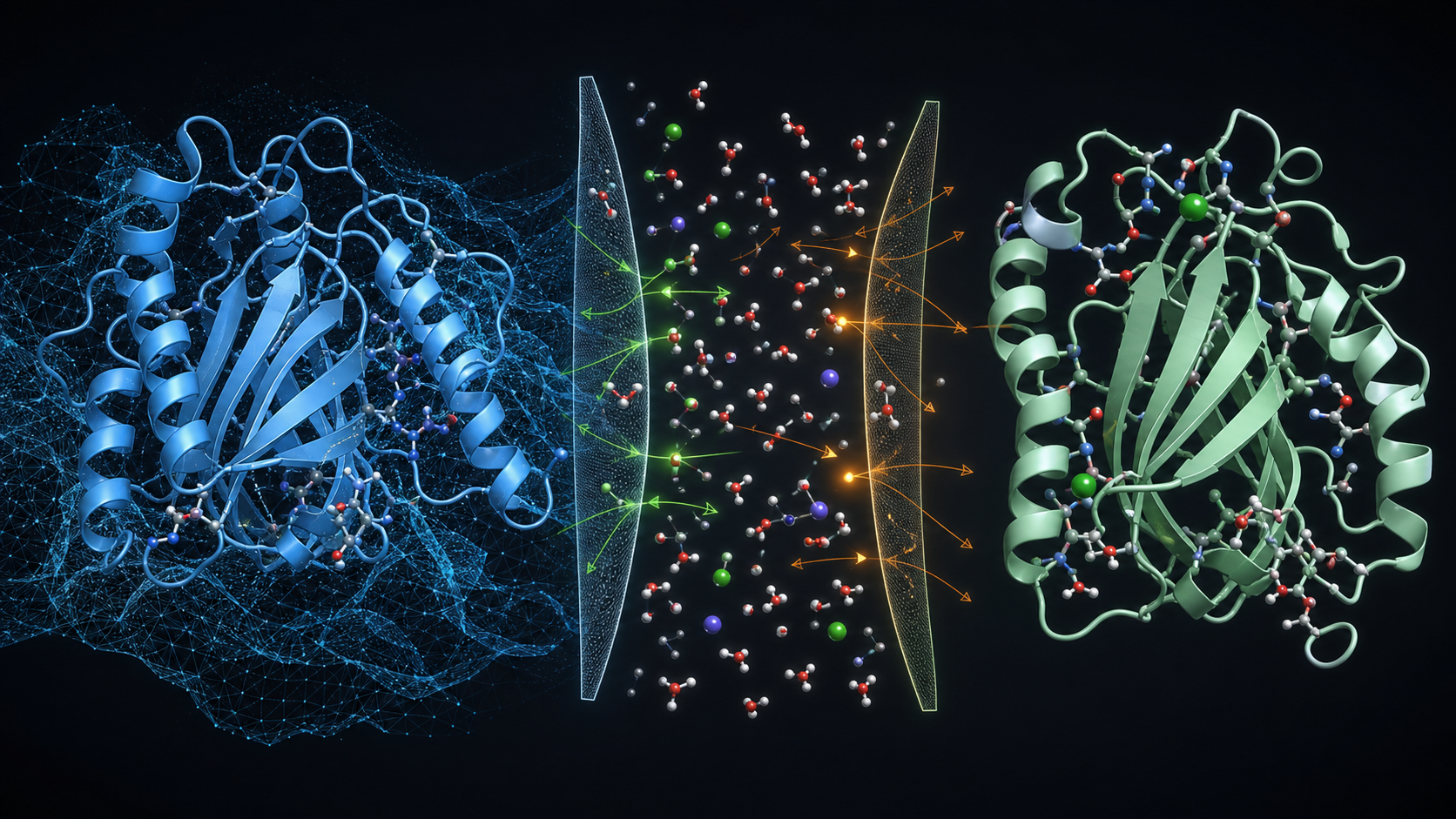
A protein model can look convincing, carry a high confidence score and still break the chemistry. That uncomfortable result sits behind new work from Rensselaer Polytechnic Institute on the way several AI structure-prediction tools handle charged amino-acid side chains.
The paper, published by the Proceedings of the National Academy of Sciences and described by RPI on 24 July 2026, asks a precise question: do popular structure predictors represent electrostatic constraints correctly when a sequence contains unusual substitutions involving ionisable residues? In the test case, the answer was unreliable enough that the author recommends physics-based checks after prediction.
That does not make AlphaFold2, RoseTTAFold2, OmegaFold or ESMFold useless. These systems have changed structural bioinformatics and can produce valuable hypotheses quickly. The study exposes a boundary between pattern recognition and physical validation. Research teams need to know where that boundary sits before a predicted structure enters a simulation, design decision or laboratory plan.
GPUMachines is not offering biological or medical validation. Our role is narrower: translate the workflow into compute, memory, storage and operating requirements without pretending a larger GPU makes the science correct.
Executive Summary
- What the study reports: several AI structure predictors produced implausible results for a protein variant involving ionisable residues, and their confidence signals did not expose the full problem.
- Why it matters: a model's confidence estimates similarity to patterns learned during training; it is not a universal certificate of electrostatic or thermodynamic validity.
- What research teams should add: structure inspection, electrostatic checks, energy minimisation, molecular dynamics and domain-expert review appropriate to the scientific question.
- Where infrastructure changes: prediction and simulation use different software paths. CPU work, reference databases, GPU memory, trajectory storage and queue design all need separate sizing.
- When a large server is excessive: one researcher testing occasional proteins may need a well-built workstation, not an HGX system or multi-node cluster.
For related platform planning, see the GPUMachines guides to AI infrastructure for bioinformatics and AI infrastructure for research institutes.
What the RPI Study Tested
George I. Makhatadze's study began with a variant of the U1A protein containing four substitutions to ionisable residues. Ionisable side chains can gain or lose a proton depending on their chemical environment. Their charge state and nearby interactions affect protein stability, so packing them into an implausible environment can make a predicted fold physically questionable even when the backbone looks tidy.
The work evaluated AlphaFold2 and RoseTTAFold2, which draw heavily on evolutionary and structural information, alongside the protein language-model approaches OmegaFold and ESMFold. According to RPI's summary, the evolutionary-data systems produced implausible structures for the variant because statistical patterns took priority over folding thermodynamics. The language-model systems made fewer impossible predictions in this comparison, but neither group handled the ionisable-residue problem reliably.
The preprint frames the question around electrostatics. That scope matters. It is not a claim that every prediction from these tools is wrong, nor that one test protein measures every use case. It shows that a high-performing general predictor can fail on a chemically awkward sequence outside the patterns it learned well.
RPI also reports a confidence problem: each tested tool rated its result more highly than the physical analysis justified. A research workflow that filters only by model confidence can therefore pass a structure that deserves a second check.
Confidence Is Not Physical Validity
AlphaFold's pLDDT score estimates expected local agreement with a reference structure. The original AlphaFold paper and human-proteome work explain how that confidence measure was calibrated against structural data. It is useful for identifying regions where the network expects its coordinates to be more or less reliable.
It does not solve every physical question. A locally confident backbone can coexist with a poor side-chain environment, an unsupported protonation state, missing ligand context, strained contacts or a sequence variant that lacks useful evolutionary examples. Different tools expose different metrics, but none should be read as a complete thermodynamic certificate.
That distinction is easy to lose in an automated pipeline. A service receives a sequence, produces a PDB file and returns a confidence plot. The output looks finished. In practice, it is a computational model that may need chemical context, relaxation, simulation and experimental comparison.
Confidence still belongs in the workflow. It helps prioritise inspection and identify uncertain regions. The error comes from asking it to answer a different question.
Why Ionisable Residues Are a Difficult Test
Aspartate, glutamate, lysine, arginine, histidine and other ionisable groups participate in electrostatic interactions that depend on local environment and pH. A charge exposed to solvent behaves differently from the same group buried inside a protein. Nearby charges, hydrogen bonds and salt bridges can stabilise or destabilise a conformation.
Sequence substitutions can disturb that balance. A predictor trained on natural structures may learn common arrangements without explicitly reproducing every energetic consequence of an unusual variant. If the proposed structure buries incompatible charges or misses a compensating interaction, the geometry can look familiar while the chemistry does not.
This is one reason physics-based refinement and simulation remain useful. A force field applies an explicit mathematical model to bonded and non-bonded interactions. It is also an approximation, with its own parameters and failure cases, but it asks different questions from the predictor.
Agreement between two imperfect methods is not proof. Disagreement is valuable because it tells the researcher where to investigate.
Prediction and Verification Are Separate Compute Jobs
Infrastructure discussions often treat protein modelling as one GPU workload. A working pipeline contains several stages with different bottlenecks.
| Stage | Typical work | Likely infrastructure pressure | |---|---|---| | Sequence and database preparation | Search reference databases, build alignments, parse metadata | CPU, RAM, fast local or shared storage | | AI structure prediction | Run neural-network inference and model recycles | GPU memory, GPU compute, model software support | | Structure preparation | Add missing atoms, choose protonation assumptions, build solvent and ions | CPU, RAM, scientific software | | Energy minimisation | Remove severe clashes under a selected force field | GPU or CPU, configuration correctness | | Molecular dynamics | Advance the system through many integration steps | Sustained GPU compute, CPU-GPU balance, checkpointing | | Trajectory analysis | Read frames, measure contacts and compare ensembles | Storage throughput, capacity, CPU and sometimes GPU | | Scientific review | Interpret the output against experimental and domain knowledge | Skilled people, provenance and reproducibility |
The final row cannot be bought as hardware.
A GPU selected only for the predictor may be a poor choice for long simulations, and a simulation node may not need the large local databases used by an AlphaFold pipeline. Shared systems should schedule the stages separately rather than reserve the most expensive accelerator while a CPU database search runs.
A Practical Verification Pipeline
The correct scientific procedure depends on the protein and research question. The following sequence is a planning framework, not a laboratory protocol or validation standard.
Start by preserving the exact input: sequence, model version, database revision, templates, random seed where relevant and every prediction setting. Without that record, a later result cannot be reproduced reliably.
Inspect predictor confidence and geometry together. Look for low-confidence regions, improbable contacts, chain breaks, missing context and unusual side-chain placement. For variants, compare the altered residue environment against the reference sequence rather than examining the new model alone.
Next comes chemical preparation. Protonation states, termini, ligands, cofactors, ions, solvent and force-field selection affect what a simulation represents. These decisions need a qualified computational scientist; an automated default may be reasonable for a screen and wrong for the actual experiment.
Energy minimisation can expose severe strain, but a structure surviving minimisation is not automatically correct. Short equilibration and molecular-dynamics runs can test whether the proposed arrangement remains stable under the chosen assumptions. Replicates may be needed because one trajectory samples one path.
Finally, compare the simulation with available experimental data and known chemistry. A computational pipeline can reject a physically implausible idea or strengthen a hypothesis. It cannot turn a prediction into experimental observation.
Hardware for AI Structure Prediction
The open AlphaFold2 repository calls for Linux, a modern NVIDIA GPU and substantial local or shared storage for genetic databases. Its current documentation says a full database download can use up to 3TB, although reduced database presets trade some input depth for lower requirements. GPU memory influences the sequence and complex sizes a system can process.
Those requirements should be checked against the exact implementation. AlphaFold2, AlphaFold3, ColabFold, ESMFold and other tools differ in licences, databases, GPU support and memory behaviour. A hardware quote based on the word "AlphaFold" alone is not ready.
For an individual researcher, a tower GPU workstation can provide local access, useful GPU memory and fast NVMe without queueing behind a shared cluster. It also places database updates, backups, software maintenance and failed-job recovery on the research group.
A shared PCIe GPU server becomes attractive when several users need isolated jobs, larger memory options or central data management. Independent prediction jobs can often use separate GPUs efficiently; they do not always need the tightly coupled scale-up fabric of an HGX system.
HGX makes more sense when the selected software can use several linked GPUs for one large job, or when the server will also run training and large-model work. Buying NVSwitch for a queue of single-GPU predictions is poor use of budget.
Hardware for Molecular Dynamics
Molecular-dynamics engines use GPUs differently from structure predictors. GROMACS accelerates common simulation kernels and supports several GPU backends. Its 2026 documentation lists CUDA for NVIDIA, SYCL paths for Intel and AMD, and full HIP offload support for AMD devices in the current release. OpenMM exposes CUDA, HIP and OpenCL platforms as well as CPU execution.
Software support should decide the accelerator, not brand familiarity. Confirm the required force field, constraints, precision mode, multi-GPU path, operating system, compiler and driver against the exact software release. A feature supported on one backend may have restrictions on another.
CPU selection still matters. Domain decomposition, constraints, I/O and unsupported kernels can leave work on the host. Memory bandwidth and NUMA placement affect how quickly the CPU side feeds the GPU. A high-end accelerator attached to an undersized host can wait.
Multi-GPU scaling must be measured on the target system size. A single simulation does not always scale across several GPUs efficiently. Running several independent replicas, variants or parameter sweeps may produce more scientific throughput than forcing one trajectory across every accelerator.
This is a useful dividing line:
- Choose fast single-GPU nodes when jobs are independent and fit device memory.
- Choose multi-GPU servers when measured scaling or concurrent demand justifies them.
- Move to multiple nodes only when the simulation method, network and job size can use distributed execution.
- Keep a CPU partition for preparation and analysis jobs that do not benefit from expensive GPUs.
Storage Can Become the Quiet Bottleneck
Prediction databases consume capacity, but trajectories create a different storage pattern. Simulations write coordinate, velocity, energy, checkpoint and log data over time. The volume depends on atom count, frame frequency, precision, run length and the number of replicas.
Saving every possible frame can fill shared storage without improving the analysis. Saving too little can hide the event a researcher needed. Output cadence belongs in the scientific plan and the capacity calculation.
Local NVMe works well for active scratch data when the application can recover from a node loss. Results, inputs and checkpoints that must survive belong on protected shared storage. A sensible layout separates:
- Versioned reference databases.
- Immutable inputs and environment definitions.
- Active scratch and temporary trajectories.
- Checkpoints used for restart.
- Curated results and figures.
- Logs, provenance and audit records.
Trajectory analysis can reread large files many times. A system sized only for sequential writes may feel slow during comparison and visualisation. Measure the analysis path as well as simulation output.
Networking and Cluster Scale
Many protein-prediction and molecular-dynamics jobs fit within one server. They do not need InfiniBand merely because a GPU is involved.
High-speed cluster networking matters when jobs distribute tightly across nodes, when many workers read common databases simultaneously, or when a shared storage system must serve a large queue. The required fabric depends on message rate, collective behaviour, storage traffic and job topology.
For embarrassingly parallel screening, scheduler throughput and storage metadata can matter more than latency between GPUs. Hundreds of short jobs can overwhelm a shared filesystem with small files even while the network links look underused.
Large simulations with domain decomposition present another pattern. Their ranks exchange boundary data frequently, making network latency and topology more significant. The team should validate scaling with its chosen engine and molecular system before ordering a specialised fabric.
The GPU Cluster Configurator can frame server, storage and network options, but GPUMachines would ask for a workload trace or representative benchmark before proposing scale.
Reproducibility Needs Its Own Design
A protein pipeline that cannot reproduce a result is unfinished. Capture software containers or environments, model weights, database versions, force fields, configuration files, seeds, hardware details and job logs.
Do not overwrite source structures with prepared or relaxed files. Give each stage a separate artefact and record the transformation between them. When a result changes after a software update, the team should be able to identify why.
Schedulers help here. A workflow manager can encode dependencies between database search, prediction, preparation, simulation and analysis. Failed stages can restart from a checkpoint instead of leaving a researcher to rebuild the sequence by hand.
Access control matters when sequences or associated data are sensitive. Keep project permissions, service accounts, backups and remote access within the organisation's approved data policy. This article does not determine whether a dataset carries clinical, personal or commercial restrictions.
Who Should Consider Dedicated Infrastructure
Dedicated hardware suits research groups with recurring prediction and simulation demand, controlled data requirements, long queues on shared facilities or a need to reproduce an environment over several years.
Bioinformatics service teams may prefer a shared PCIe server with several GPUs so independent jobs can run concurrently. Computational chemistry groups with sustained molecular dynamics may prioritise GPU arithmetic, host balance and scratch performance. Institutes supporting both need a mixed queue rather than one universal node.
Local ownership can make method development easier because researchers control drivers, containers and maintenance windows. It also creates operational work. Someone must patch the host, test updates, monitor storage, replace failed components and preserve data.
GPUMachines can review those infrastructure choices. The research team remains responsible for the scientific method and interpretation.
Who Should Not Buy a Large GPU Server
One occasional prediction is not a cluster workload. Public or institutional services, a smaller workstation or temporary hosted capacity may be enough while the method is being assessed.
A team without a defined verification procedure should not buy hardware first. More compute will produce questionable structures faster; it will not decide which protonation state, force field or experimental comparison is appropriate.
Groups with uncertain demand should also avoid an HGX purchase based on prestige. If jobs run independently on one GPU, a PCIe server or several workstations can be easier to schedule and cheaper to operate.
The final reason to wait is staffing. A system that nobody can maintain becomes an expensive queue with stale drivers and unclear results.
Our Technical View
The RPI paper is useful because it identifies a specific failure mode instead of repeating the broad warning that AI can be wrong. Electrostatic plausibility and ionisable side chains give research teams something concrete to test.
It also argues against a lazy hardware story. Prediction is one stage. Physics-based checks add sustained simulation, trajectory storage, CPU work and scientific review, so the right platform may be a balanced workstation or mixed research cluster rather than the GPU with the largest headline.
GPUMachines would size the infrastructure around a representative end-to-end pipeline. We would record where time is spent, which jobs use one or several GPUs, how much active data each run creates, and which stages need shared databases. We would not claim that the resulting server validates a protein model.
Questions to Answer Before Configuration
Bring these details to a hardware review:
1. Which predictor, version and licence will run? 2. What sequence lengths, complexes and batch volumes are expected? 3. Which databases are required, and how will they be updated? 4. Which force field and molecular-dynamics engine will follow prediction? 5. Does one job scale across GPUs, or are jobs independent? 6. How many users and concurrent jobs share the system? 7. How much trajectory data will each run write under the chosen output cadence? 8. Which artefacts need backup, retention and restricted access? 9. What acceptance workload will be run before sign-off? 10. Who owns scientific validation and who owns platform operations?
If those answers are missing, create a pilot rather than a large final design.
FAQ
Does the RPI study show that AlphaFold2 is inaccurate?
It shows a particular failure involving a protein variant and ionisable residues. AlphaFold2 remains highly useful, but the study warns that model confidence can miss a physicochemical problem. Do not generalise one test into a verdict on every structure.
Is a high pLDDT score enough to accept a predicted structure?
No. pLDDT is a valuable estimate of local structural confidence, not proof of electrostatic, thermodynamic or biological validity. Review the chemical context and use other checks appropriate to the research question.
Do all predictions need molecular dynamics?
Not necessarily. The validation route depends on how the structure will be used and what uncertainty matters. A qualified structural biologist or computational chemist should define the procedure.
Is NVIDIA required for protein modelling?
The answer depends on software. The open AlphaFold2 repository specifies a modern NVIDIA GPU, while GROMACS and OpenMM support several accelerator backends. Check the complete toolchain before selecting hardware.
Does molecular dynamics require several GPUs?
Many simulations run effectively on one GPU. Multiple GPUs help only when the engine, system size and decomposition scale well, or when the team runs many independent simulations at once.
How much storage should a protein-modelling server have?
Calculate reference databases, model files, active scratch, trajectories, checkpoints, retained results and backups separately. Output frequency and replica count can change the total more than the input structure size.
Should a small laboratory buy an HGX server?
Usually not for occasional prediction or single-GPU simulation. A tower workstation, smaller PCIe server or hosted capacity is a better starting point until queue depth and scaling are measured.
Can GPUMachines validate our predicted protein structures?
No. GPUMachines can source and configure compute, storage and networking for the workflow. Scientific validation must stay with appropriately qualified researchers.
Verdict
AI structure prediction gives researchers a fast way to form hypotheses. The RPI study shows why confidence scores cannot close the case when unusual electrostatics are involved.
The best response is not distrust of every model and it is not a bigger GPU. Build a recorded pipeline that separates prediction from physical checks, sizes each compute stage honestly, and keeps a domain expert responsible for the conclusion.
GPUMachines can help configure a workstation, GPU server or research cluster for that complete pipeline, with the scientific boundary stated plainly.
Sources and Further Reading
- RPI summary of the protein-structure prediction study
- PNAS paper: Do AI Models for Protein Structure Prediction Get Electrostatics Right?
- Earlier bioRxiv version of the electrostatics study
- Original AlphaFold2 paper in Nature
- Official open AlphaFold2 repository and installation requirements
- Current GROMACS installation and GPU-backend documentation
- OpenMM platform documentation for CPU, CUDA, HIP and OpenCL