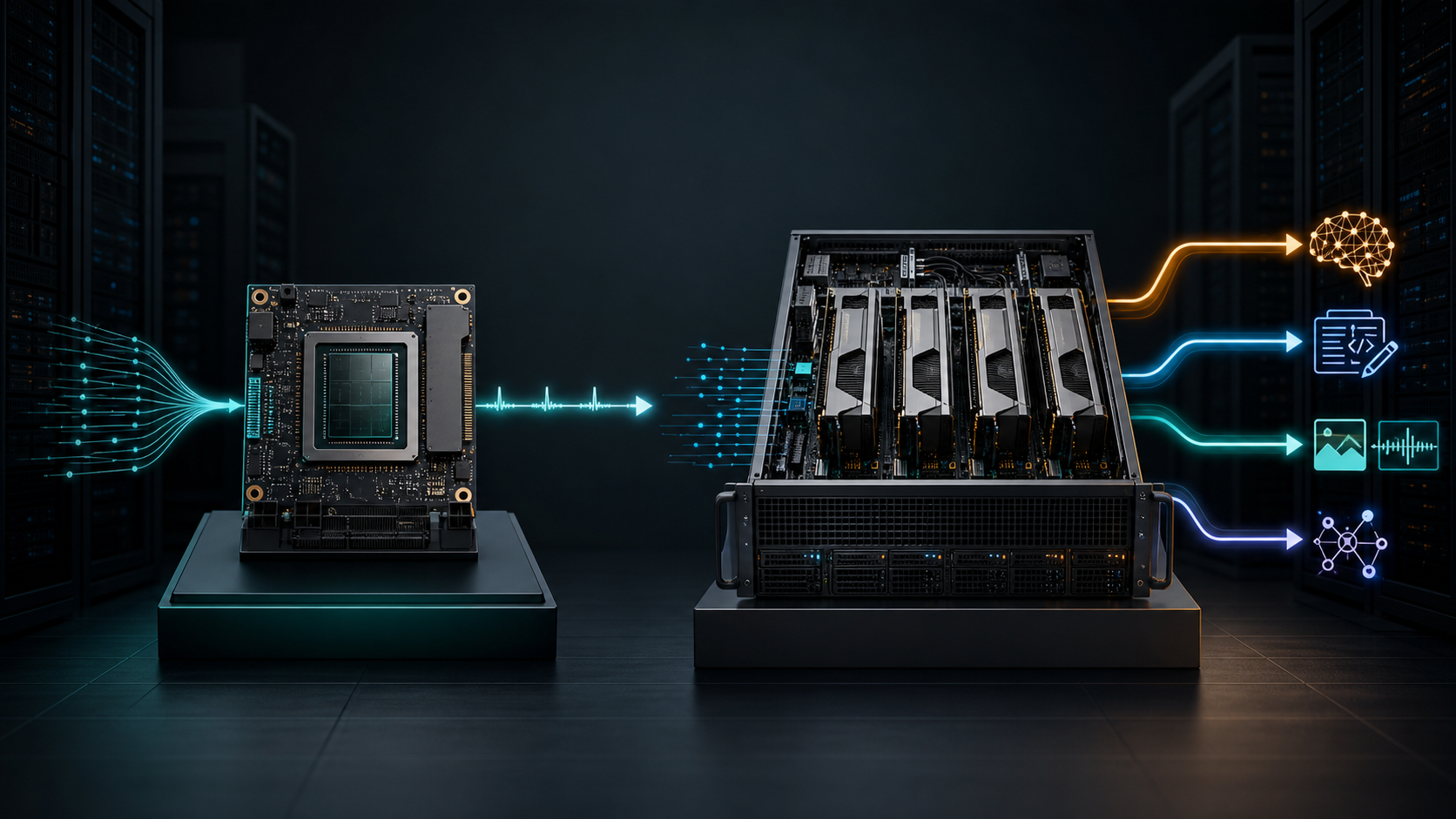
A benchmark can make a hardware road map look obsolete before the alternative is even for sale. OpenAI's first published Jalapeño results do exactly that at first glance: the custom inference accelerator beat the compared NVIDIA systems on throughput per kilowatt and latency across three large open models. A buyer planning an inference cluster could reasonably ask whether ordering GPUs now means paying for flexibility that a specialist chip has already overtaken.
For most enterprise and research buyers, the answer is still buy the GPU platform that fits the measured workload. Jalapeño is not a generally available accelerator that a customer can quote, install or support. OpenAI says production qualification and software work are continuing. Its results are useful evidence that co-designed inference silicon can push the efficiency frontier, but they do not establish the purchase price, full-rack power, availability, service model or performance of a customer deployment.
That distinction matters. A company choosing hardware needs a system it can operate, not the fastest point on a chart.
GPUMachines sells and configures GPU infrastructure, so our commercial interest is plain. This analysis does not claim that GPUs win every inference job. It explains why a proprietary accelerator built for one operator and a configurable GPU server sold to many operators answer different procurement questions. GPUMachines has not independently tested Jalapeño, GB200 or GB300 against the workloads discussed here. Numerical results below come from OpenAI's 25 August 2026 publication and should be treated as vendor-reported measurements.
The buying answer
Do not postpone a funded GPU project because Jalapeño exists. Pause only if the planned service has a stable model, very high sustained utilisation, no requirement to own the hardware, and a credible route to consume the custom accelerator through OpenAI at a lower measured cost per successful request.
Choose a GPU server or cluster when any of the following remain unsettled:
- the model family, precision or serving engine may change;
- the same hardware must handle fine-tuning, evaluation or batch work;
- data must stay on premises or within a named hosting jurisdiction;
- the team needs direct access to CUDA or another established GPU software stack;
- the asset must retain a useful second workload if the original model is retired.
Jalapeño strengthens the case for measuring inference at the service level. It does not turn a proprietary internal chip into a drop-in alternative to an HGX server.
What OpenAI actually reported
OpenAI tested Jalapeño with InferenceX, the open benchmark project maintained by SemiAnalysis. The company published results for GPT-OSS 120B, DeepSeek R1 670B and Kimi K2.5 1T. OpenAI rated the accelerator at 700 watts and said measured sustained power remained at or below 550 watts during the tested workloads.
The published comparison reported:
| Model and comparison | Peak mixed throughput per kilowatt | End-to-end latency | Important boundary | |---|---:|---:|---| | GPT-OSS 120B against GB200 | about 1.9 times higher | about 1.7 times lower | OpenAI result, normalised using package power ratings | | DeepSeek R1 670B against GB300 | about 1.7 times higher | about 3.6 times lower | Selected model, precision and operating points | | Kimi K2.5 1T against GB300 | about 1.5 times higher | about 3.4 times lower | Does not establish commercial service cost |
Those are substantial results. They also come with a methodological detail that belongs in the buying discussion: OpenAI normalised the comparison using each accelerator's published chip power rating. Package power is useful for comparing silicon, but a data-centre bill includes host processors, memory, networking, storage, fans or liquid-cooling equipment, power conversion losses and idle capacity. A rack-level meter may preserve the advantage, reduce it or expose a different bottleneck. The publication does not answer that question.
InferenceX itself is open source and designed to track fast-moving combinations of hardware, models and serving software. That makes it more inspectable than a closed demonstration. It does not make every submitted result equivalent to an independently procured production test. OpenAI supplied the Jalapeño result and described the comparison.
What the result does not prove
No public number in the announcement gives an enterprise a five-year total cost of ownership.
There is no public list price, delivery schedule for outside customers, support entitlement or replacement-parts policy. OpenAI says it is preparing Jalapeño for deployment, which is different from saying an IT team can order it. The article also does not provide a full account of rack density, host configuration, networking topology, model-loading time, failure recovery, multi-tenant isolation or sustained service availability.
It is an inference result, not a training result. Research groups that pre-train, fine-tune, evaluate and serve on the same estate still need hardware and software that cover those phases. The result does not show that Jalapeño can run an arbitrary CUDA application, a molecular-dynamics code or a new attention kernel developed next quarter.
Nor does it prove that every deployment of the compared NVIDIA systems will reproduce the baseline. Inference performance moves when the serving engine, quantisation, tensor-parallel shape, batch policy, prompt mix and software release change. Our guide to INT8 support on NVIDIA B300 explains why a precision label alone cannot guarantee a working or fast deployment.
Why a custom inference chip can win
OpenAI operates at a scale where small efficiency gains can affect data-centre capacity. It also controls more of the stack than a normal hardware buyer: model development, serving software, workload telemetry, infrastructure design and the customer service consuming the output. That control lets its engineers design a chip around known traffic patterns and tune the software alongside the silicon.
General-purpose accelerators carry features that some inference workloads do not need on every request. A specialist design can spend its power, memory movement and die area differently. It can also remove compromises imposed by compatibility with a broad customer base.
Agents make latency especially expensive. A single response might tolerate an extra second; a workflow that makes dozens of dependent model calls pays that delay repeatedly because later steps cannot start until earlier ones finish. OpenAI explicitly links Jalapeño's latency work to agent behaviour. Faster individual calls can therefore shorten the completed task even when the headline token rate tells only part of the story.
This is the strongest lesson from the announcement: inference buyers should stop treating peak chip throughput as the sole performance measure. Time to first token, time between tokens, end-to-end task duration, tokens per kilowatt and successful requests per pound can lead to different hardware choices.
Why GPUs remain the safer enterprise purchase
Flexibility is not an abstract benefit when the model road map keeps changing.
An HGX system can support training, fine-tuning, retrieval pipelines, batch inference and interactive serving, subject to memory capacity and software compatibility. It can move between open models and internal models without waiting for access to a vendor's private accelerator. The CUDA ecosystem also gives operators mature tools for scheduling, profiling, distributed communication and fault diagnosis.
That breadth may look inefficient beside a chip designed around OpenAI's own workload. It becomes valuable when the original plan changes. Suppose a team buys capacity for a 120-billion-parameter text model, then adds a vision-language pipeline, longer contexts and overnight fine-tuning. A GPU cluster can be reconfigured. A hosted specialist service may still handle the work, but the customer must accept the provider's supported model, data path, rate limits and commercial terms.
Hardware ownership changes the risk as well. An organisation running sensitive models can keep weights, prompts and generated data within its controlled environment. Readers weighing that requirement should start with our analysis of open-weight AI and infrastructure sovereignty. A cloud service can offer strong contractual and technical controls, but it is not the same operating model as owning the machines.
GPUs also have a visible supply chain. A buyer can compare server manufacturers, support packages, network choices and hosting locations. Jalapeño currently has one designer, one primary operator and no public reseller route. That concentration may suit OpenAI perfectly. It is a procurement dependency for anyone else.
The real comparison is service against system
Buyers will probably encounter Jalapeño through an OpenAI service, not as a PCIe card. The fair comparison is therefore:
OpenAI service outcome and price versus the complete cost and operating responsibility of a GPU service or owned GPU system.
That calculation should use the target workload rather than public peak numbers. Record the input and output mix, context length, concurrency, latency ceiling, daily demand curve and acceptable queue time. Then measure these four outcomes:
1. successful requests per hour at the required latency; 2. energy at the wall, including the host and cooling allocation; 3. operator time, software subscriptions and support; 4. the cost of unused capacity during quiet periods.
Cloud consumption often wins for variable demand because the customer does not carry the idle asset. Owned infrastructure can win when demand stays high, data movement is expensive, or the hardware can serve several workloads. A Buy & Host deployment sits between those models: the customer owns a specified system while a hosting facility supplies the data-centre environment and remote operation.
Do not convert a vendor's throughput-per-kilowatt ratio directly into a projected saving. The denominator, utilisation and service-level target must match the proposed deployment.
Five buyer profiles and the sensible route
A research team changing models every month
Buy GPUs. Researchers need access to kernels, profilers, training frameworks and mixed workloads. A specialist cloud endpoint may supplement the cluster for burst inference, but it should not replace the main experimental platform unless the research programme fits the provider's interface.
An enterprise serving one stable internal assistant
Benchmark both ownership and managed inference. If demand is modest or spiky, an API may cost less than an underused server. If prompts contain controlled data and utilisation is high, an owned or hosted GPU server may provide a cleaner boundary.
A neocloud selling open-model endpoints
GPU infrastructure remains the practical asset because customers expect model choice. The operator should track ASIC services as competitive price signals and optimise the serving stack aggressively. The Vera Rubin and Groq disaggregated inference analysis shows another route: separate parts of the inference path rather than force every phase onto one accelerator.
A product company committed to OpenAI models
The underlying chip matters less than the measured API outcome. Negotiate around latency, capacity, regional processing, continuity and price. Avoid building procurement assumptions around access to Jalapeño hardware unless OpenAI offers that access in writing.
A laboratory with a fixed capital budget
Choose equipment that can survive a change of grant, model or principal workload. A general GPU server usually has the better reuse case. Browse current HGX server platforms only after confirming power, cooling and memory requirements; a smaller PCIe system may be the more defensible purchase.
When not to buy the GPU server
A GPU purchase is a bad answer when the expected utilisation is low and no neighbouring team can use the spare capacity. It is also difficult to justify if the organisation lacks a suitable power and cooling environment, cannot support the software stack, or needs production inference immediately but has not hired an operator.
In that situation, buy the result as a service. Run a representative workload against OpenAI and competing providers, include privacy and exit terms in the evaluation, then reserve capacity only where the measured service meets the requirement. The existence of Jalapeño may improve that service without creating a new hardware task for the customer.
The same logic applies to short projects. Three months of uncertain demand rarely supports a five-year hardware commitment.
Questions to put into the procurement test
Ask an API or custom-silicon provider:
- Which models, precisions and context lengths receive the quoted performance?
- Is capacity dedicated, reserved or shared, and what happens during a regional shortage?
- Which regions process prompts and retain telemetry?
- Can the customer export prompts, evaluation data and tuning artefacts in usable formats?
- What contractual remedy applies when latency or availability misses the target?
Ask a GPU infrastructure supplier for the exact server, GPU memory, host CPUs, system RAM, NICs, storage path and power envelope. Require a benchmark plan that uses the intended model and service-level objective. If the design scales beyond one node, the GPU Cluster Configurator can frame the server, fabric and rack count before a detailed quotation.
Frequently asked questions
Can an enterprise buy an OpenAI Jalapeño accelerator?
OpenAI had not announced a general hardware sales channel in its 25 August 2026 publications. It described production qualification and preparation for deployment. Buyers should treat Jalapeño as OpenAI-operated infrastructure unless the company later publishes a commercial hardware offer.
Did Jalapeño beat NVIDIA GB300?
OpenAI reported better throughput per kilowatt and lower end-to-end latency than the compared GB300 system for DeepSeek R1 670B and Kimi K2.5 1T under its published InferenceX setup. That is a specific vendor-reported benchmark, not proof of superiority across training, every model or complete rack economics.
Does the result make GB200 or GB300 obsolete?
No. Those platforms support a wider range of training and inference work, have established software stacks and can be bought through multiple system channels. Jalapeño demonstrates what workload-specific co-design can achieve inside OpenAI's environment.
Is throughput per kilowatt the right metric?
It is one useful metric for power-constrained inference. Buyers also need end-to-end latency, quality, availability, full-system wall power, utilisation and cost per successful request at the required service level.
Should a team use cloud inference instead of owning GPUs?
Cloud inference is often better for uncertain or bursty demand. Ownership becomes more attractive when utilisation stays high, data must remain under direct control, or several teams can share the asset. Measure both with the same workload.
Can GPUMachines provide a Jalapeño system?
There is no public Jalapeño hardware channel to quote. GPUMachines can specify and source GPU alternatives for private, hosted or clustered deployment, subject to platform availability. We will not represent a proprietary OpenAI accelerator as orderable without a confirmed commercial route.
Sources and further reading
- OpenAI: Jalapeño's first inference results
- OpenAI: The full stack behind abundant intelligence
- SemiAnalysis InferenceX open-source repository
- InferenceX methodology and metrics
- NVIDIA GB200 NVL72 product specifications
- NVIDIA inference reference architecture
Verdict
Jalapeño is credible evidence that a model company can extract more inference work from each kilowatt by designing the chip, system and software together. It is not a product substitute an enterprise can place beside an HGX quotation today.
Buyers should use the announcement to improve their evaluation method. Compare successful service outcomes, full-system power and operational responsibility. Keep the GPU purchase when model choice, mixed workloads, ownership or reuse matter. Choose a managed specialist service when the workload is stable and the measured commercial outcome beats owning an underused machine.
GPUMachines can turn a confirmed model, concurrency target and deployment boundary into an on-premise or hosted GPU specification. Start with the GPU Cluster Configurator, then test the proposed system against the same workload used to assess any custom-silicon service.