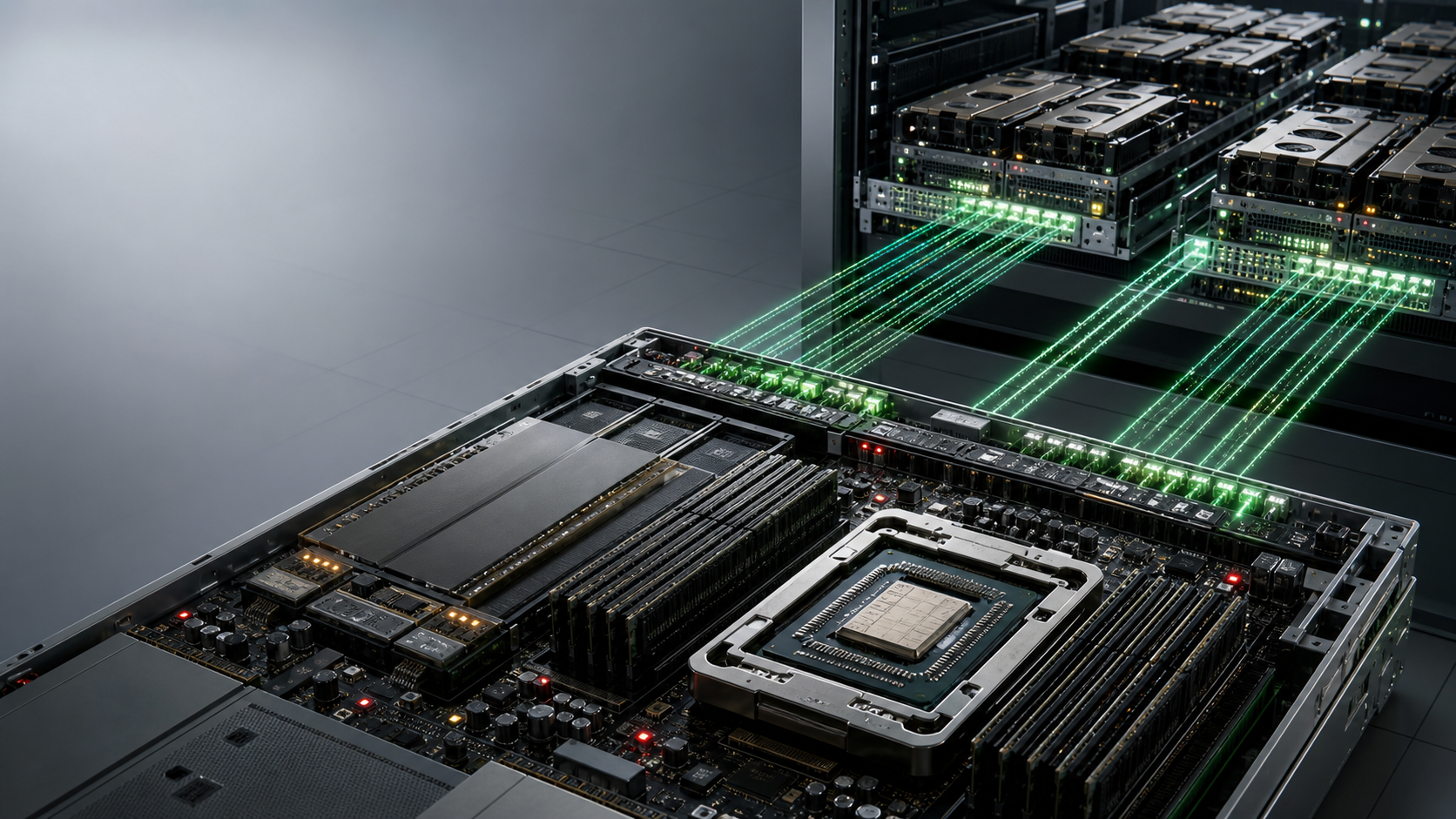
NVIDIA says Vera CPU systems are now reaching major AI operators. That makes the platform real enough to plan around, but it does not make waiting the right decision for every GPU buyer.
Short answer: do not delay a current AI infrastructure project simply because Vera has started shipping. Waiting makes sense when measurements show that CPU-side work such as agent sandboxes, tool execution, retrieval, data processing or reinforcement-learning evaluation is holding back expensive GPUs, and when the deployment schedule can absorb the availability and software risks of a new Arm platform.
NVIDIA's 27 August 2026 delivery announcement says AWS received its first Vera CPU server and Vera Rubin GPU. NVIDIA also names Anthropic, OCI, OpenAI and SpaceXAI among early recipients. Those deliveries move Vera beyond a slide-deck roadmap, although they do not prove broad availability across server manufacturers, regions and support contracts.
Executive summary
- Buyers deploying this quarter should normally continue with current HGX, PCIe GPU or hosted systems unless a vendor can give a firm Vera delivery date.
- Vera deserves serious attention for agent platforms and reinforcement-learning systems where CPU latency, concurrent sandboxes or memory bandwidth already limit throughput.
- NVIDIA's published performance figures come from NVIDIA. Ask for results from the exact framework, runtime and concurrency profile that will run in production.
- Vera's Arm architecture, SOCAMM2 memory and new platform stack require software, service and spares checks before procurement.
What changed on 27 August
Vera is NVIDIA's first custom server CPU. Its position has been clear for months: take CPU work that sits beside AI accelerators, then give it faster cores, more memory bandwidth and a tighter path into NVIDIA's GPU and networking stack. The new information is physical delivery.
AWS receiving a Vera server matters because early hardware exposes problems that specifications cannot: firmware behaviour, compiler maturity, fleet management, telemetry, failure handling and the awkward edges of a new memory subsystem. Large cloud and model companies can do that work before the platform reaches ordinary enterprise procurement.
Buyers should keep the distinction between shipment and availability. An engineering system delivered to a named customer is not the same as a supported OEM configuration with a price, delivery window, warranty, spare-parts plan and validated operating-system matrix. Ask for those items in writing.
What Vera is designed to fix
GPUs handle model compute, but an agent request can spend substantial time elsewhere. A tool call may launch Python, query a database, inspect files, run a compiler or wait for a sandbox. Reinforcement-learning pipelines can create thousands of evaluation environments whose progress depends on CPU response time. Retrieval and data preparation add more irregular memory access.
NVIDIA designed Vera around that work. Current public specifications list 88 Olympus cores and 176 threads, up to 1.5 TB of SOCAMM LPDDR5X memory, and up to 1.2 TB/s of memory bandwidth. A Vera CPU can connect to Rubin GPUs over second-generation NVLink-C2C at up to 1.8 TB/s. NVIDIA also lists PCIe Gen 6 and CXL 3.1 support.
| Published Vera feature | Buyer meaning | Question to test | | --- | --- | --- | | 88 Olympus cores, 176 threads | High concurrency without relying only on core count | Does loaded tail latency improve on your agent runtime? | | Up to 1.2 TB/s CPU memory bandwidth | More room for irregular, memory-heavy CPU work | Is host memory bandwidth actually limiting the job? | | Up to 1.5 TB SOCAMM LPDDR5X | Large CPU memory capacity with a different module format | Which capacities are supported, stocked and field replaceable? | | Up to 1.8 TB/s NVLink-C2C | A much tighter CPU-to-GPU path in Vera Rubin systems | Does the workload move enough data across that boundary to benefit? | | PCIe Gen 6 and CXL 3.1 | Faster I/O and a newer expansion base | Which NICs, DPUs and storage devices are validated at launch? |
NVIDIA marks platform values as preliminary and subject to change. It also reports up to 1.8 times faster per-core performance on agentic workloads and twice the energy efficiency of traditional infrastructure. Treat those as vendor results until the exact benchmark method and comparison system match your own deployment.
Should you wait for Vera?
Wait, or at least keep the final purchase flexible, when all of the following are true:
- CPU profiling shows the accelerator waiting on orchestration, sandbox execution, retrieval or evaluation work.
- The project targets Vera Rubin rather than a current Blackwell or Hopper platform.
- Your software stack already runs well on Arm, or the engineering team has time to qualify it.
- A named supplier can provide an exact system, delivery window, support boundary and acceptance test.
Most other buyers should proceed. A training cluster whose limit is collective communication will not be rescued by a different host CPU. Neither will an inference service constrained by GPU memory capacity, storage stalls or poor batching. If the deployment has a fixed 2026 deadline, waiting for an unquoted configuration can cost more than any later CPU gain.
The practical test is simple: profile the whole request path. Measure GPU utilisation, CPU run queues, per-core saturation, memory bandwidth, sandbox start time, tool-call latency and queueing at target concurrency. Vera becomes a purchasing argument only when those measurements point to the CPU side.
Four cases where current systems still win
Current HGX servers remain the safer purchase when the application needs proven CUDA support, an established OEM service chain and a firm delivery date. B200 and B300 systems can also address the dominant constraint directly when that constraint is GPU memory, tensor compute or NVLink bandwidth.
PCIe GPU servers make more sense for independent inference workers, visual computing or mixed accelerator fleets that do not need a tightly coupled rack platform. They offer more component choice and usually a lower entry point.
Hosted capacity is useful when demand is immediate but the long-term platform choice is not. A short deployment through Buy & Host can collect utilisation data without committing a facility to an early Vera design.
And some agent systems need better scheduling rather than new silicon. Before changing CPUs, check whether cold containers, serial tool calls, remote databases or excessive process creation explain the delay.
Vera CPU versus Vera Rubin
Vera can appear in standalone CPU servers as well as the Vera Rubin platform. That distinction affects the buying decision.
A standalone Vera system targets CPU-heavy agent environments, data processing and reinforcement-learning support work. Vera Rubin pairs each Vera CPU with Rubin GPUs through NVLink-C2C, making the CPU part of a rack-scale accelerated architecture. Our Vera Rubin NVL72 explainer covers that wider platform and its facility demands.
The separate CPU-rack question also remains open. Some operators may place sandbox and orchestration capacity in dedicated CPU pools; others will favour the tighter CPU-to-GPU connection inside Vera Rubin. The right split depends on traffic patterns, failure domains and whether CPU capacity must scale independently. See our analysis of separate CPU racks for agentic AI clusters.
Procurement checks before committing
Ask the supplier to name the exact Vera server SKU. Confirm whether the quoted system is an engineering sample, an early-access platform or a production configuration, then tie payment and acceptance to the latter.
Request a software matrix that covers the operating system, container images, Kubernetes or Slurm components, observability agents, security tooling, storage clients and any native x86 dependencies. "Arm compatible" is too broad for a production cluster.
Memory deserves its own line in the tender. Confirm installed capacity, module type, replacement procedure, spare availability and whether a failed module can be serviced without replacing the motherboard. Do the same for the NIC, DPU and storage path; first-generation platform combinations often fail at the edges rather than in the headline processor.
Finally, write an acceptance test around the real workload. Include loaded latency, completed agent steps per second, GPU idle time caused by CPU work, power at the rack and recovery after a node failure. A synthetic CPU score cannot answer those questions.
Buying decision
Vera shipping changes the planning conversation, not the default 2026 purchase. Buyers with measured CPU-side constraints and a late enough deployment window should qualify it now. Everyone else should buy against the bottleneck they can prove.
GPUMachines can compare a Vera roadmap with current HGX, PCIe GPU and hosted designs, including the storage, network, power and cooling consequences. Use the GPU cluster configurator to frame the current system, then ask suppliers to show exactly what a Vera alternative changes.
FAQ
Can enterprises order NVIDIA Vera CPU servers now?
NVIDIA says systems are shipping to named early customers, but buyers still need to confirm general availability for the exact OEM model, country and support contract. Do not infer ordinary catalogue availability from an early delivery announcement.
Will Vera make every AI workload faster?
No. Vera targets CPU work around AI, particularly agent execution, reinforcement-learning evaluation, data processing and orchestration. GPU-bound training or inference may see little benefit unless CPU-to-GPU movement or host processing is already limiting throughput.
Does Vera replace AMD EPYC or Intel Xeon?
It is a new option rather than a universal replacement. EPYC and Xeon retain broad x86 software support, mature OEM choices and established service channels. Vera is most persuasive where its per-core behaviour, memory bandwidth or NVLink-C2C connection addresses a measured problem.
Should a Vera Rubin buyer wait instead of buying B300?
Only when the workload, facility plan and delivery schedule justify a next-generation rack platform. A current B300 system is the better choice when capacity is needed now and the job fits its memory, compute and interconnect profile.