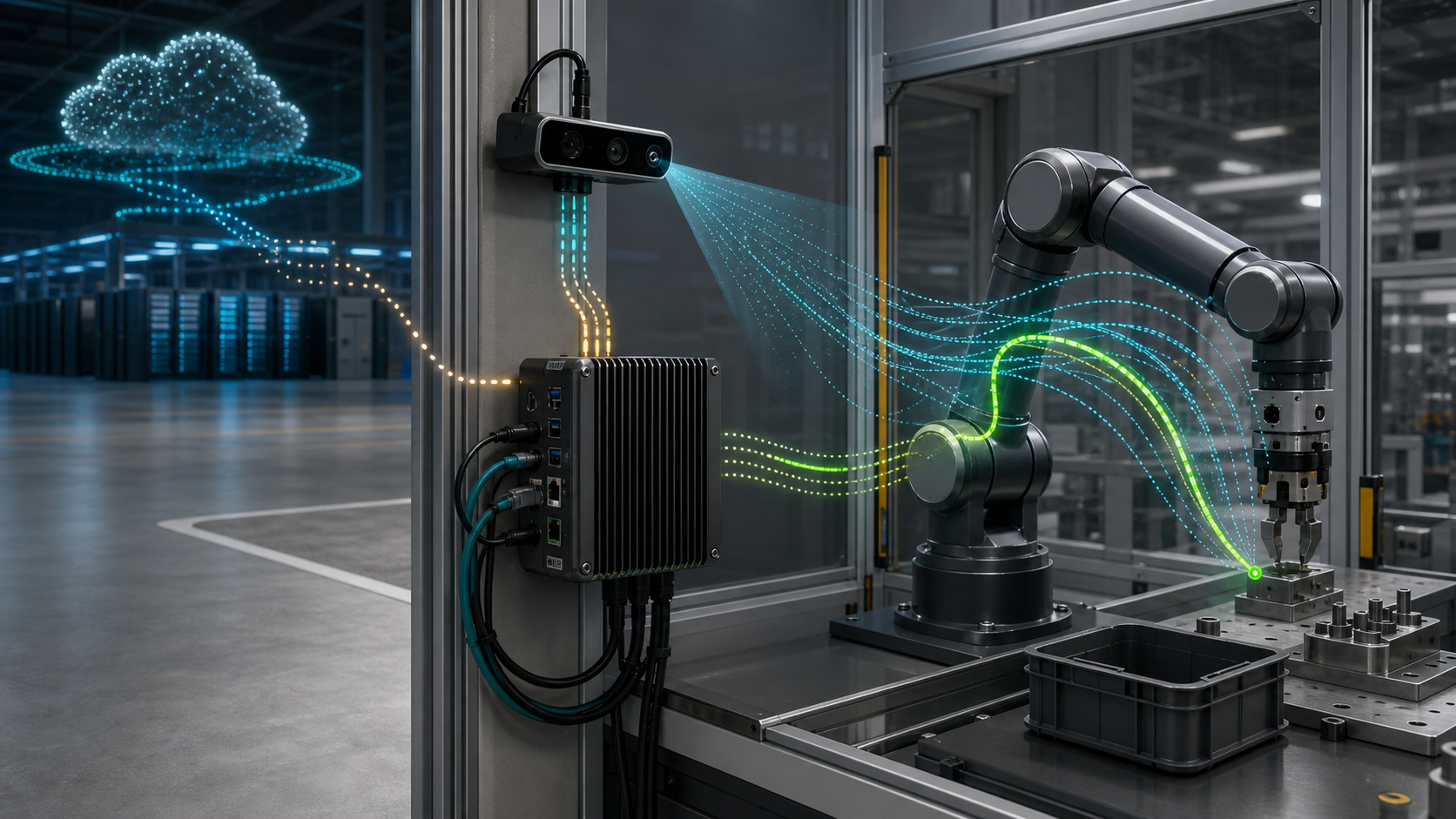
A robot that hesitates beside a conveyor belt has a different problem from a chatbot that takes an extra second to answer. The robot has camera timing, control-loop deadlines, mechanical limits and people nearby. That is the useful frame for NVIDIA Cosmos 3 Edge, a new 4-billion-parameter physical-AI model released through NVIDIA's Hugging Face organisation on 20 July 2026.
Cosmos 3 Edge can accept and produce combinations of text, images, video and actions. NVIDIA presents it as a compact world foundation model for robotics and embodied AI, with post-training on larger GPUs and deployment on workstations or edge modules. The release is interesting because it spans two very different machines: the development system that prepares the model and the local device that must run it predictably.
It is not a safety certificate, a deterministic simulator or proof that a robot will behave correctly. NVIDIA's own model card says the output is not physically accurate ground truth and should not be treated as safety-certified. Any production deployment still needs task-specific evaluation, conventional control logic, safety interlocks and a person or system that can stop the machine.
What Was Released
The public release includes a 4B-parameter Cosmos 3 Edge model and a DROID robot-policy variant. NVIDIA also describes distilled 64B Cosmos 3 Super variants, but those are a different resource class. This article focuses on the 4B Edge model and the hardware choices around it.
| Item | NVIDIA's published description | Planning implication | |---|---|---| | Model size | 4 billion parameters | Smaller than the 64B family, but deployment memory still depends on precision, context, video tokens and runtime overhead | | Architecture | Mixture-of-Transformers with an autoregressive tower and a diffusion tower | Text, visual context and action generation do not behave like a plain text-only decoder | | Inputs and outputs | Text, image, video and action | Camera pipelines, preprocessing and control integration belong in the hardware test | | Model variants | Base Edge model and DROID robot-policy model | Buyers need the correct checkpoint and task-specific post-training plan | | Published test platforms | B200, H100, H20, RTX PRO 6000, DGX Station, DGX Spark, Jetson Thor and Jetson AGX Orin | NVIDIA reports broad platform testing, but each target still needs its own latency, power and thermal validation | | Licence | NVIDIA Open Model Development and Work License Agreement 1.1, as listed on the model card | Legal and deployment teams should read the current licence rather than infer terms from the word "open" |
NVIDIA reports 15 Hz operation at 640 by 360 resolution on Jetson Thor, with 32 actions produced per inference. This is a vendor-reported result. It does not tell a buyer how a different camera count, action horizon, quantisation, control stack or thermal enclosure will behave.
Executive Summary
- Best fit: robotics teams, industrial AI developers and research groups that need a compact visual-action model close to the machine.
- Development hardware: an RTX PRO workstation, H100-class system, B200 platform or a suitable cloud instance can support post-training and evaluation, depending on batch size and experiment scope.
- Deployment hardware: Jetson Thor, Jetson AGX Orin, DGX Spark, DGX Station or a local RTX system may be candidates, but the choice follows measured latency, memory, I/O and power.
- Main engineering risk: treating a model demo as a control system. Cosmos can propose actions; it does not replace safety-rated logic, collision checking or site validation.
- GPUMachines route: compare small form factor AI systems, GPU workstations, shared PCIe GPU servers and hosted training capacity around one measured pipeline.
A Model Between Perception and Action
Many robotics stacks separate perception, planning and low-level control. Cameras and sensors describe the scene, a policy selects an objective or trajectory, and a controller turns that instruction into motor commands while enforcing limits. Cosmos 3 Edge sits around the perception and policy side of that arrangement. Its multimodal inputs can represent recent visual history and text instructions; its outputs can include action sequences.
That position explains why model quality alone is not enough. A useful deployment must maintain timestamped sensor input, preprocess frames at the intended rate, run inference within a deadline, translate model output into a validated command format and reject unsafe or stale actions. Logging must preserve enough context to reconstruct an incident without storing sensitive video forever.
The model's action horizon also affects system behaviour. NVIDIA's published Jetson Thor example produces 32 actions per inference. A longer horizon can give the controller more planned steps, but it also creates a question: when should a new observation invalidate the old sequence? The integration layer needs an answer for changing scenes, dropped frames, unexpected resistance and emergency stops.
Why Development and Deployment Need Different Hardware
Post-training and edge inference place different loads on a GPU. Training retains activations, gradients and optimiser state. It may process large batches or long video sequences and can gain from several high-memory GPUs. Edge inference usually handles a small number of live streams with tight latency, power and thermal limits.
Trying to make one box do both jobs can slow development. A compact edge module is valuable for final profiling, but it may turn every fine-tuning run into a long queue. A large training node can finish experiments faster, yet it tells little about fan noise, enclosure temperature, camera I/O or the latency of the target device.
A sound workflow has at least three stages:
1. Model and data work: curate demonstrations, inspect licences and privacy, prepare training records and establish an evaluation set. 2. Post-training and regression testing: run repeated experiments on a workstation, GPU server or rented accelerator with enough memory and storage. 3. Target-device validation: deploy the chosen checkpoint to the exact edge computer, cameras, network and enclosure used in service.
The same model version, preprocessing code and action schema should move through all three. Containerisation can help, but architecture differences and edge-specific libraries still require testing.
Memory Planning Is More Than Parameter Count
A 4B-parameter label gives only the first memory estimate. Weight precision affects the base allocation, while the autoregressive context, visual tokens, diffusion workspaces, cached state and framework add more. CUDA graphs, video decoding and camera buffers can compete for the same device memory.
Start by measuring the actual checkpoint with its supported runtime. Record idle allocation, peak inference allocation, warm-up behaviour and fragmentation after repeated requests. Test the maximum camera history and action horizon that the application will allow. Keep headroom for system services and failure recovery rather than configuring the device to sit at its memory limit.
Unified-memory systems need extra care. Host and GPU processes may share the same physical pool, so a large model allocation can leave too little for video buffers, Python workers or the desktop environment. The advertised memory capacity is not reserved for model weights.
Quantisation may reduce memory and improve speed, but it can also alter output. Re-run task success, trajectory quality and safety checks on the quantised build. A smaller file is not evidence of an equivalent policy.
Camera and Sensor I/O Can Set the Ceiling
Physical AI begins with data arriving on time. A system with several cameras can spend substantial bandwidth and compute on capture, colour conversion, resizing, synchronisation and encoding before the model starts.
Define each source by resolution, frame rate, pixel format, interface and maximum latency. Decide whether frames are copied through host memory or passed through a GPU-aware pipeline. If depth cameras, force sensors or encoders join the input, specify timestamp accuracy and how missing samples are handled.
Storage needs a separate policy. Keeping every raw stream can overwhelm a small SSD and create a privacy burden. Many teams retain short incident windows, sampled evaluation clips and compact inference traces instead. The retention design should be agreed with safety, legal and operations staff before deployment.
Network cameras add failure modes that a local benchmark misses. Packet loss, switch congestion, clock drift and a rebooted camera can change the observation. The policy must fail to a defined state rather than continue acting on an old frame.
Latency Must Be Measured End to End
Frames per second is useful, but it is not the whole control delay. Measure from sensor exposure to an accepted command at the controller. Include capture, transfer, preprocessing, inference, post-processing, policy checks and communication to the machine.
Record the distribution, not only the average. A robot may appear responsive at the median while occasional long stalls break the task. Capture p50, p95, p99 and the worst observed delay under the intended thermal and background load. Test startup and model reload as well as the warm steady state.
NVIDIA's 15 Hz Jetson Thor claim provides a reference point for its stated configuration. It cannot be applied directly to a buyer's system. Different resolution, history length, checkpoint, software build and action interface can change the result. GPUMachines would treat the published figure as a reason to test Thor, not as an acceptance criterion.
The Edge Device Is Part of a Larger System
A production cell usually needs more than one GPU module. It may include a safety PLC, motion controller, industrial Ethernet, camera switch, operator station, logging service and a management network. The AI device should have a defined place in that diagram.
Separate the machine-control path from remote management where practical. Limit outbound access, pin approved software versions and authenticate model updates. A compromised or accidental update should not silently replace the policy in a running cell.
Remote telemetry can help fleet operations, but it should not become a dependency for safe local behaviour. If the WAN link fails, the device needs a documented response. That may be continued operation within a local envelope, a controlled stop or a handover to conventional automation.
Power design also needs real measurements. A module's published power mode does not include every camera, switch, storage device or cooling fan. Test the complete enclosure at ambient temperatures expected on site, including dust management and reduced airflow.
Safety Boundaries the Model Must Not Own
NVIDIA's model card is clear that Cosmos 3 Edge output is not safety-certified or reliable ground truth. This should shape the architecture.
The model should not have final authority over emergency stops, speed limits, forbidden zones or safe torque-off. Those controls belong in deterministic, validated systems designed for the machine and jurisdiction. Model output can pass through workspace limits, collision checking, confidence rules and rate limits before reaching the controller.
Build an evaluation set from the actual site. Include occlusion, reflections, moved tools, damaged objects, unfamiliar people, partial sensor loss and recovery after a stop. A polished demonstration in one room does not cover these cases.
Keep a human review path during early deployment. The reviewer needs more than a video. Show the instruction, recent observations, proposed action, rejected actions and the version of the model and policy code. This makes failures easier to classify and prevents every problem being blamed on the GPU.
Configuration Paths
Compact development and field trial
Use a suitable SFF AI system or Jetson development platform with fast local NVMe, direct camera interfaces and enough memory for the selected checkpoint. This fits one engineer or one test cell. Keep training elsewhere and use the device for integration, latency and thermal work.
The weakness is shared access. A small field unit should not become the team's only training machine, artefact store and production controller.
Professional robotics workstation
An RTX PRO workstation can support data inspection, simulation, post-training experiments and local inference from one desk. It can carry more RAM, NVMe and camera adapters than an embedded module and gives developers a familiar Linux environment.
Check GPU memory against the real training recipe. Large video batches or the 64B Super family may require a different class of system. Also confirm that workstation thermals represent the edge target poorly; final validation still happens on the device.
Shared GPU server
A PCIe GPU server works for a team running several experiments, maintaining a model registry and serving evaluation endpoints. Multiple independent GPUs can be easier to schedule than one tightly coupled system when researchers test separate checkpoints.
Plan CPU, RAM and storage for video decoding and dataset work. Add high-speed network access to the dataset, but avoid making live robot safety depend on the research-server connection.
Large post-training programme
H100- or B200-class infrastructure may suit larger batches, many experiments or distillation work involving the bigger Cosmos family. Use local NVMe for active data and shared storage for durable datasets and checkpoints. Multi-node training may need a low-latency fabric, while a single-node project may not.
Teams without a suitable data centre can begin with GPU Cloud or dedicated Buy & Host capacity. Protect training video and control access as carefully as model weights.
Who Should Consider Cosmos 3 Edge
Robotics research groups can use the release to study multimodal policies without starting from a 64B model. Industrial automation teams may find it useful for supervised trials where visual context and action generation add value beyond fixed rules. Autonomous-machine developers can examine it as one component in a larger perception and planning system.
It is also relevant to infrastructure teams supporting physical-AI developers. Those teams need a path from shared training compute to reproducible edge builds, with model provenance, test evidence and device inventory carried between stages.
Who Should Not Deploy It Yet
A buyer seeking a safety-certified controller should not use Cosmos 3 Edge as a substitute. The model card rules that interpretation out.
Teams without representative demonstrations or a task-level evaluation set are not ready to choose production hardware. More GPU capacity cannot repair missing data or an undefined success measure.
Simple automation may not need a world model. A barcode reader, calibrated vision rule or conventional planner can be easier to validate and maintain. Use the least complex method that meets the task.
Finally, a team that only wants text generation should choose a text model and serving stack. Cosmos earns its engineering cost when visual history and action output are part of the real problem.
Our Technical View
Cosmos 3 Edge is useful because NVIDIA has placed a comparatively compact physical-AI model across workstation, data-centre and Jetson-class hardware. That gives teams a credible route to experiment on larger compute and evaluate at the edge.
Its hardest problems are outside the parameter count. Camera timing, data quality, action validation, heat, software updates and incident evidence determine whether the system can leave the lab. The model's published platform list narrows the hardware search, but it does not remove integration work.
GPUMachines can help design the compute path: an SFF or Jetson-class device for field testing, RTX PRO workstations for individual developers, PCIe servers for shared experiments, and H100- or B200-class hosted capacity for heavier post-training. The buying decision should follow a measured pipeline and a written safety boundary.
A Buyer Test Plan
Before ordering a fleet, run one complete task through the target stack and retain the evidence:
- exact checkpoint, licence, checksum and software versions;
- camera and sensor configuration with timestamps;
- peak GPU memory and host-memory use;
- end-to-end latency distribution under thermal load;
- task success and failure categories;
- behaviour after stale, missing or corrupt input;
- action rejection and emergency-stop behaviour;
- model update, rollback and device-recovery process;
- storage volume and retention policy;
- remote-access and network-egress rules.
Repeat the test after quantisation, a camera change, a new enclosure or a model update. Physical AI drifts when the environment changes, even if the server specification stays fixed.
FAQ
Can Cosmos 3 Edge run on Jetson?
NVIDIA lists Jetson Thor and Jetson AGX Orin among tested hardware. Actual fit depends on the checkpoint, precision, runtime, sensor pipeline and device configuration. Measure memory, latency and thermals on the exact target.
Do we need an H100 or B200 server?
Not for every project. Larger GPUs can shorten post-training and support more experiments, while a workstation may be enough for a small team. Edge inference still needs separate testing on the target device.
Is 15 Hz fast enough for robotics?
It depends on the task and full control loop. NVIDIA reports 15 Hz in one Jetson Thor configuration, but buyers must measure sensor-to-command latency and worst-case delay. Some machines need much faster deterministic control outside the model.
Can the model control a robot directly?
That would be unsafe as a general assumption. Pass proposed actions through task-specific checks and keep emergency, motion and workspace limits in validated control systems.
How much storage should a project plan for?
Estimate raw demonstration video, curated training data, checkpoints, evaluation runs and retained incident clips separately. Add backup and growth. A written retention policy often saves more storage than another SSD purchase.
Can GPUMachines build both development and deployment systems?
GPUMachines can review SFF systems, GPU workstations, rack servers and hosted compute around the project's models, cameras and training plan. Embedded carrier boards, industrial certification and machine controls should be confirmed with the relevant vendors and integrator.
Verdict
Cosmos 3 Edge gives physical-AI teams a smaller multimodal model with a published path from data-centre GPUs to Jetson-class devices. That is a useful starting point, not a completed robot architecture.
The best buyer has a defined task, representative demonstrations, an evaluation set and an independent safety system. Teams still choosing cameras or success criteria should spend on data and integration before buying a large training cluster.
Ask GPUMachines to size a physical-AI development and edge deployment platform from your model, sensor and latency requirements.
Sources and Further Reading
- NVIDIA on Hugging Face: Introducing Cosmos 3 Edge (20 July 2026). NVIDIA-authored release article with architecture, platform and reported performance details.
- NVIDIA Cosmos 3 Edge model card. Primary source for model variants, licence, tested hardware and limitations.
- GPUMachines: Deploying AI at the Edge. Related planning guide for local inference hardware and operations.
- GPUMachines: Edge VLM inference, output tokens and energy. Related analysis of edge-model runtime behaviour.
NVIDIA performance figures are vendor-reported. GPUMachines has not independently benchmarked Cosmos 3 Edge for this article.