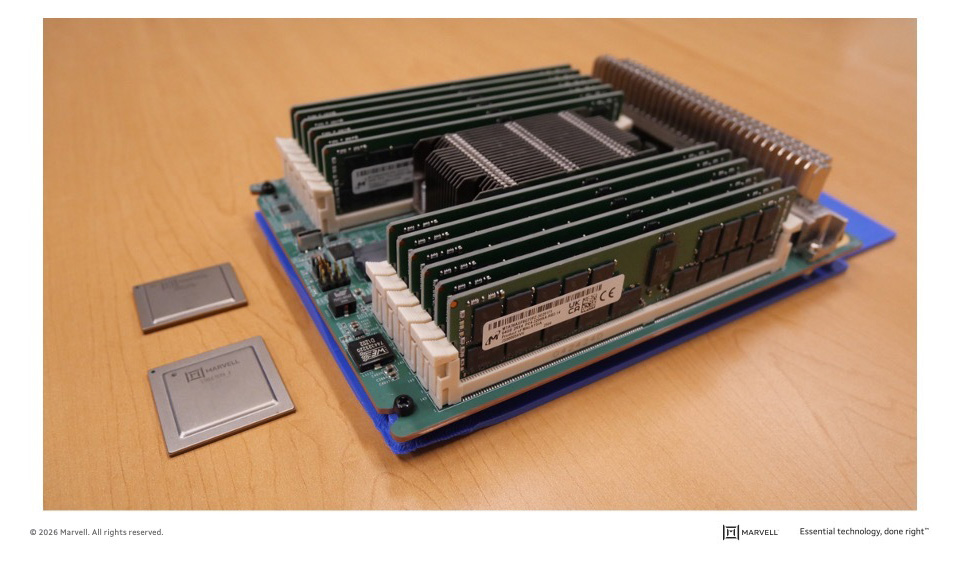
Meta's reported work on reusing DDR4 through CXL is one of those infrastructure ideas that looks modest until you follow the economics. It is not about making old memory as fast as new memory. It is about keeping useful DRAM in service, reducing pressure on DDR5 supply, and giving memory-hungry servers a second tier of capacity for colder data.
There is one important correction before we go further. Public reporting around Meta's deployment describes an in-house CXL ASIC called Vistara, not a confirmed Marvell card deployed inside Meta's fleet. Marvell is highly relevant because its Structera X CXL memory-expansion controllers explicitly support DDR4 DIMM recycling and are aimed at the same class of data-centre problem. The practical story for GPUMachines buyers is therefore: Meta has demonstrated why recycled DDR4 over CXL can matter, while Marvell's Structera family shows how this idea is moving into a sourceable commercial ecosystem.
For GPU infrastructure buyers, the lesson is bigger than one chip. AI servers are often discussed as if GPU memory is the only memory that matters. In reality, large GPU platforms also depend on host RAM for data loading, caching, preprocessing, retrieval, simulation state, storage services, orchestration and CPU-side parts of inference pipelines. If local DDR5 is expensive, constrained or under-provisioned, CXL memory expansion becomes a serious design lever.
GPUMachines can help source CXL memory expansion cards, including Marvell Structera-class solutions where available, and review compatible server platforms for buyers who want to evaluate recycled DDR4 or expanded memory tiers. That does not mean every server can accept these cards or that recycled DDR4 is appropriate for every workload. CXL requires platform support, firmware validation, PCIe lane planning, operating-system readiness and a workload that can tolerate tiered memory behaviour.
Executive Summary
- What happened: public reporting says Meta is reusing DDR4 memory from older servers by attaching it to newer DDR5 platforms through CXL, using an in-house ASIC called Vistara.
- Where Marvell fits: Marvell's Structera X CXL memory-expansion controllers include DDR4 support, DIMM recycling, inline compression, encryption and CXL 2.0 over PCIe 5.0, making them commercially relevant for similar designs.
- Why it matters: DDR5 pricing, supply pressure and AI memory demand make recycled DDR4 attractive as a lower-cost capacity tier.
- What it is not: CXL-attached DDR4 is not a substitute for GPU HBM, GPU VRAM or latency-critical local DDR5. It is a tiered-memory tool.
- How GPUMachines can help: GPUMachines can source CXL memory expansion cards and compatible server platforms, then review whether the hardware, firmware, Linux kernel, PCIe lanes and workload make sense.
- Where to start: compare PCIe GPU servers, HGX servers, GPU Cloud and Buy & Host if memory capacity is part of a wider AI infrastructure decision.
Key Facts at a Glance
| Area | What buyers should understand | | --- | --- | | Technology | Compute Express Link, usually CXL.mem through PCIe, used to expose attached memory to the host. | | Meta angle | Public reports describe Meta using Vistara, an in-house CXL memory expander ASIC, to connect recycled DDR4 to new DDR5 servers. | | Marvell angle | Marvell Structera X 2404 supports DDR4 memory expansion and explicitly enables recycled DDR4 DIMM use. | | Main value | More memory capacity without filling every requirement with new DDR5. | | Main trade-off | Higher latency and lower bandwidth than local CPU-attached memory, depending on implementation. | | Strong workloads | Caches, memory oversubscription, cold pages, inference support services, data platforms and capacity-heavy CPU-side workloads. | | Weak workloads | Latency-sensitive hot memory, GPU HBM replacement, tightly timed simulation kernels, training paths that cannot tolerate NUMA effects. | | GPUMachines role | Sourcing, compatibility review, platform selection, PCIe lane planning, deployment guidance and hosted infrastructure options. |
What CXL Memory Expansion Actually Does
Compute Express Link is an open interconnect standard that runs over the PCIe physical layer and adds protocols for coherent access between processors, accelerators and memory devices. For this topic, the relevant part is CXL.mem, which lets a CPU access memory attached behind a CXL device rather than only memory installed directly into the server's DIMM slots.
In simple terms, a CXL memory expansion card can sit in a PCIe slot and expose additional DRAM to the host. The operating system can treat that memory as another NUMA node or memory tier. Software can then decide whether pages should live in fast local DDR5 or slower CXL-attached memory.
That second tier is the point. CXL memory is usually not as fast as local CPU memory. It has extra path length, controller behaviour and sometimes compression or pooling layers. But it can be much faster and more memory-like than spilling to SSD, and it can add capacity without changing the CPU's physical memory channels.
For AI infrastructure, this matters because GPU servers increasingly carry more than GPUs. They run tokenisers, data loaders, vector databases, caching layers, retrieval services, logging agents, orchestration, file-system clients and CPU-side parts of inference pipelines. These tasks can become memory hungry even when the GPUs are the headline component.
What Meta Appears to Be Doing
Public reporting describes Meta recovering DDR4 modules from older decommissioned servers and attaching them to new DDR5-only platforms through a CXL memory expander. The reported design uses Meta's Vistara ASIC, a CXL 2.0 Type-3 memory expander that bridges DDR4 RDIMMs to newer AMD EPYC server platforms over PCIe.
The reported MemServer design combines local DDR5 with CXL-attached DDR4. In that architecture, the DDR5 tier holds hotter data while the DDR4 tier is used for colder pages where extra latency is acceptable. Software page placement is therefore as important as the card itself.
That is the real lesson. Meta is not trying to pretend DDR4 is DDR5. It is using software and hardware together to decide which memory tier should hold which data. The value comes from avoiding over-provisioning expensive local memory for data that does not need to sit in the fastest tier all the time.
For buyers outside hyperscale, this should be read carefully. Meta has the scale, engineering depth and fleet control to design custom silicon and tune kernels, firmware, telemetry and workloads around it. Most buyers will use commercial cards and vendor-supported server platforms rather than build their own ASIC. That is where Marvell-style CXL products become relevant.
Where Marvell Structera Fits
Marvell's CXL portfolio is important because it turns this idea from a hyperscale-only curiosity into something that can be discussed with the normal server supply chain. The Marvell Structera X family is described as CXL memory-expansion controllers. Structera X 2404 supports DDR4, three DIMMs per channel and recycled DDR4 memory modules. Marvell also lists CXL 2.0 / PCIe 5.0 x16 or 2x8 controller configurations, inline LZ4 compression/decompression, XTS-AES 256-bit encryption, secure boot and support for large DDR4 and DDR5 memory capacities across the family.
For a GPUMachines customer, the relevant question is not simply "can we buy a CXL card?" GPUMachines can source CXL memory expansion cards and compatible server hardware where supplier availability allows, but the build still has to be engineered properly. The server platform must support CXL, the CPU and firmware need to expose the device correctly, the chassis needs physical and thermal space, and the operating system must be able to manage the memory tier without creating worse performance than the extra capacity solves.
This is why CXL should be treated as an infrastructure design feature, not a bolt-on accessory. It sits at the intersection of CPU platform, PCIe topology, firmware, kernel support, NUMA policy, application behaviour, power, cooling and observability.
Why Recycled DDR4 Is Interesting for AI Infrastructure
DDR4 reuse sounds like a sustainability story, and it is partly that. Keeping memory modules in service can reduce waste and delay unnecessary manufacturing. But the commercial story may be even more important. If an organisation has a large stock of working DDR4 from retired servers, CXL creates a route to reuse that memory in newer systems that would otherwise only accept DDR5.
That matters because AI demand has pushed memory purchasing into a more strategic category. GPU buyers often focus on HBM, but CPU memory demand has also grown. More users, larger datasets, retrieval pipelines, vector databases, cache layers, CPU preprocessing and model-serving support services can all increase host-memory requirements.
The best way to think about recycled DDR4 over CXL is as a capacity tier. It may let a system keep more data in memory, reduce pressure on local DDR5, avoid going to storage, or improve server consolidation for memory-heavy services. It should not be sold as a magic performance upgrade.
For GPUMachines customers, the most promising cases are usually memory-capacity problems rather than memory-latency problems. If the workload is stalling because it runs out of memory and spills to storage, a slower memory tier may help. If the workload is already latency-sensitive inside local DRAM, CXL DDR4 may hurt.
Where It Could Help GPU Systems
CXL DDR4 recycling is not a replacement for GPU memory. It will not turn a 96 GB GPU into a 512 GB GPU, and it will not replace HBM on an HGX platform. GPU kernels that need data in HBM still need data in HBM. The useful question is what sits around the GPUs.
One strong use case is inference support infrastructure. Model serving often includes tokenisation, request queues, caches, retrieval indexes, policy layers, logging and application state. Some of this can tolerate a slower memory tier if placement is managed properly.
Another use case is data preparation and ETL. GPU training and fine-tuning pipelines often depend on CPU-side workers that load, decode, transform and stage data. Extra host memory can reduce churn, especially when datasets are large and preprocessing is bursty.
Vector search and retrieval-augmented generation are also relevant. Large vector databases and cache layers may benefit from expanded memory capacity, although latency sensitivity must be tested carefully. CXL memory may be more attractive for warm or cold data than for the hottest retrieval path.
Simulation, analytics and graph workloads can also be candidates where memory capacity is the limiting factor. The workload must be profiled. CXL is not automatically good or bad; it depends on access pattern, NUMA behaviour and how much the application benefits from keeping more data in memory.
Where It Is a Poor Fit
CXL-attached DDR4 is a poor fit for workloads that require the lowest possible memory latency on every access. It is also a poor fit where software cannot control or tolerate tiered placement. If hot pages are repeatedly trapped in the slower tier, performance can degrade quickly.
It is not a shortcut around GPU VRAM limits. Large language model weights, activations and key-value cache typically need careful placement across GPU memory, CPU memory and storage. CXL host memory may help surrounding services and some offload strategies, but it is not equivalent to adding HBM.
It is also not a consumer upgrade path. CXL support depends on server CPUs, platform firmware, PCIe topology and operating-system support. A card that is sensible in a data-centre server may be useless in a desktop board that lacks CXL support.
Finally, recycled DDR4 is only attractive if the operational story is clean. Reused modules must still be tested, tracked, monitored and supported. Saving money on memory is not helpful if failures, firmware issues or unpredictable latency create operational risk.
Our Technical View
In the GPUMachines portfolio, CXL memory expansion sits next to CPU, RAM, storage and networking as a platform-design option. It is not a GPU product, but it can affect GPU infrastructure because memory pressure outside the GPU often decides how efficiently the GPUs are fed.
The Meta/Vistara story is useful because it validates a direction: tiered memory can be commercially important when memory prices and supply constraints matter. The Marvell Structera story is useful because it shows a commercial route for DDR4 recycling and CXL memory expansion. Together, they make CXL worth discussing for serious AI infrastructure projects.
The strongest GPUMachines position is practical rather than hype-led. GPUMachines can source CXL memory expansion cards and compatible server platforms, including Marvell Structera-class options where available, and help evaluate whether they belong in a particular system. That evaluation should include CPU support, motherboard firmware, PCIe slot layout, cooling, operating-system support, workload profile and whether the buyer actually has DDR4 worth reusing.
For many GPU buyers, the answer will still be "buy the right amount of DDR5 and keep the design simple." For some, especially operators with DDR4 inventory, memory-heavy services or hosted infrastructure economics, CXL can be a serious way to reduce waste and improve capacity per server.
Architecture Notes
The first architecture question is platform support. CXL is not enabled just because a system has PCIe slots. The CPU, chipset, motherboard firmware and operating system must support the relevant CXL mode. Buyers should verify this before specifying cards.
The second question is PCIe lane budget. CXL memory expansion consumes PCIe connectivity that might otherwise be used for GPUs, NVMe drives, NICs or accelerators. On a GPU server, that trade-off must be planned carefully. Giving a CXL card a x16 path may be sensible in a memory server, but less sensible in a dense 8-GPU box where every lane has a job.
The third question is NUMA behaviour. CXL memory often appears as a separate NUMA node or memory tier. Linux placement policy, Transparent Page Placement-style mechanisms, application memory allocation and monitoring all matter. The system must be observed under real workload pressure.
Reliability is another major issue. Recycled DDR4 should be treated as production memory only if it passes testing and monitoring requirements. ECC, error logging, firmware health telemetry, spare strategy and replacement policy should be defined before deployment.
Cooling and serviceability matter too. A CXL memory card populated with DIMMs is not free from a thermal perspective. The chassis must be able to cool it, and the service workflow must account for DIMM replacement, card access and firmware management.
Configuration Guidance
Start by defining the memory problem. Is the system short of GPU memory, CPU memory, cache capacity, storage performance or network bandwidth? CXL only helps some of those. If the issue is GPU HBM capacity, look at larger GPUs or HGX platforms. If the issue is host-memory capacity for CPU-side services, CXL may be worth evaluating.
Then profile the workload. Look at working set size, hot versus cold pages, latency sensitivity, memory bandwidth, NUMA behaviour, cache hit rates and spill-to-storage events. CXL makes more sense when the workload benefits from a larger memory tier and can keep hot pages in local memory.
Next, verify platform compatibility. GPUMachines can help source CXL memory expansion cards, including Marvell Structera-class options, but the server must support the card. Check CPU generation, motherboard firmware, BIOS options, kernel version, PCIe lane layout, mechanical fit, cooling and vendor qualification.
Finally, decide whether on-premise or hosted deployment makes sense. For buyers without CXL expertise, a hosted or Buy & Host deployment can be attractive because GPUMachines can help manage platform selection, deployment review and operational risk.
Recommended Configuration Paths
- Best for hyperscale-style DDR4 reuse: CXL memory expansion with recycled DDR4, strong telemetry, workload-specific page placement and strict DIMM qualification.
- Best for AI support services: PCIe GPU servers with ample local DDR5 plus CXL-expanded memory for caches, staging or cold pages where latency tolerance is known.
- Best for research evaluation: a controlled pilot server with CXL cards, representative workloads and clear before/after metrics before expanding fleet-wide.
- Best for simple GPU training: skip CXL and invest in the right GPU memory, local DDR5, fast NVMe and network fabric.
- Best for hosted capacity: use Buy & Host or GPU Cloud when the buyer wants memory-rich infrastructure without operating it on-site.
Who Should Consider CXL DDR4 Recycling
Consider this route if your organisation has significant DDR4 inventory, needs more host memory capacity, operates compatible server platforms or wants to reduce memory waste while maintaining a useful performance tier. It is especially relevant for cloud providers, research clusters, hosting operators, AI service platforms and enterprises with large server refresh cycles.
It can also be interesting for GPU infrastructure buyers who run memory-heavy CPU-side services next to GPU workloads. The GPU may be the expensive part of the system, but underfed GPUs waste money. Extra host memory can sometimes improve the surrounding pipeline enough to make the whole system more efficient.
Who Should Not Use It
Do not use CXL DDR4 recycling if the workload is mainly GPU memory constrained. It will not replace HBM, NVLink or larger GPU memory configurations. Look at HGX servers, high-memory GPUs or a different model-serving strategy instead.
Do not use it if the platform is not validated. CXL support is still a platform-level feature, not a generic PCIe add-on. Unsupported combinations can create debugging work that outweighs any memory savings.
Do not use recycled DDR4 without a quality process. Production infrastructure needs memory testing, error monitoring, firmware management and a replacement plan.
Buying Through GPUMachines
GPUMachines can help buyers evaluate and source CXL memory expansion cards, including Marvell Structera-class options where available through the supply chain. We can also review compatible server platforms, CPU choices, PCIe topology, local DDR5 sizing, GPU selection, storage design, network design and whether CXL belongs in the configuration.
For AI projects, GPUMachines can compare a CXL-expanded PCIe GPU server with a simpler high-memory DDR5 server, an HGX server, GPU Cloud, or Buy & Host. That comparison is important because CXL is not always the most economical route once engineering, validation and operations are included.
The right buying conversation is not "can we add old DDR4?" It is "which memory tier should hold which data, and can the workload prove the benefit?" GPUMachines can help structure that review.
FAQ
Is Meta using Marvell CXL cards?
Public reporting reviewed for this article describes Meta using an in-house CXL ASIC called Vistara. Marvell is relevant because its Structera X products support CXL memory expansion and DDR4 DIMM recycling, but we are not treating Meta's deployment as a confirmed Marvell deployment.
Can GPUMachines source Marvell CXL cards?
GPUMachines can source CXL memory expansion cards, including Marvell Structera-class solutions where supplier availability and project requirements align. Final suitability depends on server compatibility, firmware, CPU support, PCIe topology and workload fit.
Does CXL DDR4 replace DDR5?
No. It is better viewed as a second memory tier. Local DDR5 remains the fast tier, while CXL-attached DDR4 can hold colder or less latency-sensitive data.
Does CXL memory help GPU training?
It can help surrounding CPU-side services, data staging and memory-heavy preprocessing. It does not replace GPU HBM or make a GPU behave as if it has more local memory.
Is recycled DDR4 reliable enough for production?
It can be, but only with testing, ECC, monitoring and a replacement policy. Recycled memory should not be deployed blindly.
Should I add CXL to every new GPU server?
No. CXL should be workload-driven. Many GPU servers are better served by more local DDR5, faster NVMe, better networking or a larger GPU platform.
Is this useful outside hyperscale?
Potentially, but the economics are strongest where there is DDR4 inventory, compatible platforms and clear memory-pressure evidence. Smaller buyers should run a pilot before designing around CXL.
Verdict
Meta's reported DDR4 reuse work and Marvell's Structera CXL portfolio point in the same direction: memory is becoming a tiered infrastructure problem. The fastest memory should hold hot data. Cheaper or recycled memory can sometimes hold colder data. Software decides whether that trade-off works.
For GPUMachines buyers, CXL DDR4 recycling is not a gimmick, but it is also not universal. It is a serious option for memory-heavy systems, hosting economics, AI support services and organisations with DDR4 inventory. It requires proper sourcing, platform validation and workload testing.
Final step: discuss CXL memory expansion with GPUMachines if you want to source Marvell Structera-class CXL cards, evaluate recycled DDR4, or compare a memory-expanded PCIe GPU server with HGX servers, GPU Cloud or Buy & Host.