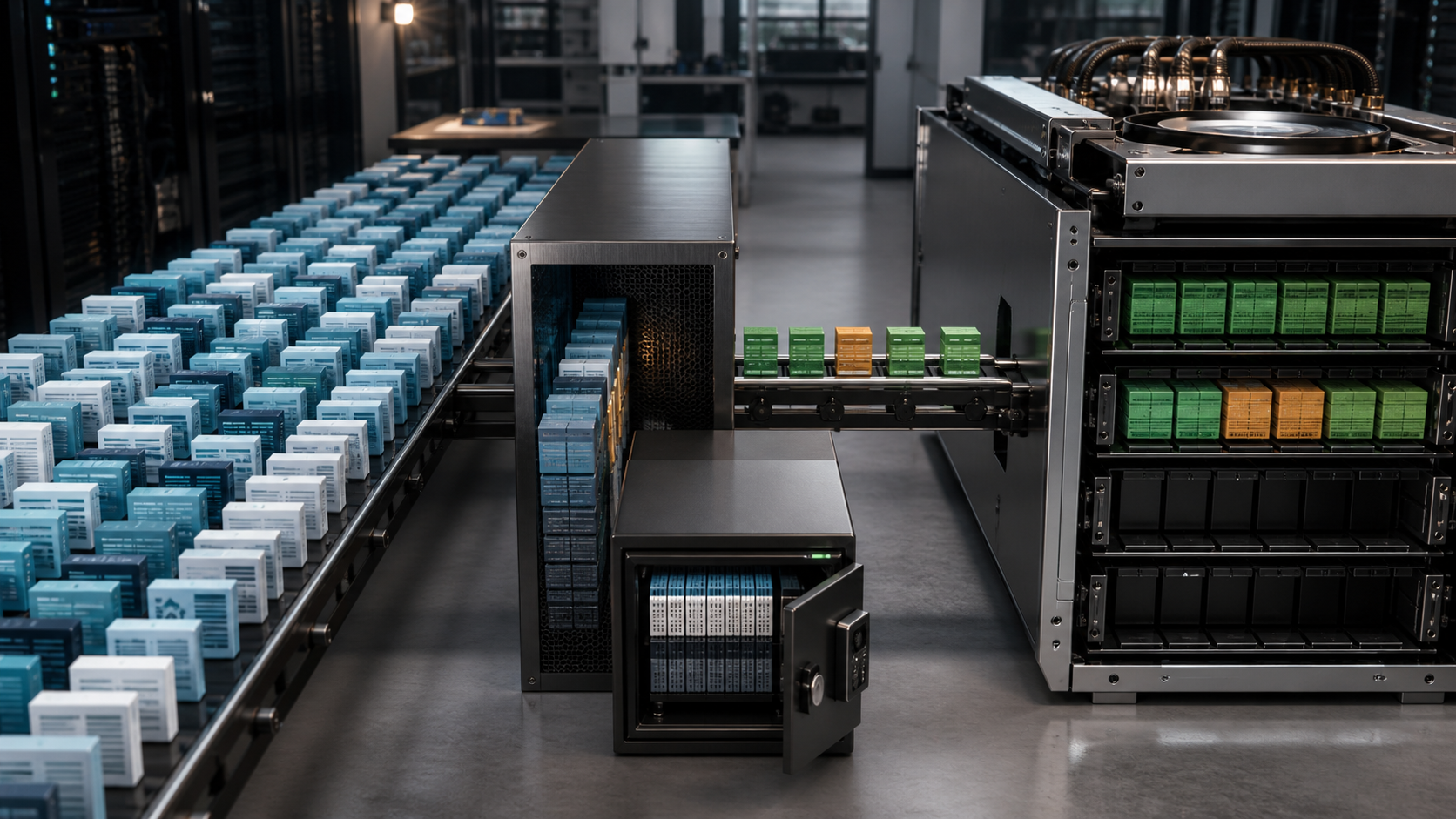
Before adding another GPU to an agent cluster, export a week of prompts.
The result may show a hardware shortage. It may also show thousands of tokens of repeated JSON, logs, tool output and conversation history being placed into every request. Both consume GPU memory, but only one is fixed by buying more HBM.
Headroom is an Apache 2.0 open-source context optimisation project that sits between an agent and its model provider. It compresses selected prompt content, keeps original material in a local retrieval cache and gives the model a route back to full data when needed. At FMS 2026, its creator presented the project as a way to reduce input tokens and therefore the KV-cache footprint created during inference.
That makes Headroom worth testing for tool-heavy agents. It does not make the project's savings figures universal, and it cannot reduce the memory occupied by model weights. GPUMachines has not benchmarked Headroom. The figures in this article are project or conference claims; the purchasing method below is designed to reproduce or reject them on your traffic.
The purchasing answer
Test context compression before expanding an inference fleet when all four conditions are true:
- Requests carry long tool outputs, logs, database rows, search results or repeated history.
- KV-cache pressure, prefill time or request preemption is visible in production telemetry.
- The current model weights already fit on the chosen GPU layout.
- The team can run an accuracy and operations trial using representative prompts.
Buy more or higher-memory GPUs when the model itself does not fit, decode compute is saturated, compressed traffic still misses the service target, or redundancy and tenant isolation require more capacity.
Context compression and hardware expansion are not competing beliefs. A clean prompt can make each GPU serve more useful work, while the correct GPU supplies the weight capacity, compute and support the service still needs.
For an early design, GPUMachines can help map the measured result to a PCIe GPU server, dense HGX platform, hosted pilot or multi-node configuration.
What Headroom actually changes
An LLM request contains more than the user's latest sentence. An agent may attach system instructions, prior turns, tool definitions, retrieved documents, command output, database rows and API responses. The inference engine processes those input tokens during prefill and stores key and value tensors so later generated tokens can attend to the context without recomputing everything.
Longer input usually means more prefill work and more KV cache. The exact memory cost depends on the model architecture, layer count, KV heads, cache data type, sequence length, batching and serving engine. A percentage reduction in text does not translate into a universal number of gigabytes across all models.
Headroom operates before the model sees the request. Its content router selects a compressor for structured data, logs, prose or other supported content. A feature called Compress-Cache-Retrieve, or CCR, stores the original locally and places a retrieval marker in the compressed material. The model can call a retrieval tool when the reduced representation is insufficient.
This changes input context. It does not quantise model weights, change attention kernels or add physical memory. It may free KV-cache room and reduce prefill work if the removed tokens would otherwise reach the model.
Why agents create the right test case
Ordinary chat can be short. Agents are often not.
A coding agent reads files, runs tests, searches a repository and returns to earlier output. A support agent queries customer records and knowledge bases. A research agent gathers pages, extracts tables and follows references. The next model call can contain a large transcript of those actions.
Some of that context is valuable. Error lines, identifiers, outliers, file names and exact values may decide the answer. Other material is repetitive scaffolding: hundreds of similar JSON objects, successful log lines, duplicated fields or history no longer relevant to the current step.
Headroom's own limitations page says its strongest cases are JSON-heavy workflows, structured logs, build output and long multi-tool sessions. It reports little value for short conversations, code-only work and single-turn requests. That is useful because it gives buyers a pre-screening rule.
If your service mostly receives a short question and returns a short answer, compression software may add another component without creating enough savings. If each turn carries megabytes of structured tool output, the economics are different.
Read the headline savings correctly
The FMS session description claimed up to 80 per cent input-token reduction, a matching reduction in KV-cache footprint, less than 100ms of compression latency and five times the concurrency in a 128K-token example. The Headroom repository currently reports different ranges by workload, including 60 to 95 per cent fewer tokens for some JSON data and 15 to 20 per cent for coding agents.
Those numbers are not contradictory; they describe different content and test cases. They are still project-reported results.
Headroom publishes a benchmark table and a command for reproducing part of its evaluation suite. That is better evidence than an unexplained marketing percentage, but it does not predict your production service. Your prompts may contain different languages, schemas, tool outputs, error distributions and correctness requirements.
Do not put "80 per cent GPU memory saving" into a business case. Put "measure input tokens, KV-cache allocation, latency and task accuracy with compression enabled" into the proof of concept.
The five measurements that decide the purchase
1. Model-weight memory
Record the memory occupied before any requests arrive. This is the floor created by weights, runtime allocations and graph capture. Headroom cannot reduce it.
If a model needs tensor parallelism simply to load, context compression will not make it fit on one device unless KV cache was the only margin preventing startup. Quantisation or a higher-memory accelerator is the relevant comparison.
2. KV-cache pressure
Measure cache use at several context lengths and concurrency levels. In vLLM, frequent request preemption can indicate that the cache lacks room. The vLLM documentation notes that recomputation caused by preemption can hurt end-to-end latency.
Compression is relevant if fewer input tokens reduce preemption without damaging answers. It is less relevant if the cache has ample space and GPUs are compute-bound.
3. Prefill and decode behaviour
Separate time to first token from inter-token latency. Input reduction should affect prefill more directly than decode. If the service spends most of its time generating long answers, removing prompt boilerplate may not move the main limit.
Record prompt tokens per second, generated tokens per second and complete task time. Agent users care about the finished job, not one flattering sub-metric.
4. Correctness
Build checks around the work the agent performs. Did it choose the correct tool? Preserve an error code? Find a rare database row? Cite the right document? Pass the test? Avoid an unsafe action?
A generic similarity score can miss operational failures. Use deterministic assertions where possible and human review where meaning matters.
5. Concurrency and queueing
Run the service at realistic arrival rates. Record admitted sequences, queue time, cache preemptions, GPU utilisation and tail latency. Then raise traffic until the service breaches its target.
The useful result is not the largest compression ratio. It is the number of accepted tasks per GPU while accuracy and latency remain inside the agreed boundary.
A controlled Headroom trial
Do not begin by routing every production request through a new proxy. Start with replayable traffic and a fixed model revision.
Step 1: capture a representative set
Sample complete agent tasks from quiet, typical and peak periods. Remove or protect sensitive data according to your security policy. Keep the original request structure, including tool results and history.
Classify tasks by context type:
- JSON or database-heavy.
- Build logs and command output.
- Retrieved prose.
- Source code.
- Long conversation history.
- Mixed multimodal or image requests.
The classification matters because Headroom's documentation says some forms pass through or compress only lightly.
Step 2: fix the serving baseline
Pin the model, precision, inference engine, GPU allocation, batching limits, maximum context and cache data type. Warm both paths in the same way. Use the same request order or a controlled randomisation.
Record software versions. A result that cannot be reproduced after an upgrade is not strong enough for a capacity purchase.
Step 3: install in an isolated environment
The project's current Python installation and local proxy commands are:
``bash pip install "headroom-ai[all]" headroom proxy --port 8787 headroom doctor ``
The repository also offers headroom wrap commands and a TypeScript library. Read the current documentation before deployment because the project is moving quickly and integrations can change.
Keep the trial local or inside the same controlled network as the agent. Confirm where CCR originals are stored, how long they persist, who can retrieve them and what is written to logs.
Step 4: run three paths
Compare:
1. Uncompressed baseline. 2. Headroom with conservative defaults. 3. Headroom tuned for the dominant content type.
Do not tune only for the average task. Include long-tail cases and requests containing rare errors or outliers. Run enough repetitions to separate warm-up noise from a stable effect.
Step 5: set a purchase gate
Agree the gate before seeing results. An example might require no statistically or operationally meaningful loss in task success, no security-policy breach, lower P95 time to first token, fewer cache preemptions and a material rise in accepted concurrency.
If compression passes, delay or resize the hardware expansion and repeat the test under projected growth. If it fails, keep the evidence. The failure may show that the service needs more HBM, a different model, better prompt construction or a different serving engine.
Where retrieval makes compression safer and harder
CCR stores original content and lets the model retrieve it. This addresses a central risk: a compressed summary may omit the one item needed for the answer.
Retrieval is not free. It adds a tool path, cache lifetime, local storage, access controls and another turn of latency when invoked. The Headroom documentation notes that transparent CCR behaviour differs across provider paths; its current Gemini path has limitations that do not apply in the same way to its Anthropic and OpenAI proxy paths.
Test retrieval rate. If the model repeatedly asks for originals, the compressed representation may be too aggressive or the workload may be a poor fit. A low retrieval rate is not automatically good either; the model might fail silently instead of realising that evidence is missing.
Include tasks where the correct answer depends on a rare row, late log line or exact number. Those are the cases most likely to expose an unsafe reduction.
Prefix caching can change the result
Many model providers and serving engines reuse a stable prompt prefix. Changing bytes early in a prompt can lower a prefix-cache hit rate even when the request becomes shorter.
Headroom documents a CacheAligner and a live-zone approach intended to preserve stable history while compressing newer content. Buyers should still measure the provider's cache metrics. A lower token count with worse prefix reuse may produce a smaller saving than expected.
This is why cost and latency must be measured at the complete request path. Token reduction alone is not the business outcome.
When a GPU upgrade is still the right answer
Context compression does not solve every form of memory pressure.
Buy more memory or more GPUs when:
- Model weights and runtime allocations consume nearly all device memory before useful batching begins.
- The service needs more independent replicas for availability or tenant isolation.
- Decode compute is saturated after prompt cleanup.
- Longer contexts are genuine user evidence rather than repeated boilerplate.
- Compression introduces unacceptable correctness, audit or latency risk.
- Growth projections exceed the tested margin.
- A larger accelerator reduces complicated model parallelism and improves operations.
Dense HGX systems are valuable when several GPUs need to act as one high-bandwidth platform. PCIe servers can be better for independent inference replicas, mixed users and cost-controlled expansion. The label "agentic AI" does not choose between them.
The existing GPUMachines analysis of agentic scheduling and KV cache explains why cache locality, load balance and serving policy need to be sized together.
When Headroom is the wrong project
Skip a compression trial when prompts are already short and deliberate. Skip it when the workload is dominated by source code that must remain exact, unless a carefully bounded integration shows otherwise. Skip it when the team cannot operate another proxy, library or retrieval cache safely.
Regulated environments need a data-flow review. "Runs locally" helps, but it does not answer retention, encryption, access, logging, backup or incident-response questions. Treat compressed and original context as sensitive production data.
Do not use compression to hide weak prompt design. If an application sends an entire database result because nobody wrote a filter, fix the query first. Deterministic filtering is easier to test than probabilistic interpretation.
A capacity model that finance can understand
The business case should compare cost per accepted task, not GPUs avoided in a slide.
Calculate the uncompressed baseline:
- Tasks completed per hour at the required latency.
- GPU and host cost.
- Provider token cost, if relevant.
- Failure and retry rate.
- Engineering and operating effort.
Then add compression:
- Change in input tokens.
- Change in cache preemptions and admitted concurrency.
- Compression and retrieval latency.
- Accuracy failures and human-review cost.
- Proxy, cache and monitoring overhead.
Finally compare the hardware route: a larger-memory GPU, another replica, a different server shape or a hosted pool. Use the same projected demand and service target for every option.
A software change that postpones one server by six months can be valuable. A software change that causes silent task failures is expensive even if the token chart looks excellent.
Configuration implications for a private agent fleet
A private agent platform needs enough CPU and RAM for orchestration, retrieval, tokenisation, compression, monitoring and tool services around the GPU. Headroom running locally adds work to that host or to a nearby service tier.
Local NVMe may be used for model files, logs and caches. Decide whether the CCR store belongs on ephemeral storage, encrypted persistent media or nowhere outside memory. Separate management access from model traffic. Monitor proxy health so a failure does not create an unexplained service outage.
For multiple inference nodes, decide whether each node has a local compression service or whether traffic passes through a shared tier. A shared service simplifies policy but can become a bottleneck and failure domain. Local services reduce that concentration but create version and configuration drift.
The GPUMachines Private Agent Fleet solution is the right conversation when prompts, documents and tool data must remain inside a controlled environment. Context policy should be designed with the server and network, not bolted on after purchase.
Questions to answer before approving more GPU budget
1. What percentage of input tokens comes from user text, system instructions, history, retrieval and tool output? 2. Are GPUs short of weight capacity, KV-cache capacity or compute? 3. Which requests trigger preemption or queue growth? 4. How often does the same prompt prefix recur? 5. Which exact fields or lines must never be compressed? 6. What task-level accuracy gate will reject a bad result? 7. Where will original context be stored and for how long? 8. Does the provider path support retrieval as expected? 9. How much growth remains after a successful trial? 10. Would another GPU improve resilience even if compression improves capacity?
If those questions cannot be answered, the next purchase should probably be preceded by observability work.
How GPUMachines can help
GPUMachines can review model fit, GPU memory, context length, concurrency, CPU and RAM, local storage, networking and deployment constraints. We can then compare a software optimisation trial with current workstation, PCIe server, HGX and hosted options.
For buyers with traffic data, the useful brief includes prompt-token distributions, model and precision, P50/P95 context length, concurrent sessions, time-to-first-token target, generated-token rate, cache preemptions and task success. That is enough to build a defensible test and hardware shortlist.
Use the GPU cluster configurator for a multi-node starting point, but do not finalise the node count until prompt and cache behaviour have been measured.
Frequently asked questions
Does Headroom reduce model weight memory?
No. It changes input context before inference. Model weights, runtime allocations and compute requirements remain. It may reduce KV-cache pressure and prefill work when the removed tokens would otherwise reach the model.
Can an 80 per cent token reduction produce 80 per cent more users?
Not reliably. Concurrency also depends on model weights, batching, cache data type, compute, output length, scheduler policy and service-level targets. Treat the FMS figure as a project claim to test.
Is Headroom suitable for production?
It is an active open-source project with several integration paths. Production suitability depends on your provider, content, security controls, failure policy, monitoring and acceptance test. Review the current release and documentation before rollout.
Will compression hurt answer quality?
It can if useful evidence is removed or retrieval fails. Headroom includes safety gates and reversible retrieval, but buyers still need task-level evaluation on their own data.
Is context compression better than KV-cache offload?
They solve different parts of the problem. Compression reduces what enters the context. Offload moves cache data to another memory or storage tier. A service may use both.
When should I buy a higher-memory GPU instead?
Choose hardware when weights do not fit, genuine context remains large after cleanup, decode is compute-bound, traffic growth exceeds tested capacity, or another replica is needed for availability.
Can GPUMachines run the sizing exercise without production prompts?
We can start with distributions and redacted traces. The result will be stronger when it includes representative request shapes, cache telemetry and service targets.
Sources and further reading
- Headroom open-source repository and current installation guide
- Headroom limitations and workload-specific compression ranges
- Headroom Compress-Cache-Retrieve documentation
- FMS 2026 programme: Reducing LLM KV Cache Memory Through Software Context Compression
- vLLM optimisation guide: KV-cache preemption and tuning
Verdict
Headroom asks a valuable buying question: is the service short of GPU memory, or is it paying to remember material the agent does not need?
For JSON-heavy, tool-heavy and long-running agents, a controlled compression trial belongs before a fleet expansion. The trial must protect exact evidence, measure retrieval and judge complete task success. Short chat, code-only work and weight-bound models are weaker candidates.
If the trial passes, the team may gain concurrency or postpone part of an upgrade. If it fails, the result still improves the hardware decision by showing that the context is genuine. Bring those measurements to GPUMachines and we can size an inference platform around evidence rather than prompt-length folklore.