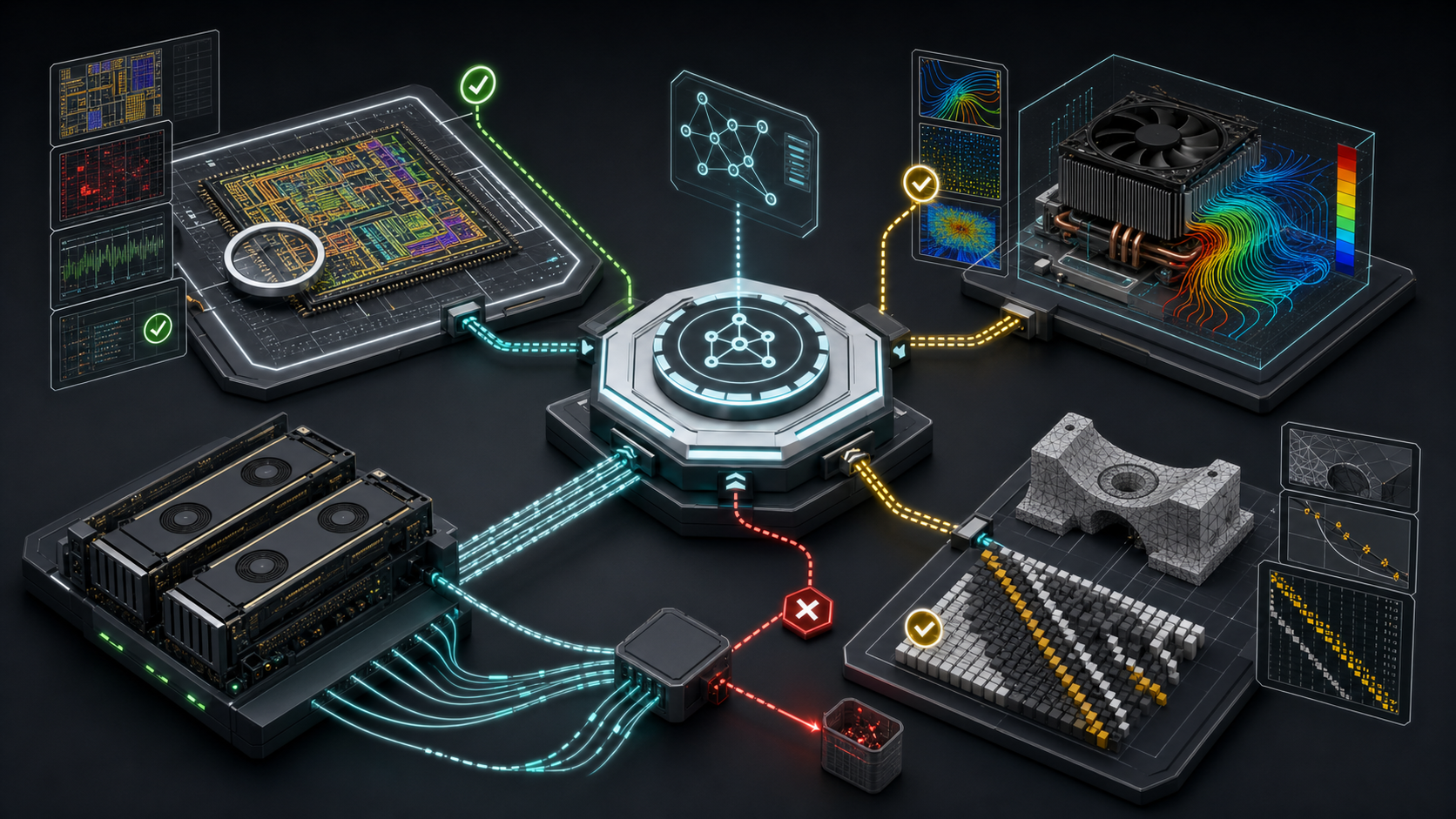
An engineering agent can write a plausible answer in seconds. That does not make the answer fit for sign-off.
Chip design, cooling analysis and physics simulation have a harder test: the proposed result must survive a deterministic tool that knows nothing about eloquence. A circuit either meets its constraints or it does not. A thermal model either converges under the stated boundary conditions or it fails. The agent may plan the job, select tools and interpret output, but the solver remains the referee.
NVIDIA's 26 July 2026 expansion of its Agent Toolkit puts that relationship into sharper focus. PhysicsNeMo and selected CUDA-X libraries are being exposed as agent-ready tools for engineering work. Siemens and Synopsys announced related EDA and CAE workflows that connect reasoning models to established design, verification and simulation software.
The infrastructure question is therefore wider than "Which GPU runs the LLM?" An engineering-agent service may need inference capacity, solver capacity, CPU-heavy orchestration, fast temporary storage, licence access and a verifier that can reject a confident but invalid result. Those resources do not always belong on the same server.
What NVIDIA announced
The NVIDIA announcement adds reworked PhysicsNeMo libraries and CUDA-X components to the company's Agent Toolkit for engineering. NVIDIA describes PhysicsNeMo as a route for training and deploying AI physics models, while CUDA-X supplies accelerated numerical tools that an agent can call as part of a job.
One named addition is cuISS, an iterative sparse-solver library aimed at large sparse linear systems. Those systems appear throughout engineering analysis, including structural, electromagnetic and fluid problems. The release also discusses GPU-accelerated direct solvers and quantum-chemistry work. The important change is not that these libraries suddenly exist; it is that an agent can treat specialist numerical software as a callable skill within a longer sequence of actions.
NVIDIA also positions Nemotron models, NeMo Gym and OpenShell around this stack. The model handles planning and tool selection. Training and evaluation environments can measure whether it uses those tools correctly. The runtime can enforce policy around files, network access and credentials.
That is a plausible architecture, but it is not a finished engineering system. Buyers still have to connect licensed applications, define accepted inputs, create verifiers, set job limits and decide which results need an engineer's approval. Tool access raises the standard for agent deployment because a bad call can now consume hours of compute or alter a real design workspace.
Why the solver changes the buying decision
A conventional LLM endpoint spends most of its time moving model weights, attention data and tokens through GPU memory. Engineering agents add another workload class. Once the model calls a simulation or EDA tool, the system may switch to sparse linear algebra, mesh processing, graph traversal, event simulation, placement, routing or thermal analysis.
These jobs have different resource profiles:
- LLM inference often depends on GPU memory capacity, memory bandwidth, batching and KV-cache headroom.
- A physics surrogate may train across several GPUs, then serve quickly once trained.
- A sparse solver may care about GPU memory, host memory, CPU-GPU transfer and numerical precision.
- EDA tools can remain CPU- and memory-intensive even when selected stages run on GPUs.
- Verification jobs may fan out into many independent workers rather than one tightly coupled run.
Buying a large GPU node for every part of that list can waste money. Equally, attaching an agent to an old CPU queue and assuming the GPU only runs the language model may leave the solver waiting behind a slow data path.
The sound design separates roles before selecting hardware. What runs the reasoning model? Which tool calls need GPUs? Which tools remain CPU-bound? Where do intermediate files live? Can several agents share a licence pool without creating a queue that wipes out the expected time saving?
A practical engineering-agent loop
The phrase "autonomous engineer" hides a sequence that infrastructure teams can inspect. A useful loop looks more like this:
1. The agent receives a bounded task, approved source files and acceptance criteria. 2. It proposes a plan and chooses an allowed tool. 3. A policy layer checks the requested command, files, credentials and compute budget. 4. The tool runs in an isolated workspace. 5. A deterministic check grades the output against engineering rules. 6. The agent reads the failure or result, then revises the plan. 7. A human approves the final artefact where the consequence warrants it.
Every step creates a systems requirement. The model server needs predictable inference. The policy service needs identity and audit records. The tool worker needs the right software image and licence. The verifier needs trusted inputs that the agent cannot quietly rewrite. Storage must preserve the original files, temporary runs and accepted result.
Long-running work makes recovery part of the design. An agent that loses twelve hours of simulation because its orchestration process restarted is not useful. Jobs need identifiers, checkpoints and resumable state. Logs must connect a model decision to the exact command and software version that followed.
Siemens: self-verification rather than fluent output
Siemens' 26 July announcement describes additions to its Fuse EDA AI Agent system. It connects NeMo Gym, OpenShell, Nemotron models and CUDA-X libraries with Siemens EDA software. The stated goal is to let domain-scoped agents plan work across semiconductor and PCB design tools while continuously checking decisions against deterministic, physics-based engines.
That distinction matters. A general model can suggest a constraint or interpret a report, yet sign-off depends on established EDA checks. The agent should not award itself a pass.
Siemens names workflows across synthesis, verification, implementation, characterisation, sign-off and PCB design. It also reports performance and token-cost improvements for selected internal workflows. Those numbers come from the vendor announcement; GPUMachines has not reproduced them, and buyers should not use them as capacity-planning inputs without a representative proof of concept.
For infrastructure planning, the Siemens example points towards a mixed pool:
- inference GPUs for the reasoning and tool-calling model;
- compute nodes for accelerated EDA stages;
- CPU and RAM capacity for tools that do not move cleanly to GPUs;
- shared project storage with snapshots and strict permissions;
- a scheduler aware of software licences as well as processors.
The last item is easy to miss. If the agent can launch more jobs than the licence server permits, extra GPUs do not improve throughput. They create a more expensive queue.
Synopsys: long jobs crossing EDA and CAE
Synopsys announced a long-running design-verification agent and a CAE workflow for electronic cooling analysis. The company describes an agent that can perform simulation setup, preprocessing and post-processing around Ansys Icepak, alongside work using NVIDIA Agent Toolkit, NIM microservices, Nemotron models, NeMo Gym and NemoClaw components.
Synopsys also publishes large improvement figures for selected demonstrations, including time to validated RTL and simulation acceleration. They are vendor-reported results from particular workflows, not a general promise for every design team. Tool versions, design size, baseline method, GPU type and licence allocation can change the result.
The cooling example is useful because it exposes how messy a real agent job can become. It may need geometry and material data, boundary conditions, meshing, a numerical solve, result extraction, visual checks and an engineering acceptance rule. A language model sits around the process; it does not replace it.
That job can also produce far more data than a text agent. Meshes, field results and iteration folders quickly put pressure on shared storage. If each trial copies an entire project tree, metadata operations and capacity can become the limiter before GPU arithmetic does.
PhysicsNeMo is a family of tools, not one workload
The PhysicsNeMo documentation covers models, meshes, data pipelines, distributed execution, active learning and examples across CFD, weather, additive manufacturing, molecular dynamics and geophysics. That range should stop buyers treating "PhysicsNeMo support" as a single sizing line.
A surrogate-model training job can resemble conventional distributed AI training: GPUs read large datasets, exchange gradients and write checkpoints. Serving the trained surrogate may need far less compute. A mesh-heavy inference or data-generation step can place more pressure on CPU preparation and storage. An active-learning loop adds repeated simulation, selection and retraining.
The first infrastructure brief should name the actual path:
- Are you training a new physics model, adapting an existing one or only running inference?
- How large are the meshes or grids, and who prepares them?
- Does the workflow couple a neural surrogate with a conventional solver?
- How many alternatives must run at once?
- Which numerical precision does the accepted result require?
- What intermediate state must survive a failed job?
No GPU model can answer those questions. A short pilot using real project files will tell the buyer more than a generic "AI engineering" benchmark.
The model tier and solver tier should be sized separately
Many engineering-agent proposals start by choosing one large model, then build the rest of the system around it. That reverses the useful order.
First define how many agent sessions run concurrently and how often each one calls a tool. A model that spends most of its time waiting for a two-hour simulation may need less inference capacity than a customer-facing assistant with the same number of users. Batching can help when many agents reach the reasoning service together, but irregular tool completion produces spiky demand.
Then size the solver pool from actual job traces. Independent thermal or verification runs may suit PCIe GPU servers because jobs can occupy separate accelerators. Tightly coupled model training or a distributed physics workload may justify an HGX platform or several nodes with a low-latency fabric. CPU-only tools need their own queue rather than a token share of an expensive GPU node.
This separation supports cleaner upgrades. The reasoning model can change without replacing solver nodes. New CUDA-X support can be added to workers without disturbing the orchestration service. A licence-heavy EDA queue can scale differently from an open physics-model training pool.
GPUMachines' PCIe GPU server category is the practical starting point when independent GPU workers, mixed accelerator choices and expansion slots matter more than one large scale-up domain. An HGX-class design becomes relevant when the measured job depends on high-bandwidth communication among GPUs rather than simple job-level parallelism.
CPU, memory and PCIe still decide whether the GPUs stay busy
An agent can make tool calls faster than an engineering team can manually submit them. That amplifies every weak part of the worker node.
CPU cores handle orchestration, preprocessing, mesh work, decompression and tools that have no GPU path. Host memory holds models, project data, sparse structures and temporary results. PCIe lanes connect GPUs, NVMe drives and high-speed network adapters; a dense configuration can look fine until several devices share a constrained path.
For PCIe GPU servers, check these items against the finished build:
- GPU slot width, spacing and cooling path;
- electrical lane allocation for every GPU and NIC;
- local NVMe bays that can stage active jobs without consuming all expansion slots;
- memory channels and DIMM population, not only maximum capacity;
- power-supply behaviour at the selected input voltage;
- room for a management NIC or DPU without stealing the intended data path.
Engineering software often carries large per-process memory demands. A node with under-populated memory channels can hold the dataset yet feed CPU stages poorly. Capacity and bandwidth are separate decisions.
Storage should preserve evidence, not merely feed GPUs
AI training guidance usually talks about storage as a way to prevent idle accelerators. Engineering agents add provenance. A result is useful only if the team can trace it back to source files, solver settings, software versions and the sequence of agent actions.
Use at least two storage behaviours:
1. Fast workspaces for temporary meshes, solver output and checkpoints. 2. Controlled project storage for approved inputs, accepted outputs, logs and rollback points.
Local NVMe works well for disposable scratch data. Shared storage remains necessary when jobs move between workers or several tools use the same project. Snapshotting protects the baseline from an over-active agent. Immutable records may be required for final reports, depending on the organisation and field.
Small-file behaviour can matter as much as sequential bandwidth. EDA project trees and agent logs may contain many files. A storage system advertised with a large streaming figure can still struggle when hundreds of workers create directories, inspect metadata and write small results at once.
Do not let the agent choose retention by itself. Define quotas, expiry rules and the point at which a result becomes an official record.
Networking depends on the boundary between jobs
There is no automatic requirement for InfiniBand because an article mentions physics or EDA.
Independent verification runs can use ordinary data-centre Ethernet if each worker stages a project, runs locally and returns a result. Multi-node model training, distributed solvers and tightly coupled simulation can need lower latency and predictable collective communication. Storage traffic may need a separate path so checkpoint or mesh reads do not compete with GPU-to-GPU communication.
Measure the boundary:
- If parallelism happens between independent jobs, schedule more workers.
- If one job spans GPUs in a server, inspect the internal GPU topology.
- If one job spans servers, model its inter-node traffic and failure behaviour.
- If every job streams from shared storage, test the client and metadata paths at intended concurrency.
The GPUMachines GPU cluster configurator can frame a larger design, but an engineering-agent cluster should start with the measured solver topology rather than a round GPU count.
OpenShell and the runtime boundary
Giving an agent access to engineering files and expensive tools creates a security problem that prompt wording cannot solve.
The NVIDIA OpenShell documentation describes a CLI, gateway and per-sandbox supervisor. The supervisor launches the agent as a restricted child process and applies policy where process identity, filesystem access, network egress and runtime credentials are visible.
That model points to sensible controls even if a buyer chooses another runtime:
- place each task in a separate workspace;
- issue short-lived credentials rather than exposing a standing licence or repository secret;
- restrict outbound network access;
- record commands, files and tool versions;
- keep the verifier outside the agent's writable boundary;
- cap wall time, GPU time and storage use.
An engineering agent should not be able to edit both the design and the golden test that approves it. Separation is the difference between verification and theatre.
Training the agent requires a real verifier
NeMo Gym is part of both the Siemens and Synopsys stories. Its training documentation describes environments in terms of datasets, an agent harness, a verifier and state. During reinforcement learning, the agent performs a task, the verifier scores the trajectory and the training system updates the model.
For engineering work, verifier quality sets the ceiling. A reward based on a neat report teaches report writing. A reward tied to a trusted testbench, numerical tolerance or design-rule check can teach tool use that produces valid artefacts.
Training also has an infrastructure cost beyond the final agent service. Rollout collection may run many attempts for each task, often across several environments. Failed trajectories still consume model inference and tool time. Teams should separate experimental training capacity from production engineering queues so an RL run cannot take every licence or solver slot.
Store enough trajectory data to explain a result, but avoid collecting project secrets that the training team does not need. Dataset and log governance belong in the design brief, not in a later clean-up.
Four deployment patterns
A workstation proof of concept
One capable workstation can host a local reasoning model, a small tool environment and representative files. It suits one or two engineers proving that the agent can complete a bounded task. It does not prove shared throughput, isolation or recovery.
A shared PCIe worker server
Several GPUs can serve independent agent or solver jobs, while local NVMe holds scratch data. This fits teams with a mixed queue and moderate concurrency. CPU lanes, GPU spacing and licence scheduling need close attention.
Separate inference and engineering pools
A central model service handles reasoning. CPU and GPU workers run approved tools through a scheduler. This is usually the cleanest production design because each pool can scale on its own evidence. It also makes policy and cost attribution easier.
A distributed research cluster
Large PhysicsNeMo training, multi-node solvers or many concurrent design experiments can justify scale-out compute and shared high-performance storage. Fabric choice should follow communication traces. A cluster is overkill when jobs remain independent and the team's real bottleneck is a licence queue.
Who should consider dedicated infrastructure
Dedicated engineering-agent infrastructure makes sense for semiconductor, electronics, CAE and research teams that already run valuable compute tools and can define machine-checkable acceptance criteria. It can also suit organisations whose project data cannot leave a controlled environment.
The strongest candidates have recurring jobs, an identifiable queue and enough engineering ownership to maintain tool images, policy and verifiers. They are not buying autonomy as a feature. They are building a controlled job system in which a model proposes work and trusted software checks it.
Owned hosted equipment can help when the team wants fixed hardware and root-level control without operating a suitable machine room. GPUMachines can review that route through Buy & Host, including server configuration, networking and physical deployment. Software licensing, workflow validation and engineering sign-off remain the buyer's responsibility.
Who should not build it yet
Do not buy a cluster because a vendor demonstration uses an "autonomous engineer" label. If the team cannot define a pass condition, it cannot verify the agent. Start with manual tool use and a small proof of concept.
A managed model API and existing solver queue may be enough when agent volume is low and project policy allows it. A workstation can cover an early research phase. Extra GPU nodes will not fix scarce licences, unreliable source data or a workflow that still needs a person at every step.
Safety-related, regulated or sign-off work also needs named human responsibility. A deterministic tool can catch specified failures; it does not know whether the specification was complete.
Questions to answer before buying
1. Which exact engineering tasks will the agent attempt? 2. What trusted tool or rule decides whether each result passes? 3. Which stages run on GPUs, CPUs or both? 4. How many jobs run concurrently, and how long do they take? 5. What licence limits apply to each tool? 6. Does one job span several GPUs or several servers? 7. How much scratch data does one attempt create? 8. Which files may the agent write, and which must remain read-only? 9. How will a failed or interrupted job resume? 10. Which results require an engineer's approval before use? 11. How will model, solver, container and project versions be recorded? 12. What is the smaller pilot that can disprove the design?
FAQ
Does an engineering AI agent need an HGX server?
No. Independent tool calls and solver jobs may run well on one workstation or a PCIe GPU server. HGX becomes relevant when one job needs tightly coupled multi-GPU compute or large shared accelerator memory. Use measured job behaviour rather than the agent label.
Is PhysicsNeMo an LLM?
No. PhysicsNeMo provides libraries and models for physics-informed and data-driven simulation work. An LLM-based agent may call PhysicsNeMo components, but the reasoning model and physics model serve different purposes.
Can the agent replace EDA sign-off?
The announcements describe agents working with established EDA and physics tools. That can automate planning and iteration, but it does not remove the need for accepted sign-off checks or accountable engineers. GPUMachines has not validated these vendor workflows.
How much storage does an engineering agent need?
Size from project files, mesh or simulation output, concurrent attempts, checkpoints and retention. Include metadata performance and snapshots. A pilot should record bytes written and file counts per completed task.
Does the cluster need InfiniBand?
Only if the measured workload benefits from low-latency inter-node communication. Independent jobs can often use Ethernet. Distributed training or solvers may need a faster fabric, but the application trace should decide.
Should the reasoning model and solver share GPUs?
They can in a proof of concept, though production systems often work better with separate pools. Separation prevents a long solver job from blocking inference and lets each tier scale independently.
What should a proof of concept measure?
Measure task completion against a trusted verifier, human correction rate, wall time, failed tool calls, GPU and CPU use, storage written, licence wait time and recovery after interruption. Token count alone says little about engineering value.
Can GPUMachines supply or host the hardware?
GPUMachines can configure PCIe GPU servers, larger GPU clusters and owned hosted deployments against a measured workload. Final software compatibility, commercial EDA licences and engineering acceptance criteria need review with the relevant vendors and the buyer's technical team.
Verdict
PhysicsNeMo and CUDA-X becoming agent-ready tools is a meaningful software change because it gives a reasoning model access to numerical work that can be checked. The useful unit is not the model alone. It is the loop joining model, policy, engineering tool, verifier and human approval.
That loop rarely calls for one giant undifferentiated GPU system. Most buyers should begin with separate sizing for inference and solver work, fast local scratch storage, controlled shared project data and strict licence scheduling. Scale-out fabric only enters the design when one measured job crosses servers.
The best first purchase may be smaller than the announcement suggests. Run a bounded task on representative files, force the agent to pass a real verifier and record every resource it consumes. If the evidence shows a queue worth scaling, GPUMachines can map it to a workstation, PCIe GPU server, HGX node or hosted cluster without pretending that every engineering agent needs the same machine.
Review GPU server and cluster options with GPUMachines using a task trace that includes model memory, solver behaviour, licence limits, storage writes and required concurrency.
Sources and Further Reading
- NVIDIA: Agent Toolkit expansion with PhysicsNeMo and CUDA-X
- Siemens: self-verifying agentic AI workflows for semiconductor and PCB design
- Synopsys: autonomous engineering workflows developed with NVIDIA technology
- NVIDIA PhysicsNeMo documentation
- NVIDIA OpenShell: how the runtime works
- NVIDIA NeMo Gym: training and verifier concepts