The best edge AI server is the smallest platform that can run the production model, ingest the live data and remain supportable at the deployment site. For a robot or camera system, that may be an NVIDIA Jetson or IGX platform inside a qualified industrial enclosure. For a branch, factory control room or regional site, it may be a short-depth 1U or 2U server with one or two PCIe GPUs. A four-GPU rack server belongs at the edge only when the site can provide data-centre power, cooling and remote operations.
Start with location rather than GPU count. Edge installations can be limited by inlet temperature, dust, vibration, power quality, acoustics, rack depth, network outages and the time needed to reach a failed unit. A fast accelerator does not solve those constraints.
Use the GPUMachines edge AI server catalogue to compare current rack platforms. The final shortlist should follow an environmental and workload specification, not the word "edge" in a product title.
Quick recommendations
| Deployment profile | Sensible starting point | Why | Main warning | | --- | --- | --- | --- | | Robotics, autonomous machines and dense sensor processing | NVIDIA Jetson AGX Thor production module in a qualified carrier and enclosure | 128 GB unified memory option, Arm CPU, Blackwell GPU, camera and control I/O at 40 to 130 W | A developer kit is not a production rugged computer | | Industrial or medical edge with enterprise management | NVIDIA IGX platform or a qualified OEM system based on it | BMC, safety-oriented platform design, high-speed networking and enterprise software path | Validate application certification, lifecycle and optional discrete GPU support | | Local LLM development or office inference | Compact GB10-class AI system or quiet GPU workstation | Large unified or discrete GPU memory without a rack installation | SFF and workstation products are not automatically suitable for factory conditions | | One-GPU site server | Short-depth 2U AM5 or single-socket server with IPMI | Low platform cost, serviceable PCIe GPU and local NVMe | Check the exact GPU's length, width, power and airflow qualification | | Two-GPU branch or site platform | Single-socket 2U EPYC or Xeon server | More CPU lanes, memory channels, remote management and redundant power | GPU TDP and inlet-temperature limits vary by chassis | | Four-GPU regional edge node | GIGABYTE E264-AG0-AAS1 or a comparable qualified 2U platform | Four Gen5 GPU slots, 12-channel memory, OCP networking and redundant power | It requires proper rack power and a 10°C to 30°C operating environment | | CPU, storage or network edge service | 1U server without a discrete GPU | Suits gateways, data reduction, caching, orchestration and local services | Do not add a GPU requirement when the bottleneck is ingest or networking |
These are platform classes, not universal product rankings. The exact operating system, model, driver, sensor interfaces and environmental certification can remove an otherwise attractive option from the shortlist.
What counts as an edge AI server?
An edge AI server runs inference, data processing or control close to where data is produced or an action is taken. The purpose is usually to reduce response time, limit wide-area data movement, keep a service working through a network interruption, or retain sensitive data at the site.
"Edge" describes placement, not a physical standard. It can refer to:
- An embedded computer mounted inside a robot or machine.
- An industrial PC beside production equipment.
- A compact system in an office, laboratory or retail location.
- A short-depth rack server in a communications room.
- A conventional 2U GPU server in a regional data centre.
Those systems have different expectations for shock, vibration, temperature, humidity, ingress protection, acoustic output and service life. A normal rack server installed near a factory is still a normal rack server. Do not call it rugged unless the OEM publishes the required environmental qualification.
Five decisions that narrow the shortlist
1. Where will it run?
Record the real environment: minimum and maximum inlet temperature, humidity, airborne dust, vibration, altitude, available rack depth, sound limits and maintenance access. Also record the local input voltage, circuit capacity and whether redundant feeds exist.
An NVIDIA Jetson module can operate in a compact power envelope, but the production carrier, enclosure and cooling design determine whether the complete product suits a vehicle or machine. A four-GPU 2U server can deliver much more throughput, but it expects controlled airflow and data-centre electrical infrastructure.
If the site has no trained staff, remote management and field replacement may matter more than peak compute. A platform with a BMC, remote console, power control, event logs and replaceable drives is easier to operate than an opaque appliance that must be physically rebooted.
2. What must happen locally?
Separate the tasks that genuinely need to remain at the edge from work that can run centrally:
- Sensor ingest, filtering and immediate control may have a strict local latency requirement.
- Video inference may need to continue when the WAN is unavailable.
- Raw recordings may be reduced locally before selected events are uploaded.
- Model training, fleet-wide analytics and long-term retention may belong in a central cluster.
- A local language model may need on-site data access, while model updates come from a central registry.
This split changes hardware. A site that performs only inference needs different GPU memory, storage and CPU capacity from one that also retrains models, retains weeks of video and serves several applications.
3. Does the model fit?
For an LLM or vision-language model, calculate memory for weights at the chosen precision, runtime workspace, KV cache, batching and concurrent sessions. For computer vision, include every active stream, input resolution, frame rate, decode path and model pipeline.
Unified memory on Jetson AGX Thor allows its Arm CPU and Blackwell GPU to work within a 128 GB addressable pool on the T5000 module. That is useful for physical-AI models, but it is not equivalent to 128 GB of discrete HBM. Bandwidth, software support and power limits differ from a data-centre GPU.
PCIe GPU servers provide a wider accelerator choice. GPU memory remains local to each card unless the application explicitly partitions the model or workload. Four 96 GB cards give 384 GB of aggregate VRAM, not one transparent 384 GB allocation.
4. What reaches the server?
Count cameras, sensors, network streams and control interfaces. Record the data rate before compression, after compression and during a burst. Camera workloads may also require hardware decode capacity, capture cards, PTP time synchronisation or direct interfaces that are absent from a general-purpose rack server.
Jetson and IGX platforms expose embedded and industrial I/O that can be useful for robotics. Conventional servers usually expect sensors to arrive through Ethernet or add-in cards. Those cards consume slots, lanes, power and airflow that might otherwise be assigned to GPUs or NICs.
5. Who will operate it?
Define secure boot, disk encryption, identity, patching, model rollout, rollback, logging and incident response before purchase. A fleet of fifty edge nodes is an operations system. It needs inventory, staged updates, health monitoring and a way to recover a site without sending an engineer for every software fault.
The hardware should support the chosen management approach. IPMI or Redfish can help with rack servers. Embedded fleets may need an OEM device-management layer. The application team and infrastructure team should agree who owns the operating system, drivers, containers and model versions.
Embedded and industrial platforms
Jetson AGX Thor
NVIDIA's Jetson T5000 module combines a Blackwell GPU, a 14-core Arm Neoverse V3AE CPU and 128 GB of LPDDR5X memory. NVIDIA lists a 40 W to 130 W module power range and four 25GbE interfaces on the production module. The developer kit includes 1 TB of NVMe storage, 5GbE, a QSFP28 interface and CAN headers.
Those specifications make Jetson AGX Thor relevant to robotics, multimodal sensor processing and physical AI where a data-centre card is impractical. The FP4 figure published by NVIDIA is a sparse low-precision peak, not a prediction of application throughput. Measure the actual model, TensorRT or serving stack, sensor pipeline and selected power mode.
The developer kit is intended for development. A production deployment needs a qualified module, carrier, enclosure, cooling system, power input and storage design. Verify the OEM's lifecycle, environmental ratings and software image.
NVIDIA IGX
NVIDIA positions IGX as an enterprise-ready platform for industrial and medical edge applications. IGX Orin combines an Orin module with a BMC, safety microcontroller and high-speed networking. NVIDIA's developer-kit documentation lists 64 GB of LPDDR5 and ConnectX-7 networking with two 100GbE QSFP28 ports, plus support for selected discrete NVIDIA GPUs.
IGX is worth considering where enterprise support, remote management and functional-safety work are part of the product programme. It is not a shortcut around validation. Medical, industrial and safety-related applications still need the required system-level certification, application testing and risk process.
Compact local AI systems
Compact GB10-class systems and SFF AI workstations suit developers who need a local model sandbox, private inference endpoint or portable demonstration system. They offer a much simpler installation than a rack server and can provide a large memory space for local language models.
They should not be confused with industrial edge servers. Check ambient temperature, continuous-load cooling, acoustic output, remote power control, replaceable storage, network interfaces and vendor support. A desktop designed for a laboratory may be excellent in that setting and unsuitable in an unattended plant room.
Choose this class when a person is normally present, the workload is modest enough for one compact node, and the system can be replaced rather than repaired on site. Move to a rack platform when several users share the service, uptime matters or high-speed network and storage expansion become necessary.
One- and two-GPU rack edge servers
A 2U single-socket platform is often the practical middle ground. It can provide one or two full-length PCIe GPUs, server-class memory, local NVMe, redundant power and IPMI without the facility load of a four- or eight-GPU chassis.
Current GPUMachines examples include AM5 one-GPU systems for cost-sensitive deployments and single-socket EPYC or Xeon platforms with two GPU positions. The CPU family should follow the host workload:
- AM5 provides a compact one-socket route for one accelerator and modest memory capacity.
- AMD EPYC SP5 provides more memory channels and PCIe lanes for storage and networking.
- Intel Xeon 6 platforms can provide MRDIMM support and a different accelerator and software qualification path.
Do not select from socket name alone. Check the qualified CPU range, GPU maximum TDP, DIMM count, drive-bay protocol, NIC slots and operating-temperature note on the exact chassis.
Four-GPU edge servers
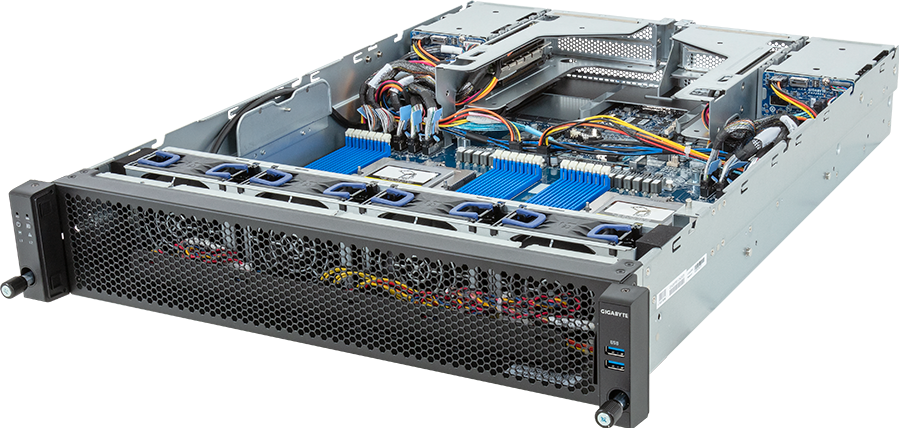
The GIGABYTE E264-AG0-AAS1 shows what a high-end rack edge platform looks like. It is a 625 mm deep 2U server with one Intel Xeon 6900-series processor, 12 DDR5 DIMM slots, four PCIe Gen5 x16 GPU slots, an OCP NIC 3.0 slot and 1+1 3,200 W power supplies.
This is short for a four-GPU server, but it is not a low-power industrial appliance. GIGABYTE publishes a 10°C to 30°C operating range. PSU output also depends on input voltage: the units provide up to 1,300 W on 100 to 127 V, 3,000 W on 200 to 220 V and 3,200 W on 220 to 240 V. A fully populated design needs a supported high-voltage data-centre feed and an exact GPU power budget.
Use this class for a regional inference node, visual-computing service or site with several independent GPU workers. If one model must communicate tightly across four or eight accelerators, compare the PCIe topology with an HGX or other scale-up platform before ordering.
CPU-only edge servers still matter
Not every edge AI deployment needs a GPU at every site. A CPU server can handle acquisition, encryption, data reduction, message brokering, storage cache, orchestration and conventional analytics, then send selected work to a central GPU service.
This can reduce power, cost and fleet complexity. It also separates the hardware lifecycle of sensor gateways from the faster-changing accelerator estate. Profile the application before adding a GPU to solve a bottleneck that is actually in video ingest, storage or network transport.
Storage and data retention
Plan four storage roles separately:
1. Boot and recovery image. 2. Model and container cache. 3. Active sensor buffer or application scratch. 4. Retained evidence, logs and datasets.
Local NVMe is useful for fast model loading and temporary buffering. Retention capacity can grow quickly when several high-resolution cameras record continuously. Calculate daily ingest from bitrate and retention period, then include filesystem overhead, redundancy and free-space margin.
Hybrid drive bays share physical positions between NVMe, SATA and SAS. The configurator must not count each protocol as an additional bay. If a chassis has two hybrid positions, the total number of drives in those positions remains two.
Decide what happens when storage fills or the uplink fails. The application may drop old recordings, reduce quality, stop accepting new data or raise an alert. That behaviour should be tested before deployment.
Networking at the edge
The network design has at least three paths:
- Sensor and camera ingest.
- User, application and upstream data traffic.
- Management and recovery access.
Keep management reachable when the primary data interface is saturated or misconfigured. For remote sites, consider an independent out-of-band route and a documented process for power cycling, console access and software rollback.
One or two 1GbE ports may be enough for a small sensor gateway. Multi-camera inference, shared NVMe storage or several GPUs can justify 10, 25, 100 or 200GbE. Link speed should follow measured traffic plus recovery and growth margin, not the accelerator label.
A production acceptance test
Test the complete system in the intended enclosure and environment:
- Run the real model at target precision, batch size and concurrency.
- Feed the planned number of live or replayed sensor streams.
- Measure end-to-end latency, dropped frames, queue depth and GPU memory use.
- Hold the system at sustained load while recording temperature, clocks, fan behaviour and power.
- Interrupt the WAN and confirm local operation, buffering and recovery.
- Fill storage to the warning threshold and verify the retention policy.
- Reboot after a failed update and prove remote rollback.
- Remove a permitted power feed, link or drive and record service behaviour.
- Confirm monitoring, logs and time synchronisation after restart.
A five-minute benchmark on an open bench does not prove that an unattended node will operate for months at a warm site.
Questions for an edge AI quote
Provide GPUMachines with:
- Deployment location and environmental limits.
- Model name, precision, framework and target latency.
- Number, format and rate of sensor or camera streams.
- Concurrent users, applications or model replicas.
- Local retention and upload policy.
- Required I/O, NICs, storage and time synchronisation.
- Available voltage, circuit, rack depth and acoustic limits.
- Security, remote-management and support expectations.
- Planned node count and fleet-update process.
That information is more useful than a request for "the fastest edge server". It allows the accelerator, host, storage and enclosure to be checked as one system.
FAQ
What is the best edge AI server for computer vision?
Choose from the stream count, resolution, frame rate, model and latency target. Jetson can suit embedded sensor processing; a one- or two-GPU rack server can suit a fixed site with several streams; a four-GPU node can serve higher aggregate throughput where rack power and cooling are available.
Is an edge server the same as a rugged server?
No. Edge describes where the system runs. Rugged describes tested environmental characteristics such as temperature, shock, vibration or ingress protection. Use only the OEM's published ratings for the complete system.
Can an edge AI server run a local LLM?
Yes, if the model weights, runtime, KV cache and concurrency fit the available memory and the latency target is met. Test the exact quantised model and serving engine. Compact unified-memory systems and PCIe GPU servers have different bandwidth and expansion characteristics.
When should I use a rack server instead of Jetson?
Use a rack server when the site needs more discrete GPU capacity, server-class DIMMs, several NVMe drives, high-speed add-in NICs, redundant power or standard data-centre serviceability. Use Jetson when embedded size, power and sensor integration dominate.
Does edge AI work without an internet connection?
It can, if models, application services, identity and required data are available locally. Define how the node buffers output, validates time, handles licences and reconciles data when the WAN returns.
How many GPUs should an edge server have?
Enough to meet measured peak demand with failure and growth margin. Independent inference workers can scale across PCIe cards. A tightly coupled model may need a different interconnect rather than more independent GPUs.
Next step
Compare the edge AI server catalogue with tower GPU workstations and PCIe GPU servers. Send the deployment environment and workload profile with the shortlist so GPUMachines can check GPU support, memory, storage, networking, rack power and remote-management requirements together.
Technical sources
- NVIDIA Jetson Thor product specifications
- NVIDIA Jetson Thor power and performance guide
- NVIDIA IGX Orin documentation
- NVIDIA IGX Orin developer-kit specifications
- GIGABYTE E264-AG0-AAS1 product page
Specifications and software support can change. Confirm the current OEM qualification, production enclosure and supplier-approved configuration before deployment.