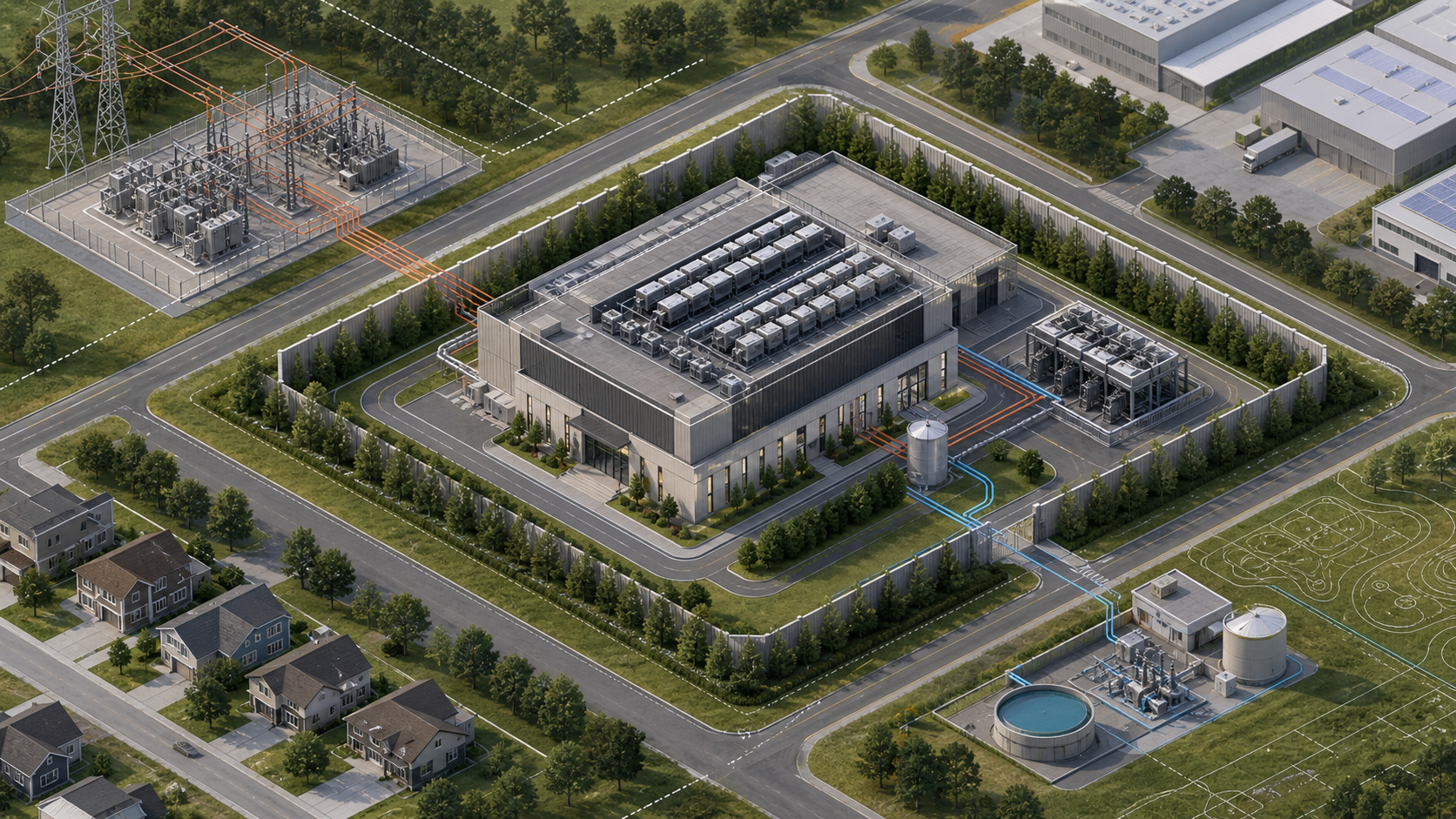
A GPU facility can be technically sound and still fail before the first rack arrives.
Across the United States, opposition to data-centre construction moved from scattered planning meetings to a coordinated national campaign on 18 July 2026. Reuters reported demonstrations planned in at least 125 locations. The organising group, Humans First, framed the protests around electricity bills, water demand, tax incentives and the pace of AI development. Those political claims need independent scrutiny, but the planning signal is hard to dismiss: residents now understand that AI infrastructure can alter a local power network, water system, tax base and industrial skyline.
This is not a US-only problem. Data-centre developers in Britain and Europe face different planning systems, yet the same questions appear wherever a dense GPU installation meets a constrained grid or a nearby community. Buyers who start with a server list and leave site consent until later are working in the wrong order.
Executive Summary
- A technically viable GPU deployment can be delayed by grid-connection disputes, water concerns, noise modelling, local planning objections or unclear public benefits.
- Community risk belongs in the infrastructure design from the first site assessment. It cannot be repaired with a press release after equipment has been ordered.
- Smaller on-premise rooms, colocation, GPU Cloud and Buy & Host can avoid some site-development exposure when the workload does not justify a dedicated facility.
- GPUMachines can help buyers translate a workload into rack count, electrical demand, cooling requirements and deployment options before a hardware quote hardens into an unsuitable project.
For buyers still comparing deployment models, start with on-premise GPU infrastructure, GPU Cloud or a dedicated Buy & Host deployment.
What Changed on 18 July 2026
Data-centre opposition is not new. What changed was its coordination and reach. Reuters reported planned protests at more than 125 US locations, while local reports documented demonstrations around individual proposed sites. A New York executive order announced earlier in the week had already paused large data-centre construction for a year while the state reviewed energy and climate effects.
No responsible infrastructure buyer should treat every campaign assertion as established fact. Electricity-pricing rules differ by utility. Water use depends heavily on the cooling system and climate. A facility with closed-loop liquid cooling does not have the same operating profile as a campus using evaporative cooling. Tax incentives may pay back through employment and grid investment, or they may leave residents carrying costs that the developer should have covered. Each project needs its own evidence.
The protests still expose a practical procurement problem. A proposal can lose political and planning support when the developer cannot answer basic questions in plain language. How much power will the first phase use? Who pays for the substation? Will water consumption rise during a heatwave? What reaches nearby homes at night: fan noise, generator testing or additional traffic? How many permanent jobs remain after construction?
If the project team cannot answer those questions before ordering hardware, it is not ready to order hardware.
Community Risk Is an Engineering Input
The phrase can sound like a public-relations category. It is not. Community risk changes the site, the cooling plant, the electrical design and sometimes the entire deployment model.
Consider noise. Dense GPU racks require substantial heat rejection, and the equipment used to move air or water can operate around the clock. Acoustic limits affect where chillers, dry coolers, pumps, generators and air-handling equipment can sit. They may require barriers, quieter equipment, different fan profiles or more separation from the site boundary. Those changes consume land and capital.
Water concerns can push a project away from evaporative cooling. That may reduce local water consumption but increase electricity demand or equipment cost, particularly during hot weather. Grid constraints can force staged commissioning, on-site energy storage or curtailment agreements. Planning conditions may restrict generator test windows. The public objection is therefore not separate from the design; it can change the design.
Start With the Workload, Not the Megawatt Number
Many proposed AI facilities begin with a large capacity figure because scale attracts investment. Buyers should work in the opposite direction.
Define the actual workload: model training, fine-tuning, high-throughput inference, private agent services, rendering, simulation or research. Estimate concurrent users, GPU utilisation, storage traffic, network traffic and growth. Then select a node type and calculate the number of racks needed for the first credible phase.
This usually produces a better answer than reserving a vast site for an uncertain future requirement. A research team may need two or four GPU servers, not a campus. An inference provider may benefit from a modular colocation deployment that can add racks as contracts arrive. A business running private agents might need one high-memory PCIe server with redundancy, plus a cloud overflow path.
Large developments are sometimes justified, but only when demand, funding, network access and operational staffing support them. A speculative megawatt target transfers uncertainty into the planning process and gives opponents an easy question: what is all this power actually for?
Build a Credible Electrical Case
GPU power is only part of facility demand. CPUs, memory, NVMe storage, network switches, pumps, fans, cooling plant, lighting, UPS losses and power-distribution losses all draw electricity. The rack total must therefore come from a real configuration and an agreed operating envelope.
Use at least four figures:
- expected operating load during the normal workload;
- credible peak IT load;
- total facility load including cooling and electrical losses;
- the demand expected at each commissioning phase.
Avoid presenting PSU nameplate capacity as ordinary consumption. It overstates some systems and conceals the assumptions behind the figure. Avoid the opposite mistake too: a laboratory benchmark at moderate utilisation does not describe a production training cluster running for days.
The utility discussion should identify who funds network reinforcement, what capacity is firm, how long the connection takes and whether curtailment can occur. If a new substation or transmission connection is required, show it in the project programme. Residents will reasonably object if a developer describes the site as privately funded while leaving large grid costs vague.
Water and Cooling Need Numbers People Can Understand
Claims that a data centre “uses water” or “does not use water” are usually too crude to help anybody.
Cooling designs vary. Direct liquid cooling moves heat away from GPU and CPU packages efficiently, but the facility still needs a method to reject that heat outside the building. A closed internal loop can connect to dry coolers, chillers or other heat-rejection equipment. Evaporative systems can reduce electrical demand in suitable conditions while consuming water. Hybrid systems switch modes according to weather and operating policy.
A useful public water statement should distinguish withdrawals from consumption, normal operation from peak summer operation, potable water from reclaimed water, and the first phase from the fully built site. Annual totals alone can hide stress during a dry month. Peak figures without annual context can make an efficient closed-loop design sound worse than it is.
Heat reuse deserves careful treatment. Exporting low-grade heat to a district network or neighbouring process can improve the site case, but only when an off-taker, pipe route and usable temperature profile exist. Do not promise heat reuse as a decorative planning benefit and leave the connection unfunded.
Noise Is Often the First Neighbour Experience
Residents do not experience a data centre through its PUE dashboard. They experience deliveries, mechanical noise, generator tests, security lighting and changes to the view.
An acoustic assessment should cover steady cooling noise, tonal components, low-frequency sound, emergency generator operation and testing schedules. Night-time limits often decide the design. Modelling should use the installed equipment, proposed barriers and realistic operating modes rather than generic assumptions.
Dense liquid-cooled systems can reduce server-fan dependence inside the white space, but they do not make the site silent. Pumps, cooling towers, dry coolers and chillers remain. Placing noisy equipment behind the building, increasing distance from homes and selecting lower-noise plant early is cheaper than retrofitting barriers after complaints begin.
Construction Traffic and Permanent Employment
Large facilities create substantial construction work. They may also require repeated deliveries of generators, switchgear, cooling equipment, server racks and replacement parts. Construction benefits are real, but they are temporary. Permanent staffing is usually smaller and more specialised.
Project material should separate construction jobs from ongoing roles. Inflated employment claims damage trust quickly, especially when residents can compare them with completed facilities elsewhere. A stronger plan describes the actual roles likely to remain: facilities engineers, electrical and mechanical technicians, security, network operations, remote-hands support and site management.
Training commitments should connect to those jobs. A local college programme is useful only if the curriculum, placements and recruitment route exist.
Tax Incentives and Who Carries the Infrastructure Cost
Tax relief can make a site competitive, but the public case needs more than a headline investment value. A server purchase contributes differently to the local economy than building work, salaries or business rates. Projects should show which taxes are relieved, for how long, and which public infrastructure costs remain with the developer.
Grid upgrades, roads, emergency-service preparation and water infrastructure can create costs outside the site boundary. The commercial agreement should allocate them clearly. Hidden or poorly explained transfers are exactly the kind of issue that turns a routine planning application into organised opposition.
This is also where phased deployment helps. A smaller first phase lets the operator demonstrate employment, noise control, utility behaviour and operating discipline before asking for the full site envelope.
Security Without Building a Fortress
GPU equipment is valuable, and private AI deployments may hold sensitive models or data. Sites need controlled access, surveillance, resilient boundaries and a plan for deliveries. Yet an opaque, heavily fenced compound can intensify local concern if the operator says little about what happens inside.
Security and transparency are compatible. Publish the facility’s function, broad capacity phases, utility requirements and environmental controls without exposing rack layouts, network topology or customer information. Explain generator testing and emergency procedures. Give residents a contact route that reaches someone able to investigate a real problem.
When a Dedicated Facility Is the Wrong Answer
Some organisations should stop the development process and buy hosted capacity instead.
A dedicated site is difficult to justify when utilisation is uncertain, the team has no data-centre operators, the first phase contains only a handful of racks, or the utility connection takes longer than the hardware generation will remain current. The same applies when planning risk could hold purchased GPUs in storage.
Colocation, GPU Cloud and Buy & Host solve different parts of that problem. Colocation transfers building and utility operations to an established facility while the buyer owns the systems. GPU Cloud transfers more capital and hardware risk to the provider. Buy & Host keeps dedicated ownership while placing the machine in a prepared environment.
On-premise deployment still makes sense for data control, predictable use, specialised integration or very low-latency local work. But “on-premise” can mean a server room or a few racks; it does not automatically mean constructing a new data centre.
A Pre-Procurement Community Risk Checklist
Before approving the first hardware order, the project board should be able to answer the following:
- What workload and utilisation evidence supports the first phase?
- What are the expected rack, IT and total facility power figures?
- Is the utility capacity firm, and who pays for reinforcement?
- Which cooling design will operate in normal and extreme weather?
- What are annual and peak water withdrawals and consumption?
- What noise reaches the nearest sensitive property at night?
- How will generator tests, deliveries and construction traffic be managed?
- Which jobs are temporary, and which remain after commissioning?
- What tax relief and public infrastructure support does the project receive?
- Can the deployment start in colocation or hosted capacity while site work continues?
Missing answers should become named project risks with owners and dates. They should not disappear into a general “stakeholder engagement” workstream.
Our Technical View
The industry often talks as though GPU demand automatically validates every proposed facility. It does not. Demand can be genuine while a particular site, capacity target or cooling design remains wrong.
For GPUMachines buyers, the sensible sequence is workload, deployment model, node configuration, rack plan, site capacity and then procurement. That sequence produces evidence for the planning case and protects the buyer from ordering equipment that the site cannot power or cool.
The strongest developers will not try to win every argument with scale. They will show a smaller credible first phase, publish understandable utility assumptions and make expansion conditional on measured demand. Where that case cannot be made, an established hosted facility is usually the better engineering and commercial decision.
How GPUMachines Can Help
GPUMachines can turn a workload into a configuration and deployment comparison before the buyer commits to a site. That includes GPU platform selection, CPU and memory sizing, NVMe and shared-storage planning, network design, rack power estimates and cooling assumptions.
We can also compare an owned on-premise system with GPU Cloud, Buy & Host, HGX platforms and flexible PCIe GPU servers. The goal is not to force every workload into a new facility. It is to place the right hardware where it can be commissioned, operated and expanded without avoidable planning risk.
FAQ
Do all AI data centres consume large amounts of water?
No. Consumption depends on cooling design, climate and operating policy. Closed-loop systems can sharply reduce water consumption, while evaporative cooling may use more water in exchange for lower electrical demand under some conditions. Buyers need design-specific annual and peak figures.
Can liquid cooling solve community objections?
It can reduce some airflow and efficiency problems, but it does not settle grid demand, external heat rejection, construction traffic, generator noise or tax questions. Liquid cooling is one engineering choice inside a wider site case.
How early should a utility become involved?
Before the server configuration becomes a purchase order. Connection capacity, reinforcement cost and delivery date can alter the viable rack count and deployment schedule.
Is colocation always easier than building on-premise?
For a small or uncertain deployment, usually. A suitable colocation provider already has planning consent, power, cooling and site operations. Buyers must still check rack density, liquid-cooling support, network access and expansion capacity.
What should a community-facing power figure include?
Show expected IT load and total facility load, plus the planned commissioning phases. Explain the difference between normal operation, credible peak demand and PSU nameplate capacity.
Can a project begin in the cloud and move on-premise later?
Yes. Hosted capacity can establish utilisation, model behaviour and storage requirements while a permanent site or owned system is prepared. The migration plan should account for data movement, model artefacts, security and service continuity.
Does GPUMachines provide planning consultancy?
GPUMachines can support the technical configuration, deployment comparison, rack power assumptions, networking and cooling discussion. Formal planning, environmental and acoustic submissions should be completed by qualified local professionals.
Sources and Further Reading
- Reuters: US data-centre protests go national as backlash grows
- Humans First: National Day of Protest Against Data Centers
- Associated Press: New York pauses large data-centre construction
Verdict
Community opposition is now a delivery risk for AI infrastructure. Buyers cannot remove it with optimistic employment figures or vague claims about efficient cooling.
A defensible project starts with measured workload demand, a phased rack plan and public utility assumptions that survive scrutiny. It also admits when a dedicated site is excessive. For many teams, colocation or hosted ownership will put GPUs into service faster and with less exposure.
Discuss an AI infrastructure configuration and deployment route with GPUMachines.